
Minister Ensures Rice Stocks Safe Despite 30,000 Hectares Affected by Drought
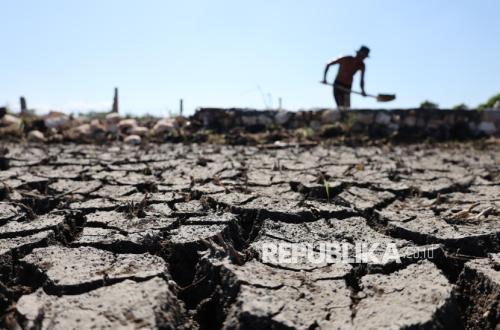
Agriculture Minister Amran Sulaiman has stated that around 30,000 hectares of agricultural land in various regions have been affected by drought. Despite this, Amran confirmed that the situation has not yet disrupted the availability of national food stocks.
Amran said the affected land area is still below one percent of Indonesia’s total agricultural land. The Ministry of Agriculture has also deployed teams to handle the impact of the drought, including in Central Java.
“For the drought across Indonesia, the latest total data is 30,000 hectares. That is 0.01 or 0.003 percent,” Amran said after attending an event at Diponegoro University, Semarang, on Thursday (6/8/2026).
According to Amran, the handling measures include the use of pumps and repairs to irrigation channels to maintain water supply to agricultural land. “This is being addressed, my team is already here,” he said.
Although the drought is beginning to affect several regions, Amran confirmed that national food stocks, especially rice and corn, are still in a safe condition. “Our stocks will last until the harvest season in March next year,” he stated.
Meanwhile, the Central Java Regional Disaster Management Agency (BPBD) recorded that as of 24 July 2026, 25 regencies/cities have been affected by the dry season. These areas cover 83 sub-districts and 148 villages, with 11 regencies/cities having declared a drought emergency alert status.
Head of Central Java BPBD Bergas Catursasi Penanggungan said his agency has distributed 6.8 million litres of clean water to the affected areas. According to him, the availability of clean water is still sufficient as there are still around 40 million litres remaining from the total 44.9 million litres prepared by the local government.
In addition to BPBD, several agencies such as the Indonesian National Armed Forces (TNI), the Indonesian National Police (Polri), and the Indonesian Red Cross (PMI) have also stated their readiness to assist in distributing clean water to drought-affected areas.