
Minister: Climate Action is Not a Burden, but a Future Business Opportunity
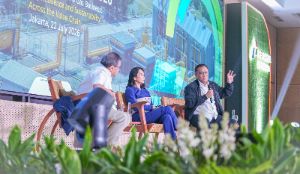
Jakarta, 22 July 2026 – Climate change is no longer seen merely as an environmental challenge but has become an integral part of the global economic development strategy. Minister of Environment and Head of the Environmental Control Agency (KLH/BPLH), Moh Jumhur Hidayat, asserted that climate action must be viewed as a future business opportunity capable of creating economic value, strengthening industrial competitiveness, and driving the transformation towards a low-carbon economy.
“Climate risk is business risk. Reducing emissions is not only about protecting the environment but also about opening up investment opportunities, carbon trading, and low-carbon technology innovation,” Minister Jumhur said while opening Pertamina’s HSSE Leadership Forum Q2 2026, themed Managing Climate Risk in Oil and Gas Business: Strengthening Resilience and Sustainability Across the Value Chain.
Minister Jumhur explained that the world is rapidly moving towards Net Zero Emissions targets, with a growing need for green investment. In this context, Indonesia holds a strategic position through its wealth of natural resources, including tropical rainforests, mangroves, peatlands, and biodiversity, which can serve as vital capital in developing a green economy.
According to him, Indonesia’s natural potential not only serves an ecological function as a carbon sink but can also generate economic value if managed through appropriate and sustainable mechanisms. One significant potential lies in mangrove ecosystems. Minister Jumhur revealed that Indonesia still has more than 700,000 hectares of mangroves requiring rehabilitation. Such restoration efforts not only improve environmental quality but also open investment opportunities through carbon trading.
“Planting mangroves is not just about protecting the environment; it can also generate economic value through carbon trading. This is an opportunity that national businesses must seize,” said Minister Jumhur.
Beyond mangroves, the minister also highlighted the emission reduction potential from around 400 open dumping sites still operating in Indonesia. He noted that methane gas produced from waste piles, which is currently a source of emissions, can be managed to become a source of energy while simultaneously generating economic value through carbon trading.
“If methane emissions are managed properly, we gain two benefits at once: a better environment and economic opportunities through methane utilisation and carbon trading,” he stated.
On the occasion, Minister Jumhur appreciated Pertamina Group’s efforts to continuously strengthen its decarbonisation agenda through various innovations, including energy efficiency, mangrove restoration, low-carbon technology development, and the implementation of Carbon Capture and Storage (CCS). He noted that these steps demonstrate that environmental stewardship and business growth are not contradictory. Rather, companies that can adapt to climate risks will have stronger competitiveness in facing global economic changes.
Minister Jumhur emphasised that the success of transformation towards a low-carbon industry depends not only on technology but also requires leadership with environmental awareness and responsibility. “Every leader must have environmental ethics. Business decisions must be able to maintain a balance between economic growth and environmental sustainability,” he stressed.
In line with national policy direction, KLH/BPLH continues to encourage businesses to accelerate decarbonisation actions through carbon trading development, methane emission control, implementation of nature-based solutions, and utilisation of low-carbon technology. Concluding his remarks, Minister Jumhur invited the business sector to make climate risk management part of their long-term business strategy, not merely a regulatory compliance exercise. “Companies that can manage climate risks today will be more resilient, more competitive, and better prepared to face future challenges,” he concluded.