
Minister Bahlil guarantees B50 biodiesel suitable for Asian and European vehicles
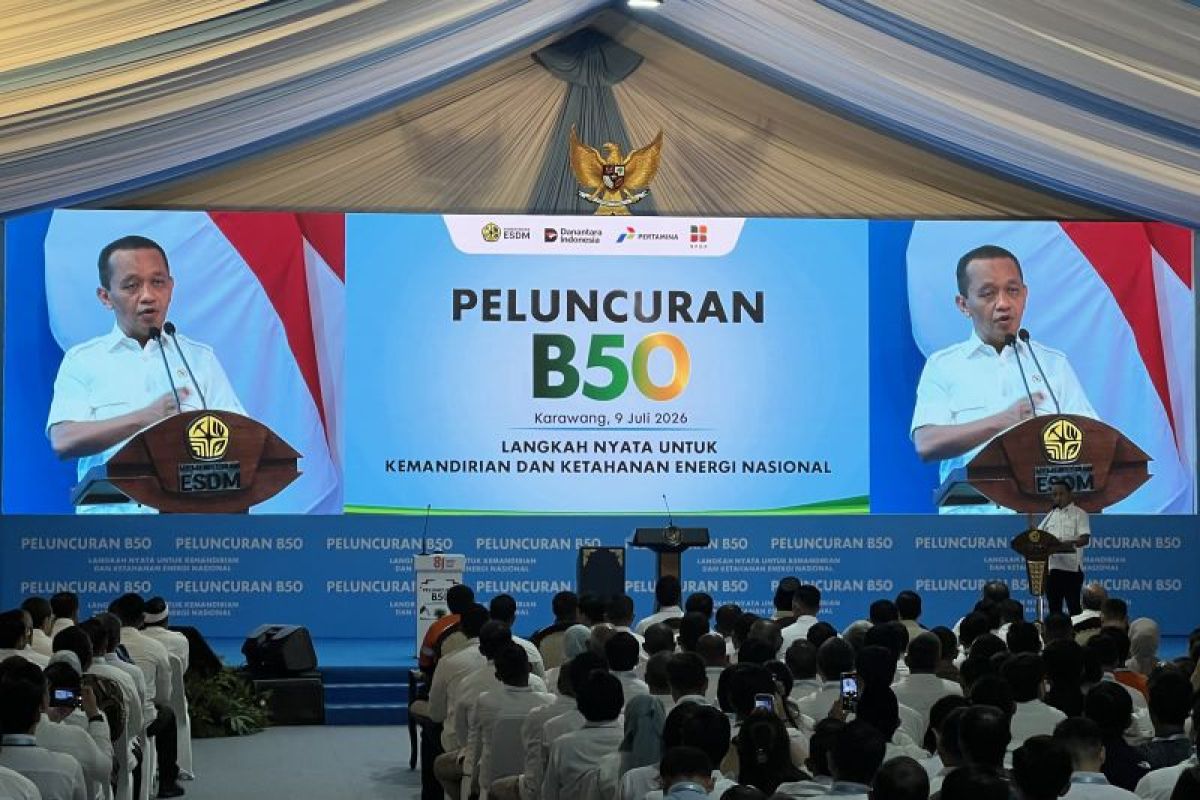
“It was not only tested on Toyota, it was also fine on Mercedes. So, we have covered everything from Asia to Europe.”
Karawang, West Java (ANTARA) — Minister of Energy and Mineral Resources (ESDM) Bahlil Lahadalia has assured that the quality of B50 biodiesel is suitable for car engines manufactured by both Asian and European firms.
“It was not only tested on Toyota, it was also fine on Mercedes. So, we have covered everything from Asia to Europe,” Bahlil said at the launch of the Mandatory B50 Biodiesel Programme at the Km 57 Rest Area, Karawang Regency, West Java, on Thursday.
Based on the results of B50 testing carried out over approximately six months, Bahlil said the quality of B50 is far better than B40.
That assessment was based on filter replacements carried out during road tests. With B40 biodiesel, he said, filters were replaced after 10,000–20,000 km of use. Meanwhile, during the B50 road test period, Bahlil revealed that some vehicles had not yet replaced their filters despite covering 40,000 km.
“When I drove an angkot (public minivan), there was no such thing as B50. For that reason, I express my appreciation to the colleagues who did this technical work,” Bahlil said.
President Prabowo Subianto officially inaugurated the Mandatory B50 Biodiesel Programme at the Km 57 Rest Area in Karawang Regency on Thursday.
The legal basis for the programme is Minister of Energy and Mineral Resources Regulation Number 4 of 2025 on the Cultivation and Utilisation of Biofuel, and Ministerial Decree Number 257.K/EK.01/MEM.E/2026 on the Obligation to Blend 50 Per Cent Biodiesel with Diesel Fuel Oil.
The B50 programme mandates the blending of 50 per cent biodiesel into diesel-type fuel oil. In its implementation, biofuel business entities, fuel oil business entities, and distribution business entities are required to apply standards and quality in accordance with the established specifications.
The policy forms part of the government’s strategic agenda to reduce dependence on fuel imports, strengthen the added value of national natural resources, and safeguard Indonesia’s economic and energy resilience.