
Minister Amran Warns: Wrong Seedlings in Plantations Lead to Decades of Hardship
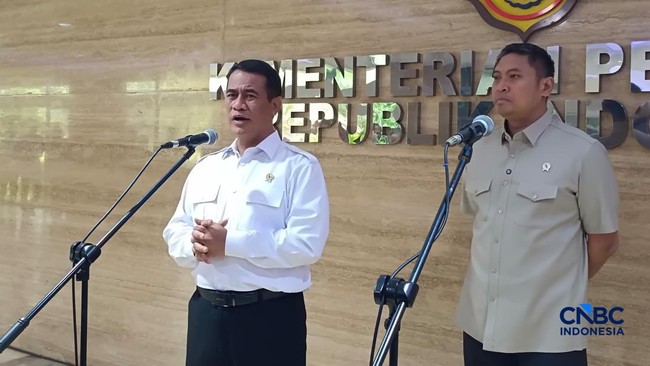
Agriculture Minister Amran Sulaiman has underscored the vital importance of seedling quality in the national plantation development programme. He warned that mistakes at the initial nursery stage could have long-term repercussions on crop productivity, lasting for decades.
The warning was issued as Amran gathered plantation seedling providers from across Indonesia. The move supports a programme to develop 870,000 hectares of plantations covering key commodities such as coconut, coffee, cocoa, sugarcane, nutmeg, pepper, and cashew nuts.
Amran cited the coconut plant, which has a very long productive lifespan, as an example. He stressed that seedling quality is a crucial factor that must not be overlooked.
"A single planting, like coconut, can be harvested for 30 to 60 years. So we are monitoring this closely. If there is a mistake at the nursery stage, it will be a mistake for 30 years. A mistake at the nursery stage will be a mistake for 60 years," Amran stated during a press conference at his office in Jakarta on Wednesday.
He views the programme not merely as a short-term project, but as an investment to improve farmer welfare and strengthen Indonesia’s plantation commodity production in the future. Consequently, the government is involving several institutions to oversee its implementation, ensuring it runs transparently and on target.
Supervision involves the Food Task Force, the Indonesian National Armed Forces (TNI), the National Police, the Attorney General’s Office, and the Corruption Eradication Commission (KPK). This measure aims to minimise potential irregularities in the procurement and distribution of seedlings.
"We are coordinating not only with the KPK, but also with the police and the prosecutor’s office. We are all working together to prevent abuse of authority," he said.
The plantation development programme has a budget allocation of approximately Rp9.95 trillion over three years. These funds are used to support the expansion and rejuvenation of plantations across a total area of 870,000 hectares in various regions of Indonesia.
Amran noted that some seedlings began to be distributed last year. Meanwhile, for this year’s programme, the nursery process is still ongoing and is targeted to enter the planting phase by the end of the year.
"Last year’s programme is already running. For this year, the nursery process is underway, and hopefully, we will plant again by the end of the year," he said.
According to Amran, the results of the programme will not be visible in the short term. However, once the plants begin to enter the production phase in the next three to four years, the increase in yields is expected to be substantial, given the high global demand for Indonesia’s plantation commodities.
In its implementation, the government is also applying an approach based on regional potential. The selection of commodities is tailored to the agro-climatic conditions and local community practices to increase the chances of success.
"Do not give coconut to those who are not accustomed to planting coconut. Do not give cocoa to those who are not accustomed to planting cocoa," Amran remarked.
Furthermore, the government has chosen to build nursery centres in the regions where the commodities are being developed. This strategy is employed to cut logistics costs while increasing distribution efficiency.
"The seedling distribution method is to place them right there, so they do not have to be transported from Java to South Sulawesi or from South Sulawesi to Papua. We bring in the experts instead. So it is more economical and efficient," he concluded.
Source: jawawa.id (https://jawawa.id/newsitem/minister-amran-warns-wrong-seedlings-in-plantations-lead-to-decades-of-hardship-1781684454)
Originally published by CNBC Indonesia (https://www.cnbcindonesia.com/news/20260617124230-4-743350/amran-kasih-wanti-wanti-perkebunanan-salah-bibit-berujung-sengsara), translated from Indonesian