
Minister Amran Unveils New Method to Boost Farmers' Income to Rp 16 Million per Month
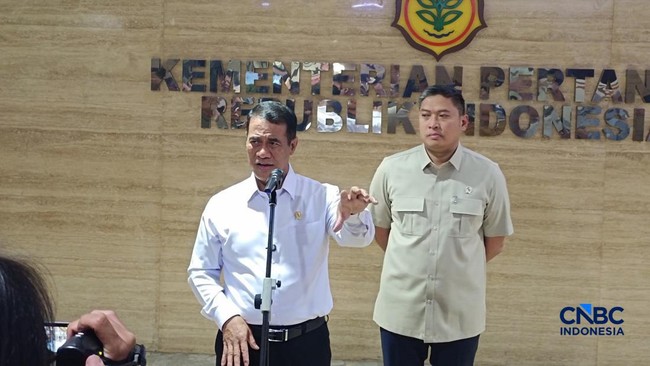
Jakarta, CNBC Indonesia — Agriculture Minister Amran Sulaiman is pushing for the acceleration of agricultural modernisation through intensification. One approach now being promoted by the government is a new planting method called PM AAS (Pertanian Modern-Advanced Agriculture System), which is claimed to boost production while raising farmers’ incomes.
Amran said the acceleration effort has been discussed with agriculture office heads and extension workers across Indonesia. The focus is not merely on chasing production targets, but also on improving farmers’ welfare through modern agricultural transformation.
“Today we gathered the heads of the agriculture offices and the regional directors of PPL from across Indonesia. The aim is to carry out an acceleration through intensification,” Amran said at a press conference at his office in Jakarta on Thursday (9/7/2026).
According to him, the intensification system will be accelerated through modern agriculture directed explicitly at improving farmers’ living standards.
“We are accelerating the intensification system, namely modern agriculture, and then farmers’ welfare. Prosperous farmers. So modern agriculture transforms, and modern agriculture makes farmers prosperous,” he said.
One example highlighted by Amran is the PM AAS method. He said the method has been trialled on 1,600 hectares of land over two years, with rice productivity reportedly reaching 10 tonnes per hectare, and in some locations as much as 12 tonnes per hectare. The minimum yield was around 9 tonnes per hectare.
“A simple example now is a new method, PM AAS. We have trialled it on 1,600 hectares. Production was 10 tonnes, even 12 tonnes in places. The minimum was 9 tonnes. Now we are trying to plant this method in irrigated areas. The national average is currently, say, 5.5 tonnes per hectare. If it’s 11 tonnes, that means it doubles,” he said.
He then described the impact if the method were applied widely. For instance, if productivity rises by 3 tonnes per hectare and is applied to 1 million hectares, additional production could reach 3 million tonnes. If the irrigated land is planted three times a year, additional production could rise to 9 million tonnes of unhusked rice.
“Say it rises by just 3 tonnes; if we plant it on 1 million hectares, that means 3 million tonnes. If planted three times a year, specifically in irrigated areas, that means 9 million tonnes. Of those 9 million tonnes, at a milling conversion rate of, say, 55 per cent, that means an increase of 5 million tonnes. That is what we are pursuing,” he said.
Beyond production, Amran also claimed the method could significantly lift farmers’ incomes. He said that if the method runs optimally in irrigated areas with three planting seasons per year and production reaching 10 tonnes per hectare, farmers’ incomes could multiply severalfold.
“If this can be optimal for irrigated areas, three plantings a year, production of 10 tonnes, then farmers’ monthly income per family, which used to be Rp 5 million, rises to Rp 16.3 million per person. Say around Rp 15 million per person. That is a threefold increase,” Amran said.
He emphasised that the current direction of modern agricultural policy is indeed aimed at farmers’ welfare. According to him, if farmers are prosperous, the drive to keep planting will grow stronger, which in turn will lift national food production.
“So the approach we are pursuing now is welfare. A massive transformation of modern agriculture, carried out with attention to farmers’ welfare,” he said.
Furthermore, Amran said PM AAS is not a new seed variety but a planting method combining the Arkansas method from the United States with the Jajar Legowo system. Through this method, the plant population per hectare is increased far beyond that of conventional planting patterns.
“No, it’s just the method. A combination of the Arkansas method and the Jajar Legowo method. Its working principle is the merging of the two. And so the AAS method was born,” he explained.
He explained that the method uses planting spaces that still allow light in, as in the Jajar Legowo pattern, but with a far denser plant population. Whereas previously the plant population ranged from 300,000 to 360,000 stems per hectare, under this method the number can be increased to around 1 million stems.
With a higher plant density, production costs do indeed rise. However, Amran said the increase is relatively small compared with the surge in income it generates.
“Costs go up. It used to be Rp 13 million, rising to Rp 15 million. But income used to be Rp 20 million, now it becomes Rp 65 million. Profit used to be Rp 5 million, now it can be Rp 16 million. That is the sequence,” he said.
In addition to increasing the plant population, the method is also said to save labour, as the planting process no longer involves the stages of nursery, uprooting, and transplanting. The pattern used is direct seeding.
“Then there is another benefit: it saves labour. Previously you had to raise seedlings first, pull them out, and then transplant them. Now it is direct seeding,” he concluded.
Source: jawawa.id (https://jawawa.id/newsitem/minister-amran-unveils-new-method-to-boost-farmers-income-to-rp-16-million-per-month-1783572750)
Originally published by CNBC Indonesia (https://www.cnbcindonesia.com/news/20260709111059-4-749385/amran-punya-jurus-baru-bikin-pendapatan-petani-tembus-rp-16-juta-bulan), translated from Indonesian