
Minister Amran Reveals 3,619 Tonnes of Bulog Rice Damaged, Details the Breakdown
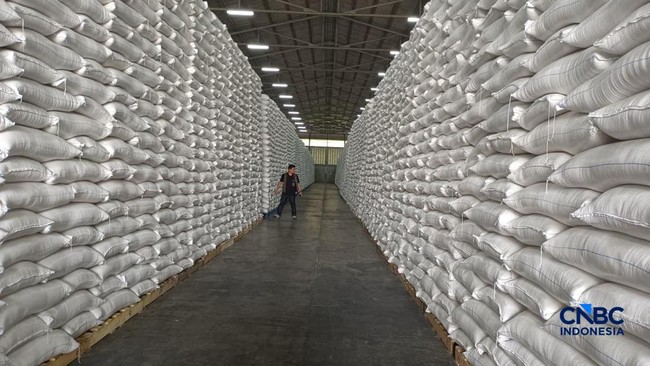
Minister of Agriculture and Head of the National Food Agency (Bapanas), Amran Sulaiman, has detailed the condition of rice stocks that have deteriorated or become damaged in Perum Bulog warehouses. Amran delivered the explanation while answering a question from the Chair of Commission IV of the Indonesian House of Representatives (DPR RI), Siti Hediati Hariyadi, widely known as Titiek Soeharto, regarding damaged rice in Bulog facilities. Before the lawmakers, Amran stated he had instructed Perum Bulog’s President Director, Ahmad Rizal Ramdhani, to transparently disclose data on the condition of stored rice stocks. “So we summoned the President Director yesterday, and this morning he just arrived back from China. I told him, ‘Don’t let this be your doing, the problem will fall on me.’ He replied, ‘Ready, Minister,’” Amran said during a working meeting with Commission IV at the parliament complex in Jakarta on Wednesday. He added that he specifically requested a detailed breakdown of the quantity of rice that had suffered damage and quality degradation to prevent public speculation. Amran demanded, “I asked for details on how much rice in Bulog’s warehouses is damaged; ‘you must be open’.” Based on the data he received, the quantity of completely damaged rice was recorded at 3,619 tonnes. This figure originates from stock affected by force majeure events such as floods and landslides, including incidents in Aceh. “The damaged rice is 3,619 tonnes. That is a fraction of a per cent. Now, this part needs special attention, there are two possibilities. This can still be processed, the rice that can be repaired is 93,488 tonnes. Most of this can still be repaired,” he explained. He noted that the majority of rice with reduced quality can still be reprocessed so that its quality is restored and fit for distribution. Out of Bulog’s total national rice stock of 5,305,594 tonnes, the quantity of quality-degraded rice was recorded at 93,488 tonnes, or approximately 1.76%. Bulog data classifies the degraded rice into three categories. Category A totals 93,488 tonnes, consisting of rice whose quality has declined but which can still be reprocessed and restored for redistribution. Category B, which is quality-degraded rice that must be released or destroyed, showed a nil balance. Category C accounts for 3,619 tonnes of rice damaged by natural disasters or force majeure. Amran asserted that even the irreparable rice still holds economic value as it can be processed into other products. “If not, perhaps 10%, say 9,000 tonnes, can become flour. And the price is still good,” he concluded. On a separate note, Amran also acknowledged that cases of substandard rice quality had been found in the field. However, he claimed the quantity was relatively small and was immediately addressed. “Honestly, I must also be open, we did find what you mentioned earlier in the regions. During our visit, we immediately phoned Bulog and asked for it to be replaced that very day, because the rice was not good, but the quantity was small,” Amran revealed. Consequently, Amran urged Bulog to increase vigilance in managing the currently high rice stock levels. He assessed that the current challenge differs from a few years ago when stocks were limited. “I ask Bulog to be vigilant from now on. We have worked extremely hard. Thank goodness, some is damaged now because we have rice; previously, nothing was damaged, Madam, because rice was scarce. Back then, imported rice all came in. This is all our rice,” he stressed. As a mitigation measure, Category A rice is planned to be reprocessed and utilised for food aid programmes through a blending scheme of one part reprocessed rice with four parts new rice from the 2026 harvest. Meanwhile, Category C rice will be downcycled into rice flour to avoid state losses. To strengthen storage quality, the government is currently constructing 100 new Bulog warehouse sites with an investment value of around Rp5 trillion. These modern warehouses are designed to maintain rice quality for a longer period. Amran concluded, “Indeed, there is a warehouse construction project. We are building 100 warehouses, worth Rp5 trillion, which has been approved and is under construction. These warehouses can keep rice for a minimum of two years. Possibly three years. In China, it can last even much longer. So the storage is far better than the current system. This is quite modern.”