
Minister Amran Exposes Fortified Rice Scam Costing Consumers Trillions
Jakarta, CNBC Indonesia – Agriculture Minister Amran Sulaiman has uncovered alleged irregularities in the circulation of fortified rice in Indonesia. Based on government surveillance, the majority of fortified rice brands tested failed to meet standards, yet were sold at prices far above the reasonable price.
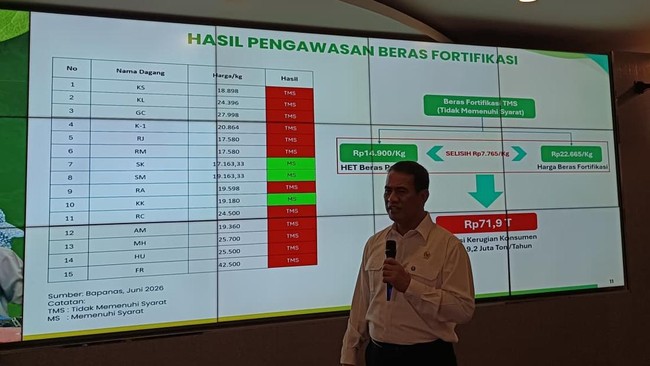
Amran said that surveillance by the National Food Agency (Bapanas) in DKI Jakarta in June 2026 covering 15 fortified rice brands showed that only three brands met the standard, while the other 12 were declared non-compliant.
According to him, the price of the non-compliant fortified rice ranged from Rp17,580 to Rp42,500 per kilogram, even though the Highest Retail Price (HET) of premium rice is only Rp14,900 per kg.
“Let me ask, is this fair? I will follow this up. Today the Deputy Chief of Bapanas has written directly to the Task Force. Next, I will write directly to the National Police Chief. Let me ask again, is Rp42,000 per kg reasonable?” Amran asserted at a press conference at his office in Jakarta on Thursday (30/7/2026).
Assuming 30% of national premium rice consumption, or around 9.2 million tonnes, shifts to fortified rice, the government estimates potential consumer losses could reach Rp71.9 trillion per year.
Amran stressed that he would promptly revoke the business licences of fortified rice producers proven to have violated the rules, while handing the criminal process over to law enforcement.
“These are the ones that do not match the lab results. Imagine, it has become even crazier than the earlier Rp17,000 — the average is now Rp22,000 per kg, with some selling at Rp42,000 per kg. Tell that to the observers: the game has become even crazier now. This Rp22,000 is from the samples we have just taken; that equates to Rp71.9 trillion. It is an assumption, but we are following it up,” he said.
“As head of the National Food Agency, Deputy Chief, Director-General: revoke their licences! Order it down the line. That is my authority — revoke the licences and they must not distribute. Because we now have lab results, then send the criminal matter to the Task Force, accepted,” Amran continued.
He explained that the additional production cost of fortified rice is actually relatively small. Based on a study by the Indonesian Fortification Coalition, the fortification cost is only around Rp700–Rp1,000 per kg. Using medium-grade rice as the raw material, the selling price of fortified rice should be in the range of Rp14,500 per kg.
However, on the ground the government found products sold at up to Rp20,000 and even reaching Rp42,000 per kg.
“The additional cost is Rp700 to Rp1,000 per kg. With the additional kernel earlier, containing B12, its value is Rp700 per kg. Then, using medium rice, if it is processed for fortification the HET price could be Rp14,000 per kg, but it is being sold at Rp20,000 and even Rp42,000 per kg. Let me ask, is this fair? Are these figures reasonable?” he said.
Furthermore, Amran highlighted that fortified rice was originally intended to help the poor, groups vulnerable to malnutrition, and stunting sufferers. Therefore, in his view, the soaring prices represent a deviation from the programme’s original purpose.
“This is meant for our brothers and sisters who lack nutrition, the poor, people with stunting. Yet it is being sold at Rp42,000 per kg, sold at Rp20,000 per kg,” said Amran.
He added that all the findings are supported by laboratory test results and will be followed up through the revocation of distribution licences and legal proceedings.
“The same as those earlier that did not comply. We already have the evidence, we have the lab results. There can be no more manipulation now; we have taken samples across the whole of Indonesia, three samples in one go — they cannot move anymore,” he said.
“I will pursue this. I am prepared to risk everything for the farmers, for the 286 million people of Indonesia. We, I, stand with them. If the risk is that my term of office ends, so be it. But we will pursue this,” Amran asserted.
Fortified Rice Standards and Violations
Fortified rice is governed by two standards: SNI 9314:2024 for fortified rice kernels and SNI 9372:2025 for fortified rice. Every 100 grams of fortified rice must contain a minimum of 0.25 milligrams of vitamin B1, 0.25 to 0.38 milligrams of folic acid, 1.0 to 1.5 micrograms of vitamin B12, 3.50 to 5.25 milligrams of iron, and 3.0 to 4.5 milligrams of zinc, with a minimum mixing ratio of fortificant kernels to milled rice of 1%.
The National Food Agency’s surveillance in DKI Jakarta in June 2026 of 15 fortified rice brands found that only 3 brands were compliant, while the other 12 were declared non-compliant, with selling prices ranging from Rp17,580 to Rp42,500 per kilogram.
The Highest Retail Price of premium rice is Rp14,900 per kilogram, while the average price of non-compliant fortified rice reached Rp22,665 per kilogram — a difference of Rp7,765 per kilogram. Assuming 30% of national premium rice consumption of 30.9 million tonnes shifts to fortified rice, equivalent to 9.2 million tonnes per year, potential consumer losses are estimated at Rp71.9 trillion per year.
In follow-up to these findings, Amran revealed that tomorrow, Friday, his side will announce the names of fortified rice producers that failed to meet the standard and revoke their business licences.
A study by the Indonesian Fortification Coalition shows the estimated additional production cost of fortified rice is only around Rp700 to Rp1,000 per kilogram, comprising Rp700 per kilogram for fortificant kernels plus processing costs. With medium rice priced at Rp13,500 per kilogram as the base, fortified rice should be sold at around Rp14,500 per kilogram — even lower than the Rp14,900 per kilogram price of premium rice — provided integrated milling is used.
This fact strengthens the suspicion that the fortified rice prices currently circulating in the market, reaching tens of thousands of rupiah per kilogram, far exceed their fair value.
The fortified rice programme has a clear legal foundation. Article 37 paragraph (2) of Government Regulation No. 17 of 2015 on Food and Nutrition Resilience mandates that efforts to improve nutritional status are carried out through meeting the nutritional needs of the community, prioritising pregnant women, nursing mothers, infants, toddlers, and other nutritionally at-risk groups.
The National Food Agency affirmed that fortified rice is directed at underprivileged families and families at risk of stunting, as an implementation of the Food Law and Government Regulation 17/2015. Yet with fortified rice prices now soaring far above their fair value, the programme has deviated from its original aim of protecting vulnerable groups.