
Minister Amran: Company's Rp 2 T Profit Is Not Business, It's Robbing the People's Rights
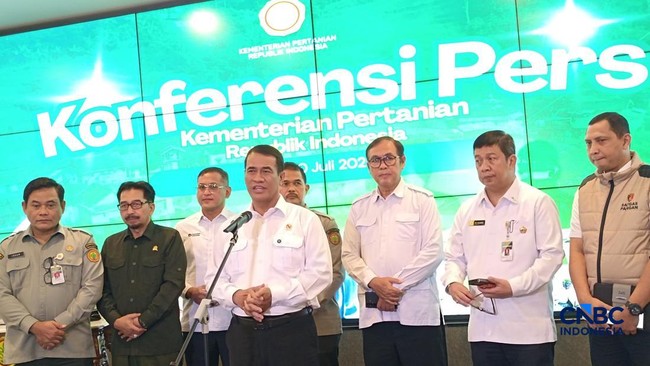
Agriculture Minister Amran Sulaiman has responded to a viral issue regarding a rice miller with a monthly revenue of Rp 2 trillion during the harvest season, which was raised by President Prabowo Subianto. Amran considered Prabowo to have been very polite in conveying the matter, whereas this is a true fact that harms farmers.
Amran presented the results of an in-depth analysis of the national rice trading system titled ‘Rice Mafia Emergency’. The analysis shows losses reaching Rp 98 trillion due to the circulation of premium rice that does not meet quality standards, plus potential consumer losses of up to Rp 71.9 trillion per year from the circulation of non-compliant fortified rice. ‘These trillions of rupiah are not reasonable business profits. This is robbing the people’s rights,’ Amran stressed at the Ministry of Agriculture office in Jakarta on Thursday (30/7/2026).
The 2025 Food Security Budget was recorded at Rp 144.6 trillion, channelled through Ministries and Agencies amounting to Rp 59.42 trillion, State-Owned Enterprises Rp 63.00 trillion, Regional Transfers Rp 22.17 trillion, and financing of Rp 0.05 trillion. From these subsidies, national paddy production is valued at Rp 537 trillion with rice production of 34.69 million tonnes, referring to a Highest Retail Price of Rp 13.5 million per tonne and an average price according to the Ministry of Trade of Rp 15.5 million per tonne. However, the distribution of profits is unequal. Farmers only receive household income of Rp 1.87 million from an allocation of Rp 215 trillion. Rice milling entrepreneurs or RMUs actually receive the largest portion of Rp 259 trillion, with a specific finding that one company group reaped unreasonable profits of up to Rp 2 trillion per month from quality fraud practices.
Amran explained the results of the government rice subsidy analysis. The rice supply chain is controlled by large entrepreneurs or conglomerates. Conglomerates utilise government subsidies for commercial activities up to 40%, and take maximum profits by raising prices above the Highest Retail Price. Field findings some time ago showed that much premium rice did not comply with the Indonesian National Standard, with a violation rate reaching 85.56%. A total of 39.75% of the total circulating premium rice, equivalent to 12.2 million tonnes, is estimated to violate standards or constitute consumer fraud, with total losses reaching Rp 98 trillion.
The National Police Food Task Force noted that throughout the 2024 to 2025 period, it handled 93 food mafia cases with a total of 77 suspects, consisting of 46 rice cases, 27 fertiliser cases, 16 cooking oil cases, and 4 internal employee cases. In addition, 2,231 fertiliser retailer and distributor permits have been revoked. Specifically for rice criminal cases, throughout 2025 there were 30 cases with 36 suspects. Entering 2026, enforcement continues with 2 cases and 6 suspects.
Regarding the imbalance in rice supply control, from the total national paddy production absorption of 65 million tonnes per year, large-scale mills with a capacity of 20 tonnes per hour, numbering 1,056 units, control 40% of the paddy supply or 25 million tonnes per year. Small-scale mills with a capacity of 0.5 tonnes per hour, although far more numerous at 161,401 units, also absorb 40% or 25 million tonnes per year. Meanwhile, medium-scale mills, 7,332 units, absorb 20% or 15 million tonnes per year. This pattern confirms that large mills, despite having far fewer units, are able to control a paddy supply equivalent to all the small mills numbering hundreds of thousands of units.
In the current staple food trade supply chain, rice flows from farmers through collectors, distributors, sub-distributors, wholesalers, to retail traders before reaching the end consumer. This long chain generates middleman profits of Rp 313.08 trillion. Therefore, the Government is promoting an alternative scheme through the Merah Putih Village or Sub-district Cooperatives, which cuts the distribution chain directly from farmers to end consumers. This scheme has the potential to generate a fairer margin for farmers and consumers of Rp 50 trillion.
Fortified rice is regulated under two standards, namely SNI 9314:2024 for fortificant rice kernels and SNI 9372:2025 for fortified rice. Every 100 grams of fortified rice must contain a minimum of 0.25 milligrams of vitamin B1, 0.25 to 0.38 milligrams of folic acid, 1.0 to 1.5 micrograms of vitamin B12, 3.50 to 5.25 milligrams of iron, and 3.0 to 4.5 milligrams of zinc, with a mixing ratio of fortificant kernels to milled rice of at least 1%. Monitoring results by the National Food Agency in DKI Jakarta in June 2026 on 15 brands of fortified rice found that only 3 brands met the requirements, while the other 12 brands were declared non-compliant, with selling prices ranging from Rp 17,580 to Rp 42,500 per kilogram.
The Highest Retail Price for premium rice is Rp 14,900 per kilogram, while the average price of non-compliant fortified rice reaches Rp 22,665 per kilogram, a difference of Rp 7,765 per kilogram. Assuming 30% of national premium rice consumption of 30.9 million tonnes shifts to fortification, or equivalent to 9.2 million tonnes per year, potential consumer losses are estimated to reach Rp 71.9 trillion per year. Following up on these findings, Amran revealed that on Friday his party will announce the names of non-compliant fortified rice producers and revoke their business permits. A study by the Indonesian Fortification Coalition shows the estimated additional production cost for fortified rice is only around Rp 700 to Rp 1,000 per kilogram, meaning that with a medium rice base price of Rp 13,500 per kilogram, fortified rice should be sellable for around Rp 14,500 per kilogram or even less.
Source: jawawa.id (https://jawawa.id/newsitem/minister-amran-companys-rp-2-t-profit-is-not-business-its-robbing-the-peoples-rights-1785383471)
Originally published by CNBC Indonesia (https://www.cnbcindonesia.com/news/20260730100628-4-754997/amran-untung-rp-2-t-perusahaan-bukan-bisnis-tapi-rampas-hak-rakyat), translated from Indonesian