
Minister Amran Claims Downstreaming of Palm Oil and Other Commodities Could Yield Value Equivalent to 10 Years of State Budget
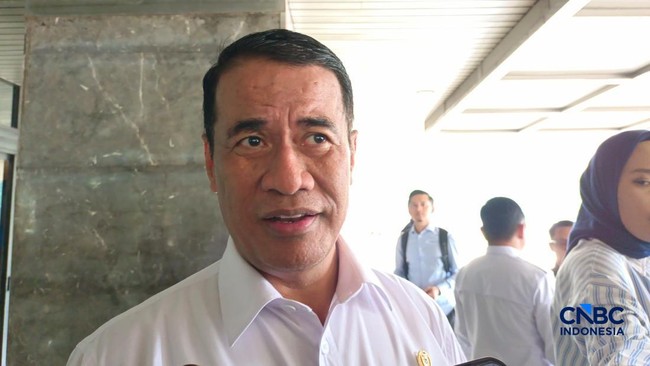
Minister of Agriculture Amran Sulaiman believes that the downstream processing of strategic commodities, especially palm oil, coconut, and gambier, can boost Indonesia’s economic added value to Rp35,000 trillion. According to him, this figure is equivalent to approximately 10 years of the State Revenue and Expenditure Budget (APBN).
Amran explained that the greatest potential comes from the downstream processing of crude palm oil (CPO). He stated that the current export value of CPO is around Rp1,000 trillion, but this could increase manifold if all products are processed domestically. “Now, if this CPO is Rp1,000 trillion, it could be 13 times that. This is the industrial tree for CPO,” Amran said during the election event for the Chairman of the Agricultural Wredatama Union (PWRI) for the 2026-2931 service period at the Ministry of Agriculture in Jakarta on Tuesday (30/6/2026).
Based on the industrial tree, he continued, palm oil derivative products could actually provide added value of up to 13 or even 19 times. However, he used a conservative assumption that all CPO would only provide 10 times the added value. “If we just multiply by 10, the downstream processing of CPO could generate Rp10,000 trillion, just from CPO alone. That is not including domestic use, only exports. And what is the impact on other countries? Unemployment could occur and their industries could halt. This is the best weapon for our economy against the world,” he said. “We have just taken hold of CPO, and we are number one in the world. This is what certain parties fear, so they cause disruption via social media, spreading slander so that there is uproar on social media,” he added.
Not only palm oil, Amran also presented the potential of coconut downstream processing. From his presentation, a single coconut initially worth around Rp1,350 can be processed into various high-value products such as virgin coconut oil (VCO), coconut milk, cooking oil, activated charcoal, and geotextiles. VCO, for instance, has a selling price of up to Rp145,000 per litre, or about 107 times the initial raw material value. According to Amran, the shift in global consumption trends from cow’s and goat’s milk towards coconut-based products presents a major opportunity for Indonesia as the world’s largest coconut producer.
“Then we downstream our coconut, our exports are Rp24 trillion. This is the industrial tree for coconut downstreaming, there is a food shift in India, China, and Europe. From cow’s and goat’s milk, they are shifting to coconut milk. They are shifting, when eating at coffee shops and such, the mixture is VCO. You know, the price of coconut has risen by Rp5,000, Rp10,000. In destination countries, it is Rp30,000 per piece,” Amran explained. “If we process it, the value increases 100 times. If Rp24 trillion is multiplied by 100, that is Rp2,400 trillion. That does not include coconut water. Now, coconut water and coconut milk together are Rp5,000 trillion. That is just the water and the flesh, not yet the shell and so on. We downstream everything,” he continued.
Amran then highlighted an example of coconut downstreaming in North Maluku. He mentioned that the government has built an integrated coconut factory producing packaged coconut water and VCO. From approximately 16.8 billion coconuts, the economic value generated from coconut water and VCO products is estimated to reach Rp896 trillion per year. Furthermore, the government has designated six strategic commodities as downstreaming priorities. Three of these are palm oil with a potential added value of Rp20,000 trillion, coconut at Rp10,000 trillion, and gambier at Rp5,000 trillion, bringing the total to Rp35,000 trillion. He stated that the processing technology for all these commodities is already available and the government has begun building several downstreaming facilities in various regions. “The technology is available. We have built them on the orders of the President,” he concluded.