
Minister Amran Champions Egg Prices for Farmers, Sidrap Model Deemed Fit for National Rollout
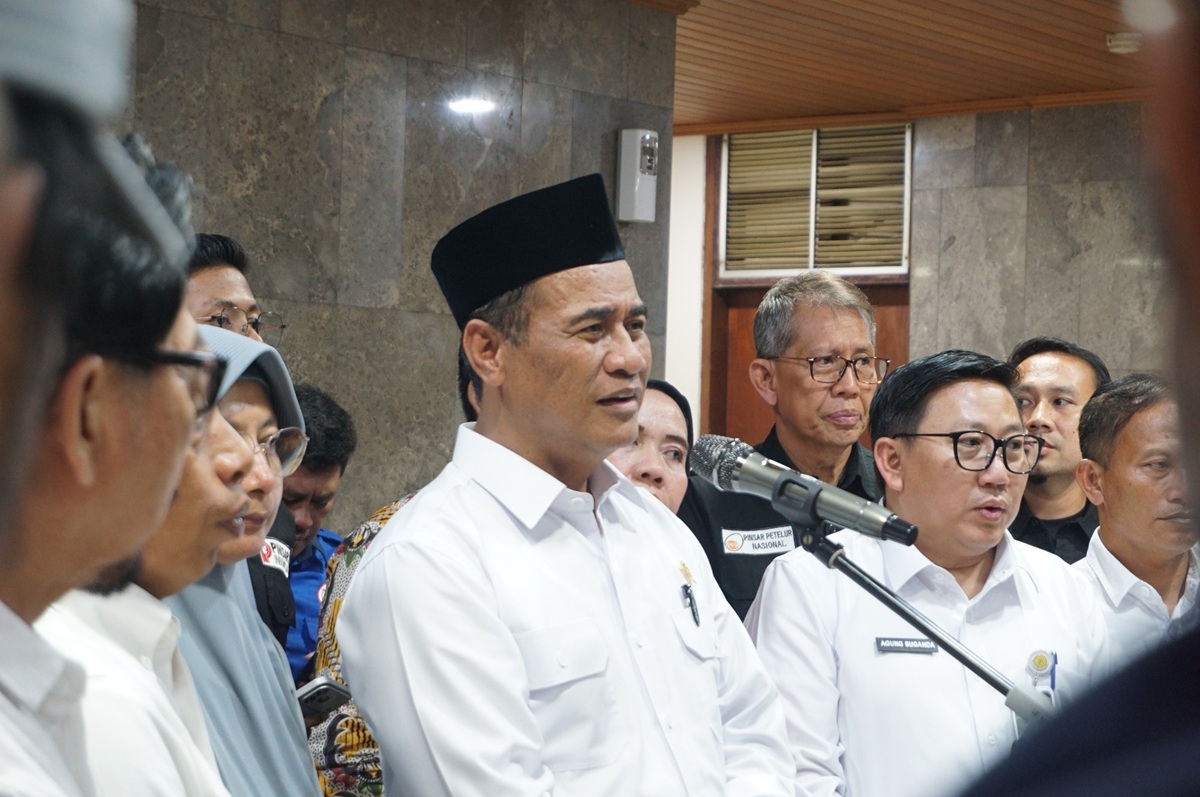
The Ministry of Agriculture is strengthening measures to protect laying hen farmers following pressure on egg prices in several production centres. This commitment was affirmed by Minister of Agriculture and Head of the National Food Agency (Bapanas), Andi Amran Sulaiman, when receiving egg farmer representatives at the Ministry of Agriculture office in Jakarta on Tuesday (9/6/2026).
Minister Andi Amran Sulaiman expressed his appreciation for the farmers who have long served as the backbone of the nation’s animal protein supply. ‘We thank our fellow egg farmers from all over Indonesia who have come to meet us requesting policies that can improve the falling price of eggs,’ Amran said.
According to Minister Amran, the achievements of national farmers deserve recognition for maintaining egg availability for the Indonesian people, even producing a surplus that opens up export opportunities. ‘I am proud of egg farmers throughout Indonesia who are able to meet the needs of the nation’s children, producing a surplus and even exporting to other countries,’ he stated.
To sustain the farmers’ business continuity, the Ministry has taken several strategic steps. One of these is overseeing the implementation of the Reference Purchase Price (HAP) for eggs at the farmer level, set at Rp26,500 per kilogram. ‘We ask all collectors and buyers, the HAP is Rp26,500 per kilo,’ asserted Minister Amran.
Beyond strengthening the reference price, the government is also continuously expanding the absorption of farmer produce through various available instruments. Minister Amran revealed that he had communicated directly with the Head of the National Nutrition Agency (BGN) to strengthen egg absorption through the Free Nutritious Meals Programme (MBG). ‘We called the head of BGN directly and she immediately agreed. We appreciate that. God willing, the contribution amount will be increased for BGN across Indonesia,’ he said.
The Ministry will also submit recommendations to the government regarding investment direction in the chicken farming subsector so that the business sustainability of smallholder farmers is maintained. ‘We will send a recommendation letter to the Investment Coordinating Board (BKPM) for investment. If possible, the people of Indonesia are already capable in this chicken farming sector. If there are other investors, ask them to move into other sectors—whether in sugar factories or mining industrialisation, but do not disturb the economy of the small people so it is sustainable,’ said Minister Amran.
Additionally, the Head of Bapanas will issue a circular to egg collectors and brokers to purchase eggs from farmers at the government-set HAP of Rp26,500 per kg, with copies sent to the food task forces at each district police precinct to strengthen supervision of the reference price implementation in the field. ‘We will send out a letter today urging all farmers, copied to the Food Task Force, to monitor this HAP. We will oversee this together to avoid harming Indonesian farmers,’ he stressed.
The government’s decision received a positive welcome from the farming community. Chairman of the Presidium of the National Layer Farmers Association (Pinsar Petelur Nasional), Yudianto Yosgiarso, considered the steps taken by the Ministry as offering hope for farmers who have been facing price pressures. ‘We thank the Minister of Agriculture for making several crucial decisions to protect laying hen farmers,’ he said.
According to Yudianto, the success of the price stabilisation policy requires support from the entire business chain, from traders and distributors to retailers, to comply with the price set by the government. ‘We hope there will be no more egg purchases below Rp26,500 per kilogram. If this still happens, it can be reported to the National Food Agency,’ he said.
He also appreciated the move by the National Nutrition Agency to increase the frequency of egg purchases to strengthen the absorption of farmer production. ‘We also appreciate the decision of the National Nutrition Agency to increase the frequency of egg purchases from once to three times a week,’ he stated.
During the meeting, the Regent of Sidenreng Rappang (Sidrap), Syaharuddin Alrif, shared his region’s experience in maintaining egg price stability through routine communication between farmers and traders facilitated by the local government. With a laying hen population reaching approximately 6 million in Sidrap Regency, the local government routinely holds coordination meetings twice a week involving small, medium, and large-scale farmers, as well as traders.
‘We hold weekly meetings for farmers and traders facilitated by the Sidrap Regional Government to determine the price of eggs every Wednesday and Saturday night,’ Syaharuddin said. According to him, the mutually agreed price is then openly announced to the public and business actors, becoming a market reference for the Eastern Indonesia region. ‘After determining the egg price, both parties—traders and farmers—agree. Then at 10 p.m. the price is set and published on farmers’ and regional government social media and on the videotron. That becomes the price benchmark for the Eastern Indonesia region,’ he explained.
Syaharuddin explained that the communication pattern built consistently has succeeded in maintaining a balance in farming and egg trading businesses for more than a year. ‘Thank God, for one year and four months the egg price has meant farmers profit and traders profit,’ he said.
According to Syaharuddin, the active involvement of local government is an important factor in maintaining balance in the poultry industry. ‘There must indeed be an effort by our local government in Sidrap to bridge both parties. So perhaps other regions can do this too, especially egg production centres,’ he concluded.
The Ministry of Agriculture assesses that the Sidrap experience demonstrates how collaboration between local governments, farmers, and business actors can serve as a model.