
Minister Amran boosts Merauke farm productivity with PM AAS modern agriculture system
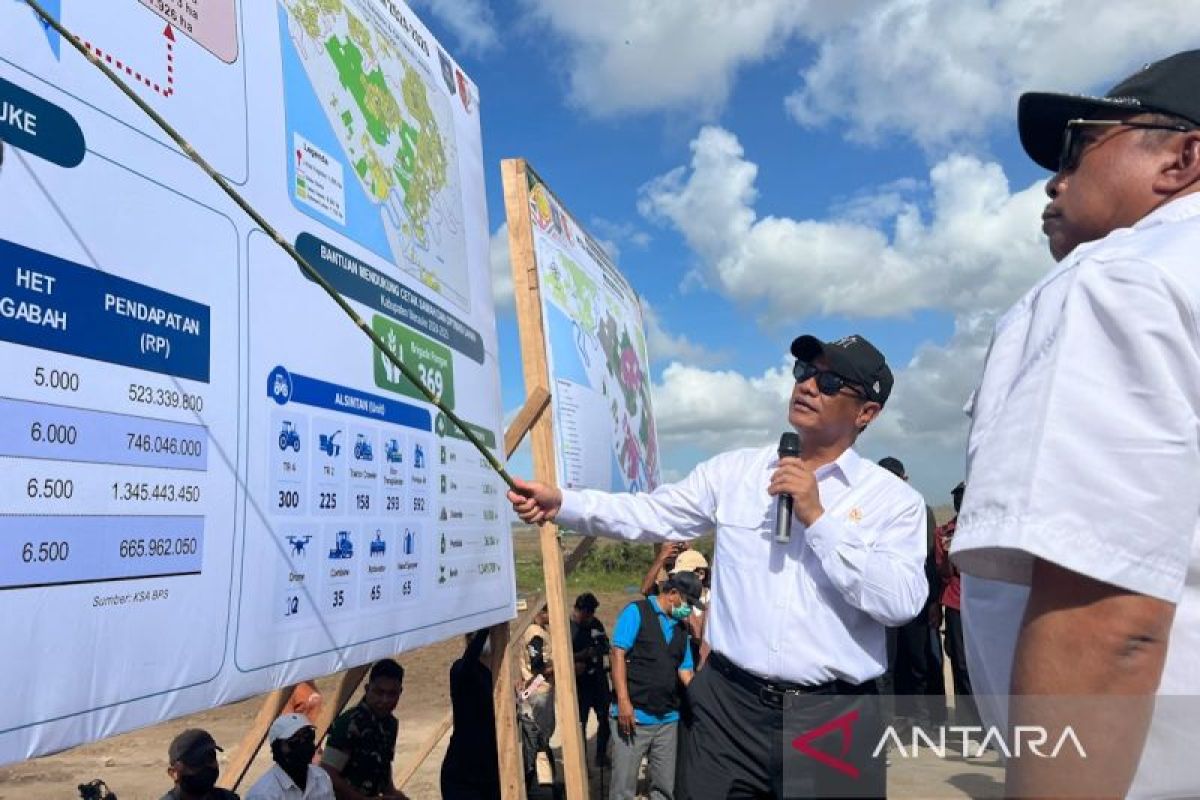
The PM AAS method combines American, Indonesian, and Chinese agricultural techniques. Agriculture Minister Andi Amran Sulaiman is accelerating agricultural transformation in Merauke, South Papua, through the implementation of the Advanced Agriculture System (PM AAS) to achieve sustainable food self-sufficiency. “Production can double. PM AAS is a combination of American, Indonesian, and Chinese methods. We researched it directly. Production can reach 12 tonnes or at least 10 tonnes per hectare,” the Minister said in Merauke on Monday. The modern cultivation method, which integrates mechanisation, location-specific superior varieties, new planting patterns, and intensive mentoring, is believed to be a lever for productivity while improving farmers’ welfare in the region. The Minister previously joined farmers for rice planting in Waninggap Kai Village, Semangga District, Merauke Regency, on Saturday (4/7). The planting applied the PM AAS method due to its advantage of potentially doubling rice production. Amran noted that the increase in productivity and cropping index per year could also impact farmers’ income and welfare. The implementation of PM AAS is expected to run in parallel with the people’s rice field printing programme and land optimisation, which are part of the government’s strategy to strengthen national food security in Papua. Meanwhile, Head of the Agricultural Assembly and Modernisation Agency at the Ministry of Agriculture, Fadjry Djufry, explained that PM AAS is a cultivation innovation developed over the last two years after studying modern farming practices in several countries. The concept was then adapted to Indonesia’s agroecosystem conditions so it can be applied in various regions, including the tidal swamp lands of Merauke. According to Fadjry, PM AAS not only relies on modern agricultural tools and machinery but also changes the cultivation system through more optimal planting spacing, increased plant population, use of superior varieties suited to local characteristics, and more precise fertilisation. This approach is expected to increase productivity while reducing farmers’ production costs. “Pilot projects we conducted in various regions showed very promising results. Therefore, this year PM AAS is being expanded across Indonesia with a target application of one million hectares. The hope is that productivity increases and farmers’ incomes are boosted,” Fadjry said. He explained that one of the main differences of the PM AAS method is the closer planting distance and direct seeding. With this spacing, the plant population can be increased to between 800,000 and one million plants per hectare. “This new planting method is combined with local Indonesian wisdom. The basis is close spacing. If transplanting usually yields a population of 250,000 to 600,000, this current method achieves 800,000 to one million,” he explained. “So you can imagine the possibility of doubling production because the population is doubled. Our hope is that if fertiliser and nutrient needs are met, production can double,” he added. He further stated that the application of PM AAS is tailored to local land characteristics. For Merauke, the recommended varieties are those tolerant to tidal swamp conditions and endemic pests such as tungro, so the technology can deliver optimal results. “Here it is type C tidal land, so we use varieties that are more tolerant to salinity. This is also a tungro endemic area, so later we will use Inpari 37, which is more tolerant to tungro pests,” he clarified. For the planting method, Fadjry said drones can be used for seed spreading. Additionally, farmers can use a simpler method with a drum seeder. “In some places we use drones, and we are trying to facilitate this. Then for areas that are new, the drum seeder is one tool that farmer groups can use. With a drum seeder, planting costs are cheaper, around Rp400,000 per hectare, or Rp600,000 per hectare in Papua,” he said.