
Minister Amran: 137,000 Hectares of New Rice Fields in Papua Belong to the People
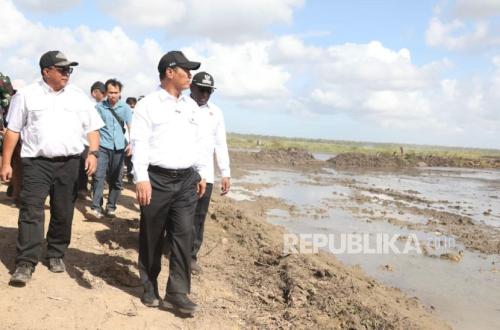
Agriculture Minister Andi Amran Sulaiman conducted a rice planting event with farmers in Waninggap Kai Village, Semangga District, Merauke Regency, South Papua, on Saturday (4/7/2026). The Minister stressed that the entire rice field development and land optimisation (oplah) programme currently underway in Papua is fully intended for the people, particularly native Papuans, as part of the acceleration of national food self-sufficiency. Papua has become one of the priority areas for national food development. As of 2026, the government has developed 83,030 hectares of new rice fields and optimised 54,399 hectares of existing land across Tanah Papua. South Papua is the largest development centre, with 48,934 hectares of new rice fields and 53,499 hectares of optimised land, totalling nearly 100,000 hectares of food production area. Other development areas include 24,248 hectares in Papua, 4,675 hectares in Southwest Papua, 3,373 hectares in West Papua, and 2,000 hectares in Papua Pegunungan. Strong community enthusiasm is evident from the numerous requests for new rice field openings across various regions. Minister Amran emphasised that the programme does not take away community rights but is instead designed to improve the welfare of indigenous communities and Papuan farmers. “This programme belongs to the people, to the native sons and daughters of Papua. Let no one claim to represent the community and say they disagree, because the fact is, after the programme started, people’s incomes have risen by up to 300 per cent. In fact, the community is now asking for more rice fields to be developed,” he asserted. He stated that the government would continue to expand food production areas in Papua according to the community’s needs. Upon receiving reports of a diesel fuel shortage affecting farming operations, the Minister immediately coordinated with Pertamina to ensure the quota would be increased. “As soon as we received the report on the diesel shortage, we coordinated with Pertamina and the quota is ready to be added. The important thing is that farmers’ needs are met so that field activities are not disrupted,” he said. The agricultural development programme in Merauke has begun to show tangible results. The cropping index has increased from 1.05 to between 1.82 and 2.00, while rice productivity has also surged. Rice production, harvested area, and farmers’ incomes have all continued to rise. Minister Amran noted that the government is not only opening new rice fields but also building a modern agricultural ecosystem through the provision of machinery, superior seeds, irrigation, food brigades, and intensive mentoring for farmers. “Now Merauke’s farmers can operate modern agricultural equipment. Technology used in developed countries is now being utilised in Papua to increase productivity and farmers’ welfare,” he said. South Papua Governor Apolo Safanpo stated that Merauke is the backbone of food development in Tanah Papua. Of the total 84,000-hectare rice field development programme in Tanah Papua, more than 48,000 hectares are located in Merauke Regency. Similarly, for the land optimisation programme, around 53,000 hectares of the total 54,000 hectares are in Merauke. “More than half of the rice field development programme in Tanah Papua and almost the entire land optimisation programme are in Merauke. This shows that Merauke is the centre of food development in Tanah Papua,” he said. He affirmed that the South Papua Provincial Government is ready to support all National Strategic Projects, especially in the food sector, as part of the implementation of President Prabowo Subianto’s Asta Cita to strengthen economic stability and achieve national food security. “We express our gratitude to the Minister of Agriculture because this programme provides great economic benefits to the community. We are ready to fully support it so that South Papua becomes a food barn, and in the future, even a rice exporter,” he said. A representative of farmers from Waninggap Kai Village acknowledged that the benefits of the government programme have been directly felt by the community. In addition to increasing production, the mechanisation and mentoring provided by the government have made farming costs more efficient and harvest yields have increased. “Previously, our land was not optimally cultivated. Now, with government assistance, agricultural tools, seeds, and mentoring, harvests have increased and farmers’ incomes are much better. We are optimistic that Merauke can become Indonesia’s food barn,” the farmers’ representative said. Minister Amran reiterated that the government will continue to expand food production areas in Papua as part of the strategy to strengthen national food self-sufficiency. He stressed that the entire programme is designed so that the benefits return to the Papuan people as the landowners and main actors in agricultural development in the region.