
Minister Agus opens opportunities for prisons and detention centres to develop cooperatives
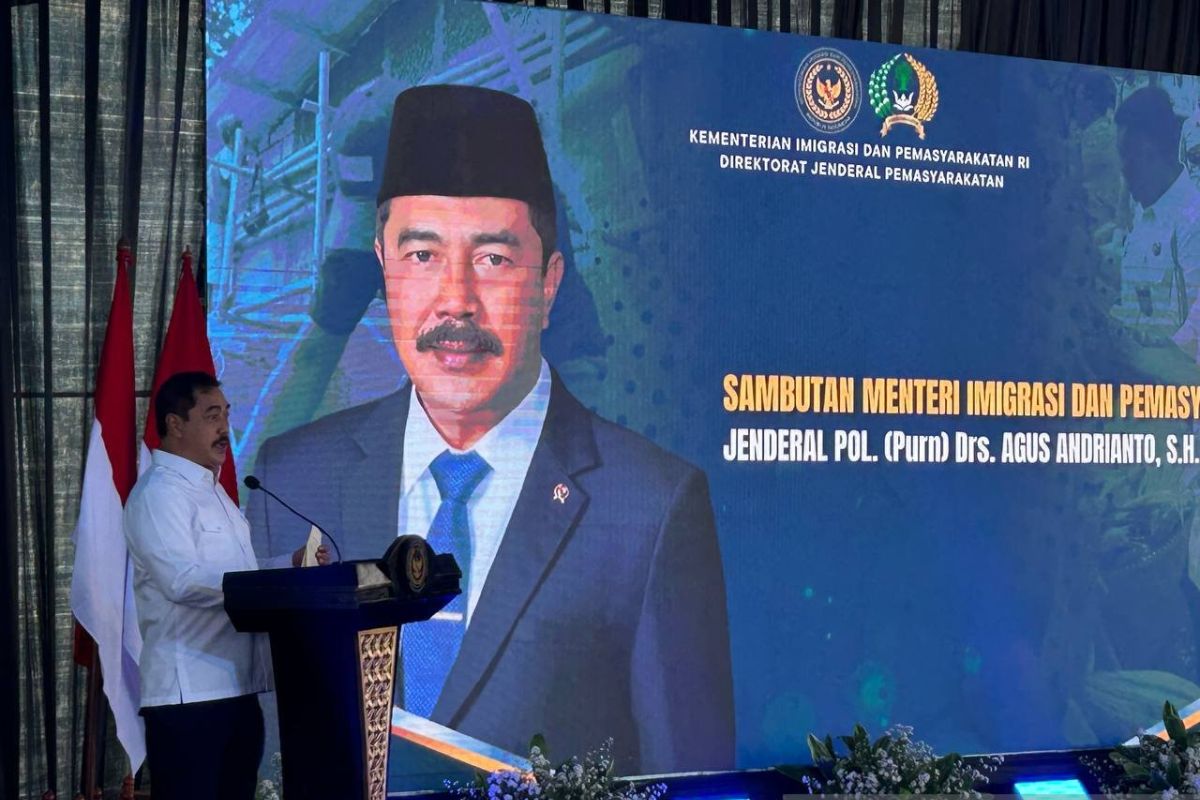
Minister of Immigration and Corrections (Imipas) Agus Andrianto is providing opportunities for correctional institutions (lapas) and state detention houses (rutan) to develop cooperatives in partnership with local government and entrepreneurs. He stated this move is intended to make prisons and detention centres self-reliant, improve staff welfare, and ensure the benefits are felt by inmates and the local community. “I also ask the heads of prisons and detention centres to collaborate with local entrepreneurs, with the profits later shared with investors, the cooperative, and also the officers assigned to guard duties,” Agus said during a social service event for house renovations, places of worship, and the optimisation of assimilation and education facilities at the Class II A Warungkiara Prison in Sukabumi, West Java, on Wednesday. The retired National Police general explained that at the beginning of his leadership, he launched a transformation in the corrections sector by identifying occurring problems. He had posed three questions to employees at the time: how to improve staff welfare, how to provide training to inmates with the hope of receiving premiums from the work training programmes built by the prisons, and how the proceeds from these two activities could fund social services in the form of ‘Friday blessings’ and other social activities. He noted that before his assignment to the ministry, food supplies in the corrections system were managed centrally, allowing entrepreneurs from Jakarta to manage prison food supplies in places like East Java or Sumatra. “Since 2026, I have asked the Directorate General of Corrections to report whether all prison food supplies are already managed by local entrepreneurs,” he said. He requested that local management of correctional food supplies be maintained so that this authority is not pulled back to the central level. The hope is that the budget entrusted by the state to the corrections system can assist the government in preparing regional food security. “At the same time, this budget can stimulate the local economy. The amount is relatively small, depending on the number of inmates and detainees under the responsibility of the corrections system,” he explained. He added that in this way, food security in every region can be supported by the budget entrusted by the state to corrections. “Back then, many prison canteens were run improperly by officials’ family members. But now, that is no longer the case,” Agus revealed. Now, he continued, dry and wet canteens selling coffee, nasi uduk, fried snacks, tea, and pecel, as well as telephone kiosks within prisons, are managed by cooperatives whose members are all correctional employees. “So the profits are enjoyed by the employees. From this alone, they are actually already prosperous. This means we have handed everything over to the regions,” he said. On the occasion, Agus reminded the ranks of the Directorate General of Corrections not to engage in any improper conduct to avoid trouble with law enforcement officials. Agus asserted he had issued a warning on 5 May to stop such illicit activities, but an incident still occurred on 5 June. “Don’t do it, or I will remind you like last month. On 5 May I warned you to stop. But on 5 June, there was an incident,” he stated. “I am asking the corrections ranks to please stop any remaining improper conduct. We have already given everything to our colleagues in corrections,” Agus added. The former Deputy Chief of Police also urged prison heads to develop businesses from the profits of cooperative and telephone kiosk management by opening new business units. If previously profits were distributed to members, they can now be developed into ventures supplying correctional food ingredients. Alternatively, prisons can develop agricultural and livestock businesses to supply prison food needs. For instance, the West Java Regional Office of the Directorate General of Corrections requires approximately 28 tonnes of chicken eggs per month for prison food, but can currently only supply about 14 tonnes from existing prison food security programmes. A shortfall remains that can be optimised by other prisons. “There are still 15 tonnes needed for internal correctional needs. This means the opportunity that can be seized from utilising monthly profits should not continuously be divided up, so that the profit points multiply,” he said. The former Chief of the Criminal Investigation Agency said this step is being taken so that staff welfare can be achieved, removing the need to engage in workplace misconduct. “Enough, later everything will be torn apart. I say, please stop these things. So that we are all protected. Remember, colleagues have families whose honour must be safeguarded so they do not become unnecessary victims,” Agus concluded.