
Minister Affirms Commitment to Comprehensive Maritime Safety Overhaul
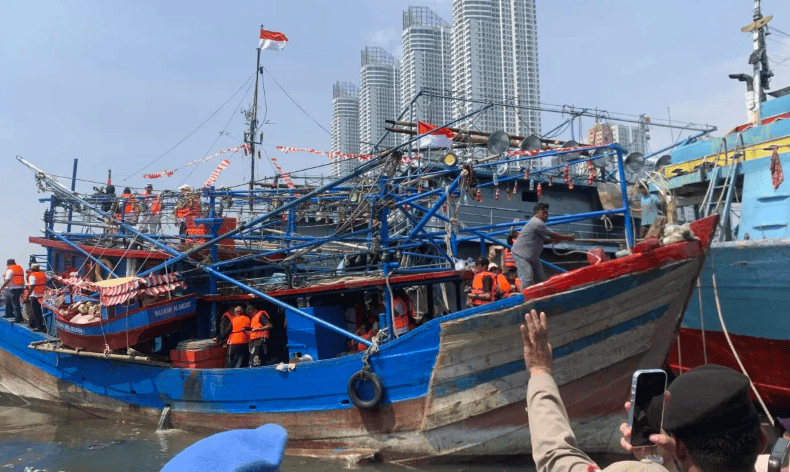
Transport Minister Dudy Purwagandhi has affirmed the Ministry of Transportation’s commitment to continuously evaluate and comprehensively improve maritime safety. He made the statement during a working meeting with House of Representatives Commission V regarding the government’s explanation of several ship accidents, held at the DPR building in Senayan, Jakarta, on Wednesday (19/8).
According to the minister, safety must not only become a concern after an accident occurs, but must be ensured at every stage of the journey, from when the ship prepares to depart until all passengers arrive safely at their destination. ‘Safety must not only become a concern after an accident occurs; it must be ensured from before the ship departs, during the voyage, until all passengers arrive safely at their destination,’ Dudy said, as quoted on Thursday (20/8).
During the meeting, the government presented its handling and evaluation of four incidents that have drawn attention: KMP Mutiara Sentosa II, KMP Putri Yasmin, KLM Nurul Salsa 01, and KM Prince Soya. Dudy again expressed condolences to the victims and their families. He stressed that the government’s presence before Commission V was a form of accountability as well as a commitment to make improvements.
‘Our presence is a form of government accountability to convey the handling that has been carried out as well as the evaluation and improvement measures that are being and will be implemented,’ he said.
He emphasised that safety evaluation must not stop at document completeness and fulfilment of administrative requirements. Inspections must be able to ensure that safety systems are truly functioning and ready to face emergency conditions in the field. ‘Complete documents do not make us stop at the administrative aspect. These incidents actually serve as a basis for us to evaluate more deeply the effectiveness of the implementation of safety systems on board ships, particularly fire protection systems, crew preparedness, vehicle and cargo conditions, and the ability to respond to emergencies,’ he stated.
Evaluation of the incidents covers various important aspects, including the reliability of fire protection systems, access to survival craft, emergency response readiness, and crew capability in controlling emergency situations. The evaluation also targets supervision of traditional vessels, manifest accuracy, carrying capacity, readiness of safety equipment and supervision of ship departures, as well as implementation of hot work permits, identification of hazardous materials, fire watch, and supervision of maintenance work on board ships.
As part of the overhaul, the Ministry of Transportation is strengthening layered accident prevention, from regulation, self-inspection, vehicle and cargo screening, spot checks, to the final decision before a Sailing Approval Letter (SPB) is issued. Supervision is also carried out through audits, inspections, ramp checks, operational and seaworthiness examinations, accident investigations, action against non-compliance, and law enforcement.
‘Every finding must be followed up. If a major deficiency is found, departure must be postponed, or the ship must not sail,’ Dudy asserted.
The overhaul is also directed at the accuracy of passenger and vehicle manifests. The ministry is encouraging integration between manifests, ticketing, and boarding so that the recorded number of passengers, vehicles, and cargo truly matches the actual conditions on board. The system is directed towards a single data system so that every data change can be updated and validated in real time.
‘Going forward, the principle must be firm: the SPB will not be issued if the data has not been validated. In safety, it is better not to depart than to depart but not arrive safely at the destination,’ Dudy said.
In addition, controlling overloading and over-dimension, fulfilling ship stability aspects, supervising dangerous cargo, and random inspections before departure are also part of strengthening the safety system. These measures are taken to ensure potential risks can be identified and addressed as early as possible before the ship leaves the port.
Dudy stressed that strengthening maritime safety requires consistency and collaboration from all parties, from the government, operators, ship crews, the public, to other stakeholders. According to him, there is no reason to compromise safety for the sake of a departure.
‘The Ministry of Transportation will continue to conduct evaluations. However, we also need the support of House Commission V and all stakeholders so that this strengthening of the safety system can be implemented consistently and comprehensively. Because in safety, even one life is already too many,’ he continued.
He said the government does not intend to use the explanation of the ship accidents as justification. The government acknowledges that there are still shortcomings that must be corrected and ensures that the improvement process continues while awaiting the results of investigations into each incident. He assured that every finding, recommendation, criticism, and directive from House Commission V will be followed up as part of the comprehensive improvement of maritime safety.
‘We do not intend to make this explanation a justification. There are still shortcomings and gaps in the implementation and supervision of maritime safety that we must seriously correct. Evaluation and improvement measures will continue to be carried out,’ Dudy concluded.