
Mining Stocks Surge, IHSG Rises 0.65% to 7,175
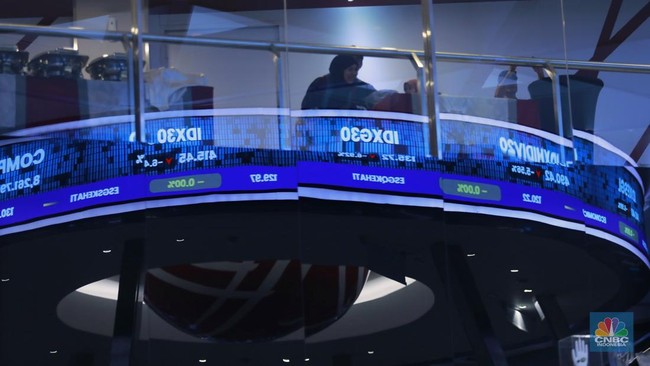
The Composite Stock Price Index (IHSG) strengthened during trading today, Monday (27 April 2026). The IHSG rose 46.13 points or 0.65% to 7,175.62 at the end of the first trading session.
Most stocks were in the green zone, with trading value reaching a notably high Rp 10.36 trillion. A total of 22.21 billion shares changed hands in 1.41 million transactions.
According to market data, shares of major banks recorded the largest transaction values. BBCA led with a total of Rp 2 trillion. However, shares of this Djarum Group issuer fell and briefly touched 5,975, down more than 1%. Next were Bank Mandiri (BMRI) and Bank Rakyat Indonesia (BBRI) shares, with transaction values of Rp 1.65 trillion and Rp 830 billion, respectively.
The majority of trading sectors strengthened, with the highest gains recorded in the basic materials and infrastructure sectors, while only the financial and energy sectors corrected today.
Citing Refinitiv, commodity stocks were the main reason for the IHSG’s significant strengthening today. Amman Mineral Internasional (AMMN), which rose 8.5% to Rp 5,425 per share, was the main contributor to the IHSG’s rise, contributing 18.43 index points.
Merdeka Gold Resources (EMAS), up 4.84%, contributed 6.63 points, and Bumi Resources (BUMI), up 5.56%, contributed 5.89 points.
Other mining issuers that also drove IHSG performance today included Bumi Resources Mineral (BRMS) and Aneka Tambang (ANTM).
Several shares of issuers owned by Prajogo Pangestu also experienced price surges after being pressured by investor selling last week. Only Petrosea (PTRO) shares weakened among the Barito Group.
The IHSG’s movement today was in line with the majority of markets in the region.
Japan’s Nikkei 225 index rose 0.53% to a record high, while South Korea’s Kospi index surged 1% and also hit a record high.
However, the Australian market, the S&P/ASX 200 index, fell 0.54%.
Meanwhile, the Hang Seng Hong Kong futures contract was at 26,041, compared to the index’s last close at 25,978.07.
Citing CNBC International, market sentiment remained stable despite diminishing hopes for a diplomatic breakthrough between Iran and the United States.
US President Donald Trump cancelled plans to send US envoys Steve Witkoff and Jared Kushner to Islamabad, Pakistan, last Saturday for negotiations with Iran.
“Too much time wasted on travel, too much work! Besides, there is great internal discord and confusion within their ‘leadership’,” Trump wrote in a post on Truth Social, quoted Monday (27 April 2026).
Oil prices surged around 2% after plans for a second round of US-Iran peace negotiations hit another impasse.
The Brent crude futures contract, the international benchmark, rose more than 2% to US$107.49 per barrel at 19:35 ET, while US crude oil also jumped 1.79% to US$96.19.
Tensions in the Strait of Hormuz remain high after Iran’s Revolutionary Guard forces were reported to have boarded two cargo ships near the strategic sea lane.
The Indonesian financial markets this week will only operate for four days, Monday to Thursday, due to Labour Day holiday on 1 May or this coming Friday.
The main focus of the market this week is on the latest developments in US-Iran negotiations, the Federal Reserve’s interest rate decision, the release of US PCE inflation data, US and China manufacturing data, and the Bank of Japan’s (BOJ) interest rate decision.
Markets expect the Fed to hold its benchmark interest rate in the 3.50%-3.75% range. This expectation arises because US inflation remains above target, while the surge in energy prices due to Middle East conflicts makes it difficult for the US central bank to move too quickly to ease policy.
This Fed decision will be very important for global markets. If the Fed signals it will hold rates longer, the US dollar could remain strong. This condition could again pressure Asian currencies, including the rupiah.
Conversely, if the Fed’s statement begins to sound more dovish by considering the risk of economic slowdown, markets could interpret it as an opportunity for rate cuts in the following semester. This scenario could provide room for strengthening bonds and risk assets, including stocks in emerging markets.