
Mining Human Resources Urged to Prepare for Technological Transformation and Environmental Challenges
Technological changes and increasing demands for responsible mining practices are altering the human resource requirements within the mineral and coal sectors. The younger generation is no longer expected to master technical competencies alone, but is also required to understand digital technology, safety, the environment, sustainability, and ethics.
This issue was a primary focus of the ‘ESdem Goes to Campus 2026 Subsector Minerba’ event, organised by the Directorate General of Mineral and Coal of the Ministry of Energy and Mineral Resources (ESDM) alongside the Mineral and Coal Testing Centre (BBPMB) tekMIRA and the Society of Renewable Energy (SRE) Indonesia at Lambung Mangkurat University (ULM), Banjarmasin, South Kalimantan, on Monday (31/8/2026).
More than 300 students from ULM and several other universities in South Kalimantan registered for the event. Approximately 200 students participated in the series of activities, which covered topics ranging from good mining practices and innovation to readiness for entering the workforce.
The Director of Technical and Environmental Affairs for Minerals and Coal, Ahmad Syauqi, stated that the younger generation should view the mining sector as more than just a source of employment. He noted that students have opportunities to serve as researchers, innovators, entrepreneurs, industry leaders, and policymakers.
Vice Rector IV of Lambung Mangkurat University for Cooperation, Public Relations, and Information Systems, Yusuf Azis, added that industry needs for university graduates are shifting from being merely ‘job-ready’ to ‘future-ready’.
According to him, this shift requires strengthening technical competencies alongside digital literacy, an understanding of sustainability, leadership, and ethics. Collaboration between universities and industry is also essential through responsive curricula, problem-based and project-based learning, practitioner involvement, and joint research.
The need for the ability to develop technology-based solutions was evident in the innovations presented during the ‘Innovation Harvest: Good Mining Practice Case Competition 2026’.
The competition received over 140 proposals from various universities across Indonesia. The submitted ideas covered the implementation of Good Mining Practices, environmental management, post-mining reclamation, as well as community development and empowerment.
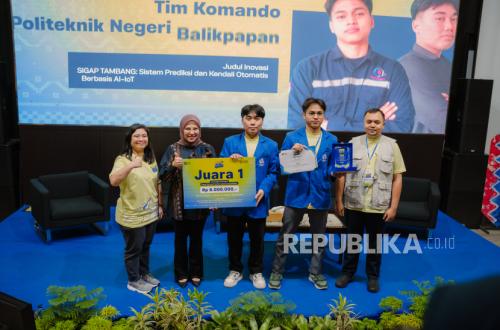
One innovation that garnered significant attention was ‘SIGAP TAMBANG’, an AI-IoT-based prediction and automatic control system designed to mitigate highwall landslide risks in open-pit coal mines. This innovation was developed by the Komando Team from Balikpapan State Polytechnic, which was subsequently selected as the first-place winner of Innovation Harvest 2026.
Regustian Dana and Arkan Jihadi Asyrof, members of the Komando Team, presented their innovation during the ESDM Goes to Campus event. They explained the background of the innovation’s development, the challenges faced during the process, and their experiences participating in the competition.
The Coordinator of Public Relations and Public Information for the Directorate General of Mineral and Coal, Anggemma Miftah Hairani, stated that providing space for students to develop ideas is necessary so that issues in the mining sector can be viewed from the perspective of the new generation.
“Through Innovation Harvest, we want to provide a platform for students to not only present ideas but also bring those ideas to a wider audience,” said Anggima.
Challenges for mining human resources also relate to the expanding scope of aspects that must be addressed in mining activities. Occupational safety, environmental management, inspection and verification, and the implementation of technology are all becoming essential competencies for prospective workers.
These topics were discussed in the ‘Youth Empowerment Talkshow’, which featured representatives from the Directorate General of Mineral and Coal, the mining industry, inspection and verification agencies, and academics. The discussion covered policy, safety and the environment, inspection and verification, and the competencies required by the younger generation.
Meanwhile, the ‘Career Industry Talks’ brought students together with practitioners from BBPMB tekMIRA, PT Arutmin Indonesia, PT Putra Perkasa Abadi, PT Borneo Indobara, and PT SUCOFINDO. The discussions focused on competency requirements and an overview of the working world within the mining sector.
This shift in competency requirements demonstrates that the future challenges of the mining sector involve not only managing mineral and coal resources but also preparing a workforce capable of operating technology, understanding risks, and maintaining safety and environmental standards.
Therefore, the connection between universities, the government, and industry is vital to ensure that education does not stop at theoretical mastery. Students need opportunities to test their knowledge against real-world problems while understanding the ever-changing needs of the industry.
Developing human resources through this approach is a crucial factor in preparing a mining generation capable of meeting the demands for safer, more responsible, and sustainable mining practices.