
Minimum Wage Increases No Longer Support Workers with Families, as Calculations Cover Only Single Workers
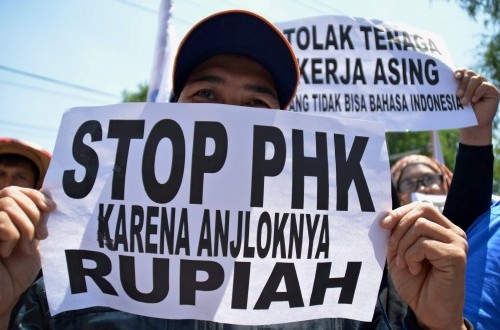
SEMARANG — Mulyono, chairman of the Independent Workers’ Federation (FSBI), said annual minimum-wage increases, particularly in Central Java, can no longer cover the living costs of workers with families. He said the formula used to calculate increases has so far been based only on the needs of a single worker.
Ahead of discussions on setting the 2027 minimum wage, Mulyono called for the formula to be adjusted. “We are pointing out that the decent living needs (KHL) calculation has so far covered only one person, a single worker. We are asking for the formula to be adjusted as soon as possible,” he said on Wednesday (11 November 2026), when he submitted the FSBI’s study on minimum-wage levels that would meet the KHL for workers with families to a Central Java provincial government representative.
Mulyono said workers’ lives, particularly those of workers with families, were increasingly under pressure from rising living costs. This was especially true for workers in Central Java, whose wages are among the lowest in Indonesia. The province’s 2026 provincial minimum wage (UMP) is Rp2.3 million.
“Without a new formula, Central Java will always lag behind, because the focus will remain on wage increases that only cater for single workers,” Mulyono said.
According to the FSBI’s survey and study, a wage that meets decent-living needs for a worker with a spouse and two children is Rp16 million a month. The costs included in the study cover clothing, food, housing, healthcare and education.
“Our findings put the figure at Rp16 million for a family of four — a couple with two children. That is broadly in line with other countries if we want to bring wages up to comparable levels,” Mulyono said.
Mulyono has submitted the study to the Central Java provincial government, which is expected to forward it to the central government.
“This is simply a proposal. Perhaps there will be special consideration so that the 2027 wage increase is not just 10 per cent. We are sure that a 10 per cent increase would only be enough for single workers and would not cover the day-to-day needs of workers with families,” Mulyono said.
He noted that both the provincial minimum wage (UMP) and regency/city minimum wages (UMK) in Central Java remained very low. Even if wage increases could not reach the level identified in the FSBI study, Mulyono urged the government to intervene to meet workers’ needs.
“For example, university fees could be scrapped and covered by the government, or the government could provide other subsidies. The burden should not be left entirely to employers,” Mulyono said.
Source: jawawa.id (https://jawawa.id/newsitem/minimum-wage-increases-no-longer-support-workers-with-families-as-calculations-cover-only-single-workers-1794405226)
Originally published by Republika (https://rejogja.republika.co.id/berita/toc9gb282/hanya-hitung-kebutuhan-lajang-kenaikan-upah-minimum-dinilai-tak-lagi-hidupi-pekerja-berkeluarga), translated from Indonesian