
Minerals Key to Decarbonisation as MIND ID Boosts Low-Emission Mining
Jakarta (ANTARA) – The transition to a low-carbon economy requires a sustainable supply of minerals to build electric vehicle ecosystems, renewable energy infrastructure and energy storage technologies. This makes the mining industry a strategic sector in supporting global decarbonisation.
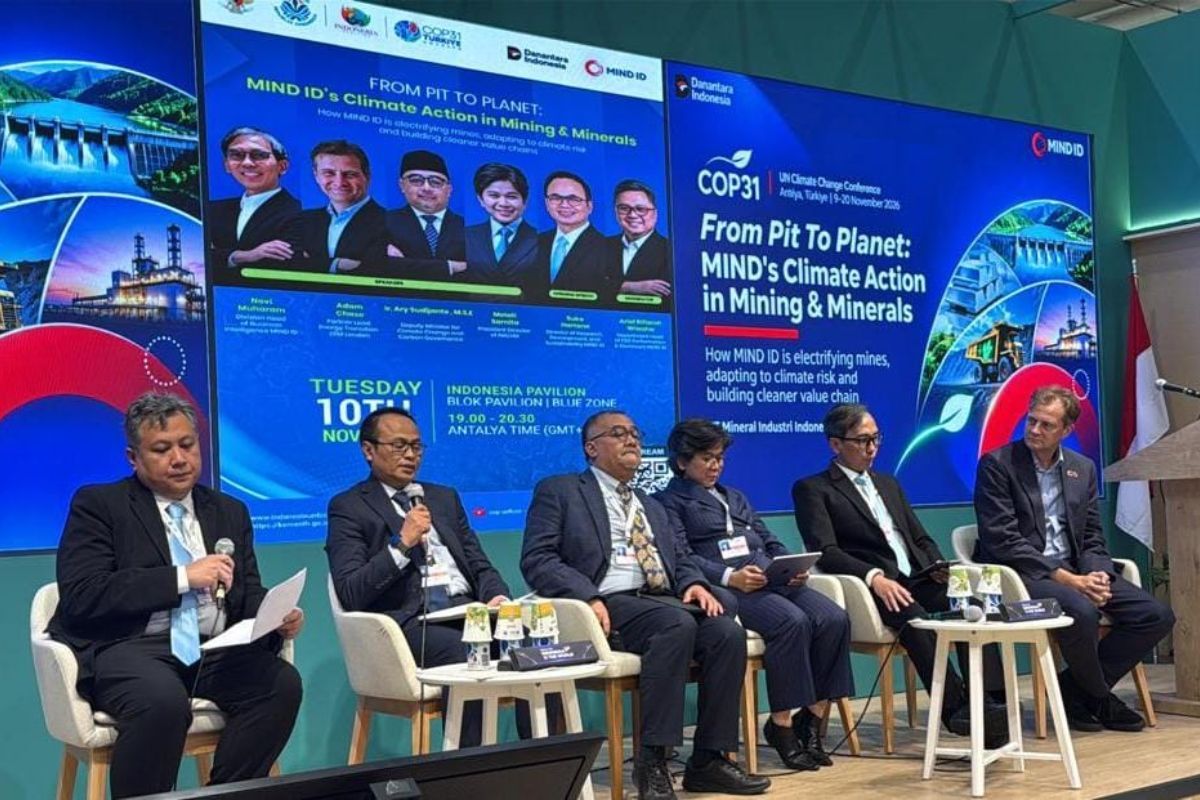
The role of mining was discussed by Indonesia’s mining industry holding company MIND ID during a panel session entitled “From Pit to Planet: MIND’s Climate Action in Mining & Minerals” at the United Nations Climate Change Conference (COP31 UNFCCC) in Antalya, Türkiye.
MIND ID Director of Research, Development and Sustainability Suko Hartono explained that nickel, copper and aluminium are fundamental materials for a range of low-carbon technologies, from electric vehicles and renewable power plants to energy storage systems.
Demand for these minerals is expected to continue rising. In its 2024 report Critical Minerals and Clean Energy Transitions, the International Energy Agency (IEA) estimated that by 2040 global demand would be 3.6 times higher for nickel, 2.5 times higher for copper and 2.1 times higher for aluminium than in 2023.
“The world needs more minerals to accelerate the transition to a low-carbon economy. The mining industry has an important role in supplying materials for future technologies. However, increased production must also be accompanied by changes to mining and processing methods so they become more efficient and produce fewer emissions,” Suko said.
Suko said MIND ID was implementing a decarbonisation roadmap towards 2060 to ensure that increased mineral production goes hand in hand with emissions reductions in extraction, processing and refining.
The strategy has four elements: improving energy efficiency, switching to lower-carbon fuels, electrifying operational equipment, and building a lower-carbon, more circular industrial value chain.
In 2025, the MIND ID Group achieved emissions reductions of 605,000 tonnes of CO₂e, exceeding its target of 250,000 tonnes of CO₂e. It aims to cut Scope 1 and Scope 2 emissions by 2.025 million tonnes of CO₂e by 2030, equivalent to 15.75 per cent against the business-as-usual (BAU) scenario.
The measures are being implemented across mining and mineral processing. B40 biodiesel has been introduced for heavy equipment and operational vehicles, while a switch to B50 is being prepared, subject to operational readiness.
In coal production, the MIND ID Group operates electric equipment including bucket-wheel excavators, conveyors and pumps, and is preparing to electrify haul trucks.
In processing and refining, MIND ID is promoting the use of cleaner energy, including through electricity supply integration and Renewable Energy Certificates (RECs) to support operations at the nickel smelter in Pomalaa.
These efforts are complemented by post-mining reclamation, watershed rehabilitation and mangrove ecosystem restoration. MIND ID is also developing nature-based solutions and assessing the use of carbon capture and storage (CCS/CCUS) technologies as part of its long-term decarbonisation efforts.
Suko added that MIND ID was using COP31 to explore international cooperation in three strategic areas. The first is a Low-Carbon Metals Partnership, covering the development of aluminium, nickel, copper and tin with improved environmental performance, product carbon-footprint measurement, certification and stronger access to international markets.
The second is a Mining Electrification and Energy Efficiency Partnership, involving technology collaboration to electrify equipment, optimise energy use and improve mining productivity.
The third is a Cleaner Smelter Power and Climate Financing Partnership, focused on developing cleaner energy solutions, improving the efficiency of processing and refining facilities, and exploring financing for decarbonisation projects.
Suko said the future transformation of the mining industry would contribute more effectively to tackling climate change while preserving the sector’s competitiveness.
“For MIND ID, minerals and coal are strategic commodities that support a low-carbon civilisation of the future. Through our ‘From Pit to Planet’ approach, we are committed to ensuring that increased mineral production goes hand in hand with the transformation of mining and processing into operations that are lower-emission, more efficient and sustainable,” Suko concluded.