
Minerals Deep Within the Earth Can Store Water, New Findings Reveal
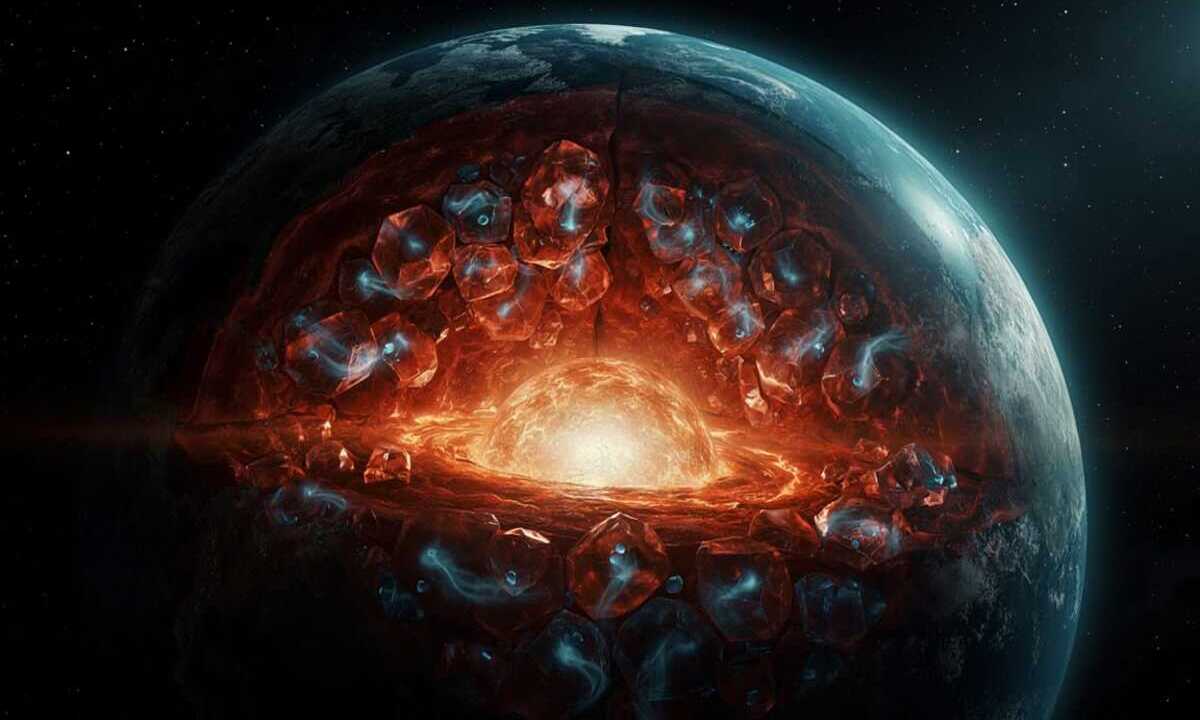
Water on Earth is not only found on the surface in the form of oceans, rivers, and lakes. Part of this water is actually stored deep within the planet, bound within the mineral structures of the Earth’s mantle. Recent research provides an in-depth look at how certain minerals serve as water storage sites under conditions of extreme pressure and temperature.
One of the latest findings, published in Nature Geoscience on 8 September 2026, reports on two types of iron oxyhydroxide minerals, namely Fe₅O₁₂Hₓ and Fe<0xE2><0x82><0x87>O₁₂Hₓ. These minerals can form in conditions resembling the lowermost part of the Earth’s mantle. Through high-pressure and high-temperature simulation experiments, researchers found that these minerals possess a dense structure capable of carrying hydrogen derived from water.
Researchers suggest that these two mineral phases have the potential to act as reservoirs for ancient water or water that re-enters the Earth’s interior through long-term geological processes.
The ability of minerals to store water is not a new concept in Earth sciences, but its scope continues to expand. One long-studied example is ringwoodite, a mineral found in diamonds from deep within the Earth.
Ringwoodite is located in the mantle transition zone, approximately 410 to 660 kilometres below the surface. Research on ringwoodite samples shows that this mineral can contain significant amounts of water, making the mantle transition zone one of Earth’s important interior water reservoirs.
Another study in Nature Communications in May 2026 reinforces this data. Minerals such as wadsleyite and ringwoodite have been proven to incorporate hydrogen into their crystal structures. Wadsleyite is estimated to be able to store up to 3.3% by weight of water, while ringwoodite can hold about 1.3% under certain conditions.
The term “water within the Earth” does not refer to liquid oceans like those on the surface, but rather to hydrogen or hydroxyl groups chemically bonded within the mineral crystal structures due to extreme pressure.
Understanding the presence of water in Earth’s interior is crucial for studying planetary dynamics. The presence of water affects the physical properties of rocks, melting processes, mantle activity, and even the movement of tectonic plates.
However, this water-storing capacity is not uniform throughout the Earth’s layers. Research in August 2026 found that bridgmanite, the primary mineral in the lower mantle, actually has a very low water content, specifically less than 40–70 parts per million (ppm).
This difference in storage capacity between minerals indicates that the distribution of water within the Earth is a highly complex system. Research into sub-surface minerals helps scientists understand how water enters, moves, and potentially returns to the surface over geological timescales of millions of years.