
Mineral Exports Stalled by Rare Earth Content, Nickel Industry Speaks Out
Jakarta, CNBC Indonesia - The Indonesian Nickel Industry Forum (FINI) has spoken out over the problem of mineral exports hampered by rare earth element (REE) content.
Previously, FINI appreciated the staging of the Coordination Meeting on the Governance of Critical Mineral and Rare Earth Element (REE) Exports, held by the Presidential Staff Office (KSP) on 27 July 2026. The meeting was attended by representatives of ministries and agencies, business players, surveyors, law enforcement agencies, research institutions, and business associations.
FINI Chairman Arif Perdanakusumah said the meeting provided certainty for business players that exports of a number of processed and refined mining products, such as nickel and bauxite, previously held up by mandatory testing for REE and radioactive element content, had been allowed to resume shipments. The earlier obstacles arose from various regulatory and governance issues, including limited readiness of equipment and the technical execution of testing.
Nevertheless, as of Wednesday (29/7/2026), FINI noted that around 120 Surveyor Reports (LS) covering various mining commodities had yet to be issued. The reports relate to operational activities in Sulawesi, West Kalimantan, and Bangka Belitung, with the process still ongoing at a number of surveyors, including Anindya, Carsurin, Sucofindo, Tribhakti, and Geo Services.
“The industry in principle supports the mandatory testing aimed at mapping the potential or inventorying Indonesia’s REE reserves. However, the presence of REEs as accompanying elements in a processed or refined product should not automatically change the classification of the main product (which under normal conditions can be exported) into a product that is prohibited from export,” he said, quoted from a written statement on Wednesday (29/7/2026).
According to him, export policy needs to consider the identity of the main product, its Harmonized System (HS) Code classification, the content levels of the elements, mineralogical characteristics, and technically and economically viable recovery potential. Setting thresholds for the content of certain elements is also considered important so that policy can be applied accurately.
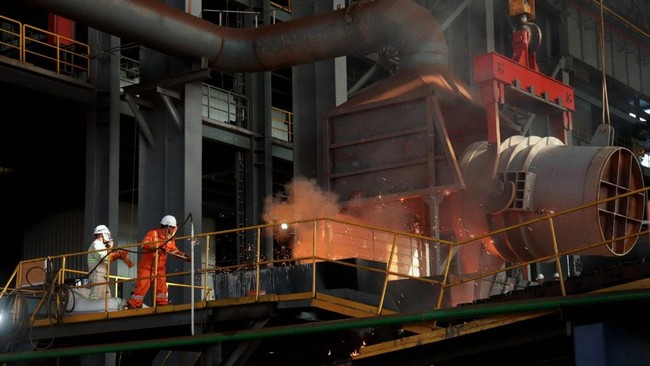
He went on to explain that nickel processing and/or refining facilities based on High Pressure Acid Leaching (HPAL) and Rotary Kiln Electric Furnace (RKEF) technology, as well as a number of other technologies under development, such as Oxygen-Enriched Side-Blown Furnace (OESBF), Heap Leach, and others, are essentially built with technology designs focused on processing nickel ore into intermediate products such as Mixed Hydroxide Precipitate, Nickel Pig Iron, Ferronickel, and Nickel Matte.
Meanwhile, the extraction and refining of the REEs that are incidentally contained in these nickel processing and refining products still requires further research and study, both in terms of technology and economics.
On the other hand, Indonesia’s nickel downstream industry is still relatively young and is currently facing severe pressure on its core business. These pressures include declining global demand, price fluctuations, rising production and energy costs, increases in the cost of key raw materials and auxiliary raw materials such as sulphur and industrial diesel, as well as several policies that present their own challenges for business players.
“Considering these conditions, policy related to REEs needs to be designed proportionally and implemented gradually, with a clear transition period. Policy also needs to consider technological readiness, business economics, and the industry’s capacity to develop new value chains without disrupting the sustainability of the nickel downstream industry that is already running,” he said.
Moreover, the greatest added value from REEs is indeed created after the separation and refining process. Therefore, the direction of REE policy should be focused on encouraging the formation of a downstream ecosystem capable of carrying out that process in a dedicated and sustainable manner.
Meanwhile, the nickel processing and refining industry currently in operation can be given several options for its role. Smelters, for example, can function as providers of raw materials or initial residues under fair recovery and incentive schemes. Smelters can also be encouraged to develop further downstream if studies prove clear benefits and economics.
“With that approach, the nickel industry is not merely required to build the entire REE value chain independently. Instead, REE development can be carried out through a measured, collaborative division of roles that matches the competencies and readiness of each player within the industrial ecosystem,” he said.
Source: jawawa.id (https://jawawa.id/newsitem/mineral-exports-stalled-by-rare-earth-content-nickel-industry-speaks-out-1785300704)
Originally published by CNBC Indonesia (https://www.cnbcindonesia.com/news/20260729105629-4-754677/ekspor-mineral-terganjal-kandungan-ltj-industri-nikel-buka-suara), translated from Indonesian