
Mineral Downstreaming Enters Phase Two, Indonesia Targets Battery and Manufacturing Industries
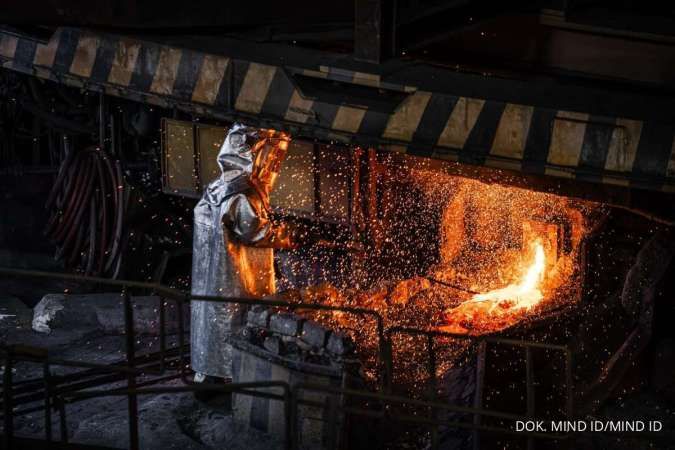
The Indonesian government has begun shifting the focus of its mineral downstream development from the construction of processing and refining facilities towards higher value-added industries, including electric vehicle (EV) batteries and Battery Energy Storage Systems (BESS).
Heldy Satrya Putera, Deputy for Strategic Investment Downstreaming at the Ministry of Investment and Downstreaming/BKPM, stated that Indonesia’s downstream development is currently entering its second phase, following the government’s efforts to build an industrial foundation through smelters and refining facilities.
“The Ministry of Investment and Downting/BKPM has drafted a roadmap for downstream industrial development covering 28 strategic commodities, with an estimated investment requirement reaching US$ 618.1 billion until 2040,” Heldy said in a statement on Wednesday (30/09/2026).
“Our priority in entering Phase Two is to expand development into the electric vehicle battery industry, Battery Energy Storage Systems (BESS), and other high value-added manufacturing,” he added.
This shift in focus occurs as Indonesia’s downstream investment has reached an increasing scale. In the first semester of 2026, downstream investment realisation reached IDR 300.1 trillion, equivalent to 29.7% of the total national investment realisation.
This realisation grew by 6.9% compared to the same period in the previous year. Of the total downstream investment, foreign direct investment (PMA) reached IDR 212.8 trillion or 70.9%, while domestic investment (PMDN) stood at IDR 87.3 trillion or 29.1%.
However, moving downstream into the next phase brings new challenges. The development of the battery industry depends not only on the availability of mineral raw materials but also requires technology, product quality, buyer certainty, and project economic viability.
Therefore, discussions on mineral downstreaming are no longer limited to building production capacity. The industry must also ensure that the products produced meet the specifications and needs of global buyers and are able to compete in terms of cost.
“Solid collaboration between the government, industry, and the investor community will be very important to realise this potential,” said Catherine.
In addition to the battery industry, the development of nickel processing capacity through high-pressure acid leach (HPAL) is also a point of focus. The cost structure of HPAL, the competitiveness of sulphuric acid, and the choice of nickel processing technology are part of the discussions at ICMMS 2026.
On the other hand, access to global markets is increasingly influenced by environmental and governance standards. Environmental, Social, and Governance (ESG), supply chain traceability, the Carbon Border Adjustment Mechanism (CBAM), and Human Rights Due Diligence (HRDD) are factors that the industry must consider.
Consequently, the second phase of downstreaming requires Indonesia not only to produce more processed mineral products but also to build a battery and high-value manufacturing industry that is competitive, meets global standards, and is connected to international supply chains.
Source: jawawa.id (https://jawawa.id/newsitem/mineral-downstreaming-enters-phase-two-indonesia-targets-battery-and-manufacturing-industries-1790761960)
Originally published by nasional.kontan.co.id (https://nasional.kontan.co.id/news/hilirisasi-mineral-masuk-tahap-dua-indonesia-bidik-industri-baterai-dan-manufaktur), translated from Indonesian