
MIND ID: National Mineral Stockpile an instrument to safeguard raw materials
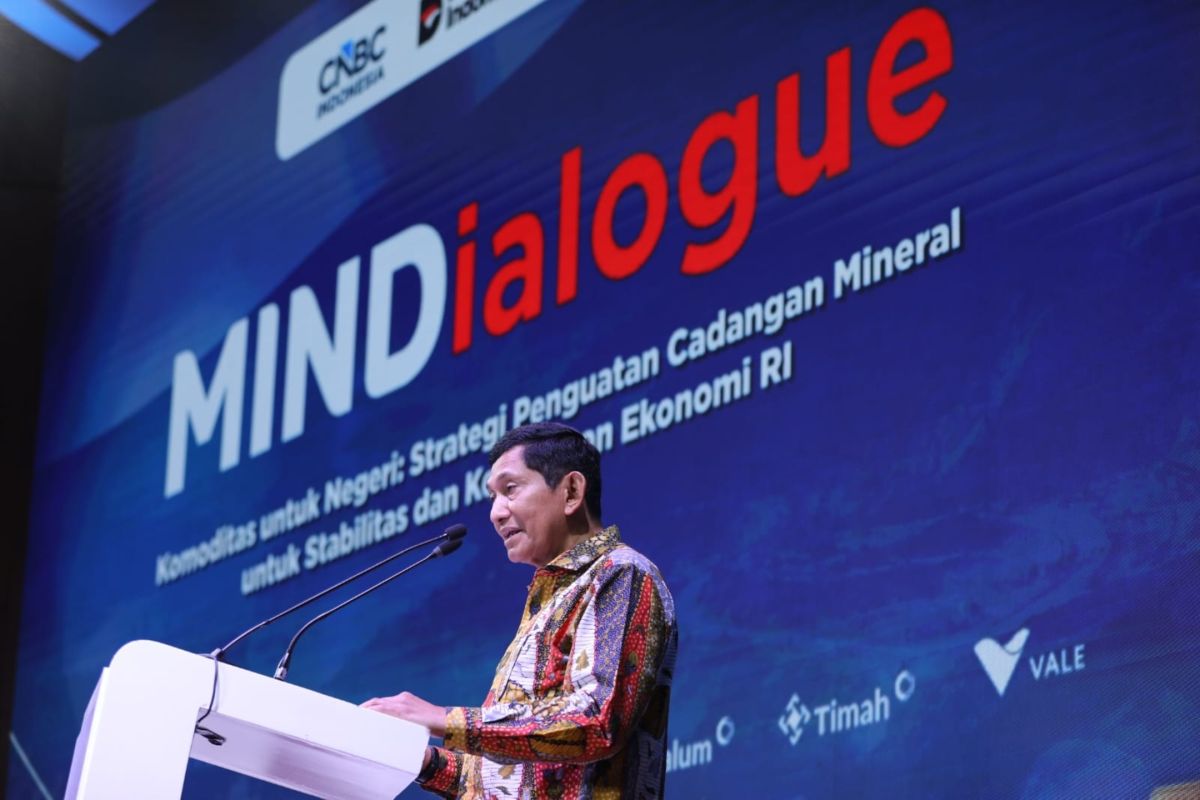
Jakarta (ANTARA) - Indonesia’s mining industry holding company, MIND ID, considers the establishment of a National Mineral Stockpile to be an instrument for safeguarding the availability of industrial raw materials while strengthening the country’s position in managing strategic commodities amid potential global supply chain disruptions.
MIND ID President Director Maroef Sjamsoeddin said the establishment of a national mineral stockpile would allow the government not only to rely on market mechanisms in managing mining products, but also to determine which commodities need to be stored as reserves and the right time to release them to the market.
“There is a weakness with our natural wealth. What if we realise a National Mineral Stockpile so that we can regulate when to release our goods and when to store them,” Maroef said in his statement in Jakarta on Tuesday.
According to him, this approach is relevant because strategic minerals not only have economic value as trade commodities, but also serve as raw materials for various national industries.
He said that with a national reserve, a portion of mineral production could be stored to anticipate changes in market conditions or supply disruptions, so that domestic industrial needs would have a stronger buffer.
Maroef said a similar concept could also be considered for coal. The government could prepare storage systems and facilities so that certain commodities would not have to be entirely released to the market when production is available.
He cited commodity storage mechanisms implemented by several countries as references for Indonesia in designing similar policies.
“We can see how Malaysia controls international CPO because it has a stockpile for when to release and when to store,” he said.
He noted that several countries have also made mineral reserves part of their supply security policies.
South Korea, for example, has a critical mineral stockpiling policy through government agencies, including the Korea Mine Rehabilitation and Mineral Resources Corporation (KOMIR) and the Public Procurement Service (PPS), to anticipate supply chain disruptions.
Japan implements a national storage system for a number of strategic metals through the Japan Organization for Metals and Energy Security (JOGMEC).
The United States also has a National Defense Stockpile as an instrument to safeguard the availability of strategic materials.
These experiences show that mineral reserves do not merely function as commodity storage facilities, but serve as supply buffers when disruptions occur while maintaining the continuity of industrial sectors that require specific minerals.
He assessed that for Indonesia, this idea also needs to be placed within the framework of improving mineral governance from upstream to downstream.
According to him, the country’s large resource wealth must be accompanied by the state’s ability to track production, manage supply, and ensure that minerals provide optimal added value for the national economy.
He cited gold as an example. Antam’s gold production is recorded at around 743 kilograms, or only 0.83 percent of total national production. This means that around 99.17 percent of national gold production comes from companies outside Antam.
The large production volume outside MIND ID member companies demonstrates the importance of building national governance capable of recording and integrating strategic commodity production from various business actors.
Within this framework, the national mineral stockpile could be developed not merely as a storage facility, but as part of a national mineral management system.
He said the government could determine which strategic minerals need to be reserved, which industrial needs must be secured, and the mechanism for releasing reserves when supply is disrupted.
This policy could also strengthen Indonesia’s position, which has long been known as one of the countries with large mineral resources, so that it does not only act as a producer but increasingly has control over the utilisation of its mineral wealth.
He emphasised that mineral resource management must ultimately be directed towards maximising economic benefits domestically and strengthening national self-reliance.
Source: jawawa.id (https://jawawa.id/newsitem/mind-id-national-mineral-stockpile-an-instrument-to-safeguard-raw-materials-1787039862)
Originally published by Antara (Indonesian) (https://www.antaranews.com/berita/5699635/mind-id-national-mineral-stockpile-instrumen-jaga-bahan-baku), translated from Indonesian