
MIND ID and Perminas Collaborate to Build Critical Mineral Supply Chain
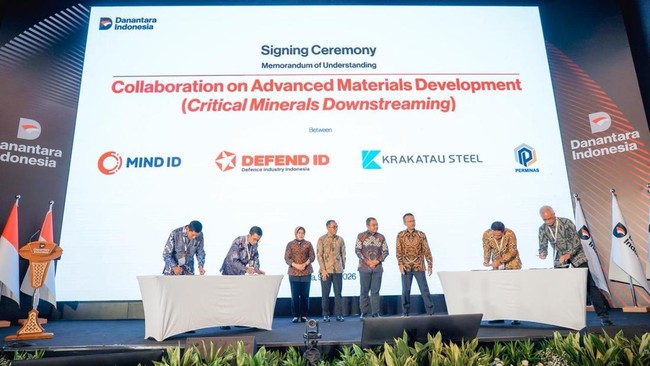
State-owned mining holding MIND ID, together with PT Len Industri, PT Krakatau Steel, and PT Perminas, is collaborating to build a national critical minerals supply chain. This partnership is expected to strengthen the availability of raw materials for strategic industries while increasing the added value of Indonesia’s mineral resources.
CEO of Danantara Indonesia, Rosan Roeslani, stated that Indonesia needs to elevate its position in the global industrial value chain by optimising its mineral wealth. He urged all parties to move further within this industry. According to him, Indonesia is blessed with extraordinary mineral riches, ranging from nickel, bauxite, copper, and tin to rare earth elements. These materials form the foundation of future technologies, such as electric vehicle batteries, semiconductors, defence systems, and clean energy.
“However, for decades we have too often stopped at the extraction point: exporting raw materials, then buying back the finished products at many times the price,” Rosan said, as quoted from a written statement on Wednesday.
This collaboration aims to optimise the supply-offtake chain of critical minerals and advanced materials to meet domestic strategic industrial needs. It is also expected to accelerate the realisation of a large-scale national advanced materials industry through joint technology development, while simultaneously driving high-value-added economic growth through various strategic industrial programmes. The development scope is not limited to national electric cars and motorcycles, but also extends to aerospace, maritime, basic components, defence, and electricity.
Chief Technology Officer of Danantara Indonesia, Sigit P. Santosa, stated that the development of the mid-stream advanced materials industry must be viewed as part of the national industrial transformation. He envisions this transformation leading towards a technology-based economy, high-value-added manufacturing, and mastery of future supply chains.
According to Sigit, Indonesia must be able to capture regional demand opportunities, build technological capabilities, and compete in the global market to achieve sustainable economies of scale. Therefore, the development of the advanced materials industry needs to be directed in a more integrated manner as a foundation to strengthen the competitiveness of national industry. He noted that Indonesia’s strength lies not only in the availability of minerals, but in the ability to transform them into an advanced materials industrial ecosystem that supports batteries, clean energy, defence, transportation, and various future strategic technologies.
“Nickel remains one of the important advantages, but the larger agenda is to build a broader, high-value-added, and globally competitive industrial capacity,” Sigit said.