
Millions of Indonesia's Middle Class Fall into Poverty, Is Gallon Water to Blame?
Millions of Indonesia’s middle-class citizens are reportedly experiencing a decline in economic status. This trend was identified in a Mandiri Institute report titled ‘Demographic Insights: Middle Class Dynamics in 2025’, released in February 2026.
According to the report, the middle-class population shrank by 1.2 million people, falling from 47.9 million in 2024 to 46.7 million over the past year. Consequently, the proportion of the middle class relative to the total population eroded from 17.1 per cent in 2024 to 16.6 per cent in 2025.
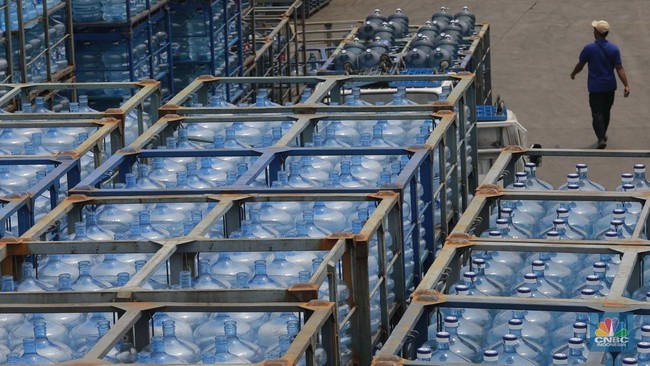
Does the consumption of bottled water drive people into poverty? Senior economist and former Finance Minister, Bambang Brodjonegoro, stated that the decline in Indonesia’s middle-class economic level is not solely due to the Covid-19 pandemic and widespread layoffs. It is also caused by daily habits regarding the need for packaged water, such as gallon-sized bottles.
“For a long time, we have unconsciously eroded our income quite significantly through our lifestyle of relying on gallon water, bottled water, and various others,” Bambang said at the Indonesian Chamber of Commerce and Industry (Kadin) office recently.
The former Minister of National Development Planning (PPN)/Head of Bappertnas under President Joko Widodo’s administration emphasised that the habit of consuming packaged water is not universal. In developed nations, for instance, the middle class is accustomed to drinking water provided by the government in public spaces. With these mass drinking water facilities available, citizens in developed countries do not need to spend money on drinking water.
“Their middle-class purchasing power remains secure because they do not need to spend too much even for water,” he said.
Nevertheless, Bambang noted that the cost of drinking water is just one of many factors causing the middle class to drop into a lower economic tier. He suspects the primary factor for the decline of the Indonesian middle class was the Covid-19 pandemic.
“The causes are varied. If we look at the data from 2019 to 2023, the primary cause was Covid,” he stated. During the pandemic, many middle-class individuals lost their jobs, while others faced business bankruptcies. “Do not forget that Covid lasted for two years, during which middle-class members lost employment and others saw their businesses cease or go bankrupt.”
Unfortunately, he added, after the pandemic subsided, the public was hit by other problems, such as high interest rates. The rise in interest rates, he noted, inevitably impacted the economy.
“I see it as a combination that began with Covid, then was prolonged by high interest rates, a weakening exchange rate, and the rising cost of goods,” he said.
In addition to high interest rates, Bambang stated that the middle class’s efforts to recover from Covid-19 were further hindered by rising rice prices due to the El Niño effect. Although general inflation remains stable, Bambang noted that the increase in rice prices has reduced middle-class purchasing power.
“That combination is what has caused part of the middle class to fall into the ‘aspiring middle class’ category,” he said.
Bambang also warned that the phenomenon of online gambling significantly affects an individual’s economic condition due to its highly addictive nature. According to him, this activity drains people’s finances very quickly. “Because it is addictive, it can deplete our income very rapidly,” he concluded.