
Military Spending Surges, Is Japan Beginning to Leave Its Era of Peace?
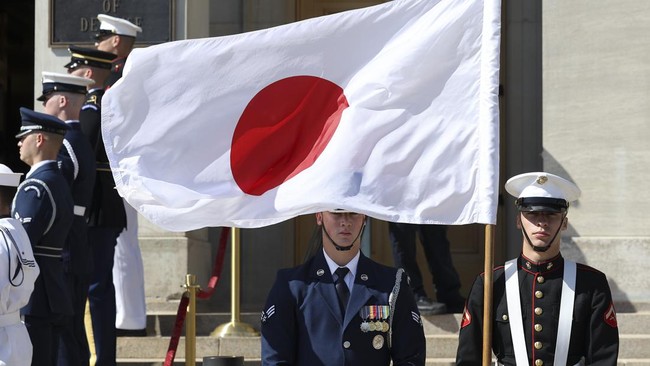
Jakarta, CNBC Indonesia — Japan has been known for decades as a major economic power in Asia. After World War II, Tokyo’s influence was largely built through trade, investment, development aid, technology, and popular culture.
However, Japan’s face is now slowly changing. Tokyo is no longer relying solely on economic strength and diplomacy but is also beginning to strengthen its military role.
This change is occurring as the security situation in the region becomes increasingly complex.
China continues to expand its military power, particularly in the East China Sea and South China Sea. North Korea remains a threat through its nuclear and missile programmes. Meanwhile, the Russia-Ukraine war demonstrates that major inter-state conflicts can still occur in the modern era.
Another factor comes from the United States (US). Under the Trump 2.0 era, Washington’s allies are being urged to shoulder a greater defence burden. Japan is one of the countries facing this pressure.
Nevertheless, Japan is not moving abruptly. This change is being done gradually because Tokyo still carries its post-war identity as a peace-loving nation.
However, the need to strengthen defence capabilities is now increasingly difficult to avoid.
Defence Spending Rises, Japan Prepares Long-Range Missiles
Japan’s shift in security direction is becoming increasingly evident as Tokyo promotes the concept of a Free and Open Indo-Pacific. This concept was first championed by former Prime Minister Shinzo Abe and emphasises the importance of an Indo-Pacific region that is free, open, and not dominated by a single major power.
In 2014, Japan also reinterpreted its constitution. This step allows the Japan Self-Defence Force (JSDF) to participate in collective defence missions if Japan’s allies are attacked.
The next major change occurred in 2022, when Japan released its National Security Strategy and National Defence Strategy. These two documents state that Japan’s security environment is the most severe and complex since the end of World War II.
Tokyo also affirms that it will not tolerate unilateral changes to the status quo by military force.
For that reason, Japan is beginning to strengthen its defence capabilities more seriously. One important step is the development of counter-strike capabilities. Japan is purchasing Tomahawk cruise missiles from the United States and developing its own long-range missiles.
In terms of budget, Japan is also increasing defence spending. For years, Japan’s defence spending has been around 1% of gross domestic product (GDP). Now, Tokyo is targeting defence spending to rise to 2% of GDP.
Under the Sanae Takaichi administration, this target is even being accelerated to fiscal year 2025. Takaichi is known as a successor to Shinzo Abe’s policy line and is expected to accelerate Japan’s security policy changes.
Her government is also pushing for the establishment of a national intelligence agency and plans to revise rules on the transfer of defence equipment and technology in 2026. If these rules are relaxed, Japan could more freely export weapons and expand its defence industry production.
Data in the report also shows that Japan’s arms imports surged 155% from 2019 to 2023. With this increase, Japan has become the world’s sixth largest arms importer.
Southeast Asia Increasingly Invited to Cooperate
Japan’s strengthening of its military role is also evident in Southeast Asia. Tokyo is becoming more active in building defence cooperation with countries in the region, particularly in the maritime sector.
According to the Lowy Institute Asia Power Index 2024, Japan’s biggest increase is seen in its defence network. Japan’s activities with the United States and other regional partners have significantly boosted its defence score.
Meanwhile, according to the Lowy Institute’s Southeast Asia Influence Index, Japan’s position as a defence partner for Southeast Asia has risen sharply from 15th place in 2017 to 4th place in 2025.
Japan’s defence cooperation is quite strong with several countries, particularly the Philippines, Vietnam, Indonesia, Malaysia, and Cambodia. Japan’s military exercises with Southeast Asian countries have also increased since 2014.
Indonesia is one of the countries frequently involved. The largest portion of Japan’s military exercises in the region is recorded with Indonesia, at 18.8%. After that, there is the Philippines at 18.2%, Singapore at 17.7%, and Malaysia at 16.6%.
The presence of Japan Maritime Self-Defence Force (JMSDF) ships in Southeast Asian ports is also becoming more routine. This shows that Japan is increasingly active in building direct defence relations with countries in the region.
In addition to military exercises, Japan is also using a new instrument called Official Security Assistance (OSA). This programme was launched in 2022 and allows Japan to provide non-lethal defence equipment to partner countries.
The Philippines is one of the biggest beneficiaries. Manila has received rigid-hulled inflatable boats, coastal radars, and aerial surveillance equipment to strengthen its maritime monitoring capabilities.
Japan-Philippines cooperation is also becoming closer through 2+2 dialogues between the defence and foreign ministries of both countries. In addition, the Japan-Philippines Reciprocal Access Agreement (RAA) will take effect in 2025.
Malaysia has also received assistance through OSA in the form of rescue ships to support monitoring and surveillance missions.
Japan Aims for a Larger Role in Global Defence
Outside Southeast Asia, Japan is also expanding defence cooperation with many partners. Tokyo is involved in the Global Combat Air Programme (GCAP) with the UK and Italy to develop a sixth-generation fighter jet targeted to start operating in 2035.
In 2025, Australia selected Japan’s Mitsubishi Heavy Industries to build 11 Mogami-class frigates worth US$6.5 billion. This agreement is one of the major defence contracts.
Source: jawawa.id (https://jawawa.id/newsitem/military-spending-surges-is-japan-beginning-to-leave-its-era-of-peace-1778781522)
Originally published by CNBC Indonesia (https://www.cnbcindonesia.com/research/20260513161108-128-734798/belanja-militer-melonjak-jepang-mulai-tinggalkan-era-damai), translated from Indonesian