
Military Prosecutor Responds to Andrie Yunus's Vote of No Confidence: The People Will Judge
JAKARTA, KOMPAS.com - Colonel Chk Andri Wijaya, head of the Military Prosecutor’s Office II-07 Jakarta, responded to the vote of no confidence from KontraS activist Andrie Yunus, a victim of an acid attack, regarding the handling of his case if tried in a military court.
“We cannot prevent a citizen from liking or disliking the TNI institution; it is the public or the people who will judge it,” said Andri Wijaya when contacted by Kompas.com on Sunday (12/4/2026).
Andri Wijaya stated that the TNI carries out its primary duties to protect all Indonesian blood, safeguard the sovereignty of the Indonesian people/nation, and maintain the integrity of the Unitary Republic of Indonesia’s territory.
“And the Military Court is one part of the TNI’s mechanisms to enforce the law so that the TNI is not disrupted or can continue to carry out its primary duties well and in a balanced manner,” he emphasised.
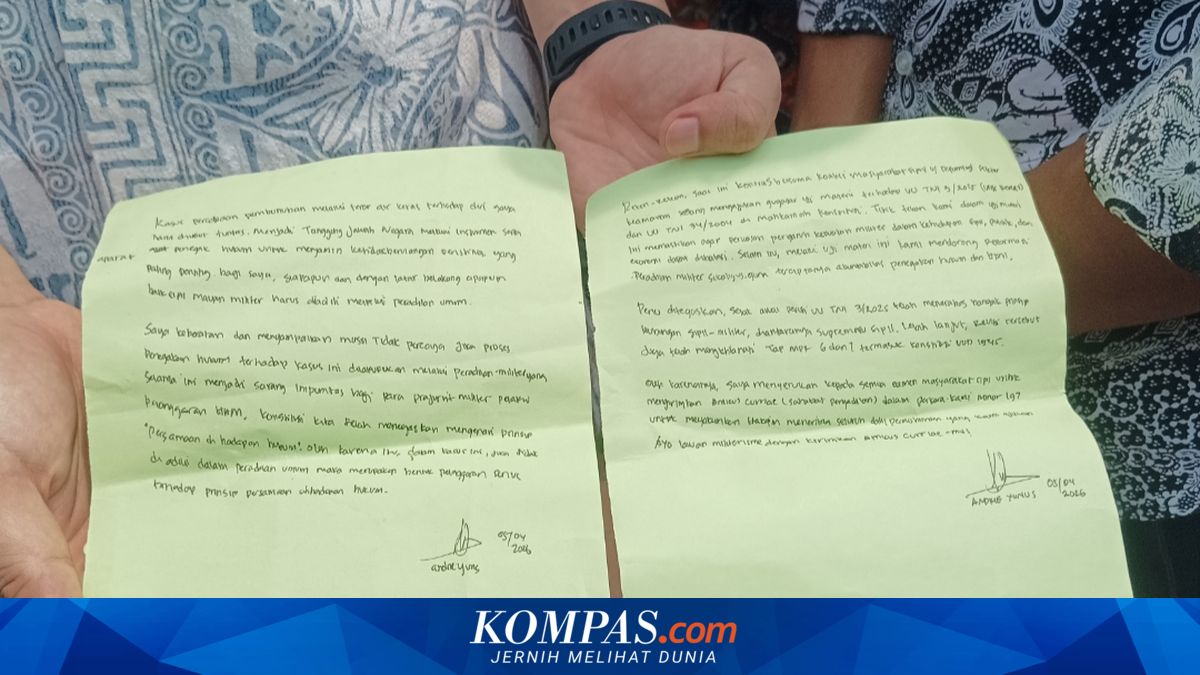
Deputy Coordinator of KontraS, Andrie Yunus, sent a letter to the Constitutional Court (MK), specifically to the judges hearing the judicial review of the TNI Law.
The letter was read during a civil society solidarity action in front of the MK building on Wednesday (8/4/2026) by Hussein Ahmad, Deputy Director of Imparsial.
In the opening of the letter, Andrie stated that the attempted murder case through the acid terror against him must be thoroughly investigated.
“The most important thing for me is that whoever and whatever their background, whether civilian or military, must be tried through the general court,” wrote Andrie Yunus.
“I object and express a vote of no confidence if the law enforcement process for this case is carried out through the military court,” he emphasised.
Andrie said that so far, military courts have been a nest of impunity for soldiers who commit human rights violations.
Moreover, Indonesia’s current constitution affirms the principle of equality before the law.
“Therefore, in this case, if it is not tried in the general court, it would constitute a serious violation of the principle of equality before the law,” Andrie concluded.