
Military Power Map of 15 Middle Eastern Countries in 2026: Who is the Strongest?
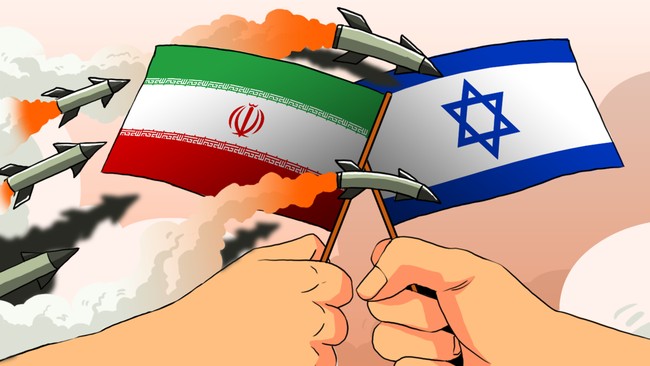
The Middle East entered August 2026 amidst an expanding theatre of war. Battles are no longer confined to Gaza and Lebanon but have spread to Iran, Iraq, the Gulf states, and major global shipping lanes.
On Saturday (1/8/2026), a tanker was reported to have been struck by an unidentified projectile approximately 11 nautical miles northeast of Lima, Oman. The attack damaged the engine room, leaving the vessel unsteerable, though no casualties or environmental impacts were reported. The location of the attack is near the entrance to the Strait of Hormuz, a narrow passage connecting the Persian Gulf to the Gulf of Oman. This strait is a critical energy artery, normally handling approximately one-fifth of the world’s energy shipments.
The incident occurred a day after Iran claimed to have intercepted two ships attempting to exit the Strait of Hormuz and forced four other tankers to turn back. These claims have not yet been independently verified.
Maritime tensions are part of the ongoing conflict between the United States (US)-Israel and Iran, which has persisted since 28 February 2026. The US and Israel have launched strikes against Iran, while Tehran has retaliated by targeting Israel and US military bases in Gulf nations. Tensions escalated further in July following the collapse of a temporary ceasefire agreement.
On 29 July 2026, US military forces conducted a two-hour strike against dozens of Islamic Revolutionary Guard Corps (IRGC) facilities, including command centres, missile and drone facilities, coastal defences, and Iranian maritime capabilities. Iran subsequently attacked US military facilities in Kuwait and Bahrain on Friday (31/7/2026). Kuwait stated it successfully intercepted several drones, though debris caused some damage.
The conflict has also expanded into Saudi Arabia and Iraq. The Houthi group in Yemen announced a maritime embargo against Saudi Arabia on 20 July 2026, alongside attacks on Saudi tankers and infrastructure. By late July, the US and Saudi Arabia launched joint strikes against pro-Iranian militant locations in Iraq, following attacks on oil facilities in eastern Saudi Arabia.
List of Major Middle Eastern Wars:
Arab-Israeli Wars: Occurred in 1948, 1956, 1967, and 1973, involving significant territorial shifts and regional power struggles.
Iran-Iraq War: A conflict from 1980-1988 driven by territorial disputes and regional rivalry, resulting in hundreds of thousands of casualties.
Gulf War: Initiated by Iraq’s invasion of Kuwait in 1990, leading to the US-led Operation Desert Storm in 1991.
Iraq War: The 2003 US-led invasion toppled Saddam Hussein, leading to a power vacuum and the rise of ISIS.
Syrian Civil War: Began in 2011; while the Assad regime fell in December 2024, the nation still faces sectarian violence and Israeli incursions.
Yemen War: Started in 2014 with Houthi control of Sanaa; recent Houthi attacks in the Red Sea have heightened regional risks.
Israel-Hamas War (Gaza): Triggered by the 7 October 2023 attacks; despite a new roadmap announced by US President Donald Trump in late July 2026, fighting continues.
Israel-Hezbollah War (Lebanon): Broke out on 2 March 2026, involving significant Israeli ground and air operations in southern Lebanon.
US-Israel and Iran War: Direct conflict initiated on 28 February 2026.