
Military Judges: No Intelligence Operation Behind Andrie Yunus Attack
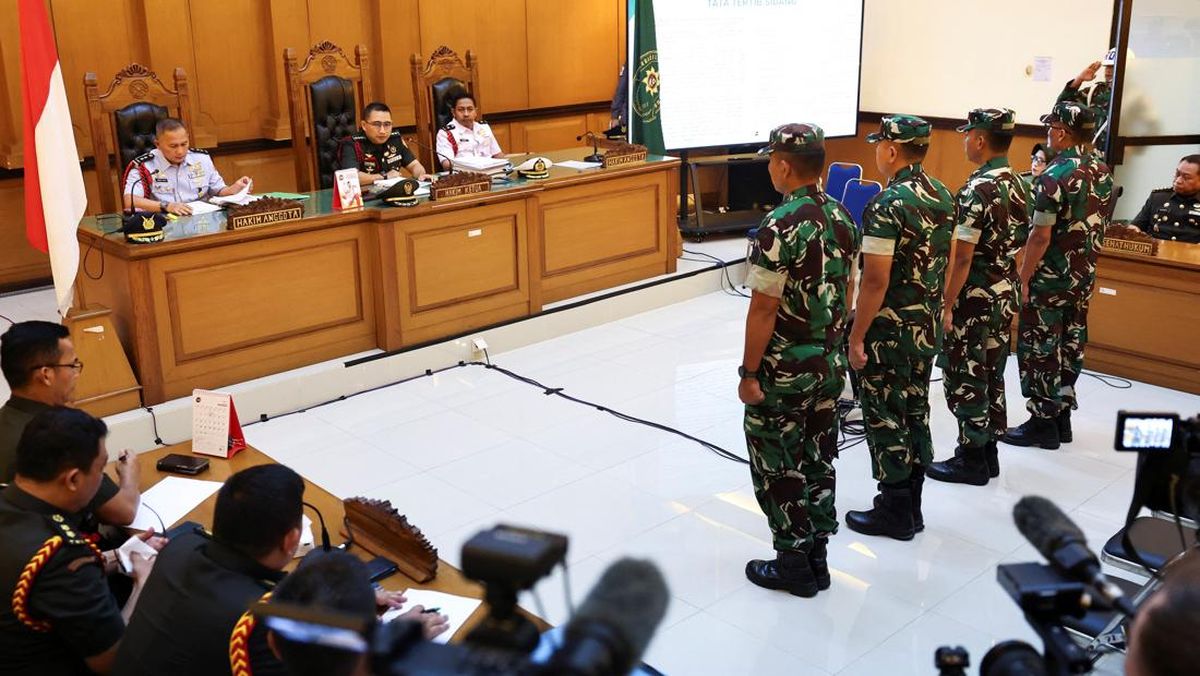
The panel of judges at the Jakarta Military Court II-08 concluded there was no intelligence operation behind the acid attack on the Deputy Coordinator for External Affairs of KontraS, Andrie Yunus, carried out by four members of the Indonesian Armed Forces (TNI) Strategic Intelligence Agency (BAIS) Detachment Headquarters. Based on legal facts revealed during the trial, the judges stated that the defendants carried out the acid attack because they were resentful of Andrie’s actions in interrupting a meeting discussing the TNI Law at the Fairmont Hotel in March 2025 and intended to teach him a lesson. Standing as defendants are Defendant I Second Sergeant Edi Sudarko, Defendant II First Lieutenant Budhi Hariyanto Widhi, Defendant III Captain Nandala Dwi Prasetyo, and Defendant IV First Lieutenant Sami Lakka. ‘It is true that the perpetrators, who emotionally did not know the victim but harboured resentment and ill will towards him, fall under the theory of vicarious trauma,’ said member judge Major Laut M. Zainal Abidin during the verdict hearing in the Garuda courtroom at the Military Court II-08 Jakarta on Wednesday (10/6). Vicarious trauma is a condition of stress or emotional trauma that arises from frequently hearing, seeing, or being exposed to the traumatic stories and experiences of others. The judge explained that an intelligence operation is not a spontaneous act but is designed systematically and based on strategic state objectives. An intelligence operation, the judge clarified, is not built upon personal anger but upon calculations of state interest. ‘It is true that in military intelligence doctrine, an intelligence operation is not a spontaneous, emotional act, let alone one carried out by individuals without a command structure. A military intelligence operation is an activity designed systematically, with tiers, measurably, and based on strategic state objectives,’ the judge stated. ‘It is true that in the intelligence world there is an important principle that intelligence is a state tool, not a tool of emotion. Strategic intelligence operations are not built on personal anger, but on calculations of state interest,’ he continued. On that basis, the judge considered that to label an act as an official intelligence operation, it should be provable by the presence of strategic state objectives, orders or authorisation, a command structure, operational planning, operational system support, execution control, an evaluation mechanism, and accountability. If these elements are not met, then it is difficult to name an act as an official military intelligence operation. ‘Without these elements, it is very difficult professionally and doctrinally to call an act an official military intelligence operation,’ the judge said. In this case, the judge also referred to the testimony of strategic intelligence expert, retired Rear Admiral Soleman B. Ponto, presented in court. The judge noted the expert stated that if an act displays personal emotion and disorderliness, it is an indicator that it is not an official intelligence operation of an institution. ‘The panel of judges in this matter bases its finding on that expert opinion, asserting and believing that these acts of the defendants had no connection to the involvement of a command structure,’ the judge said. The judges handed down prison sentences to the four defendants in this case. Defendant I Second Sergeant Edi Sudarko was sentenced to 3 years in prison; Defendant II First Lieutenant Budhi Hariyanto Widhi was sentenced to 2 years and 6 months in prison; Defendant III Captain Nandala Dwi Prasetyo was sentenced to 2 years in prison; and Defendant IV First Lieutenant Sami Lakka was sentenced to 1 year and 6 months in prison. Defendant I and Defendant II acted as executors or the ones who threw the acid on Andrie. The judges considered the degree of fault and the quality of the actions of Defendant III and Defendant IV, thus imposing lighter sentences, even though their ranks were higher than the other two defendants. Furthermore, the judges also handed down additional punishments to Defendant I and Defendant II in the form of a dishonourable discharge from military service. ‘Ordered for the defendants to remain detained,’ the judge stated. The defendants were proven to have violated Article 467 paragraph 1 in conjunction with paragraph 2 in conjunction with Article 20 letter C of Law Number 1 of 2023 concerning the Criminal Code. The article regulates premeditated assault, carrying a maximum prison sentence of 4 years (paragraph 1) and 7 years (paragraph 2). The verdict is not yet legally binding as the military prosecutor and the defendants stated they would utilise the 7-day period for consideration. The case was examined and tried by the panel’s chief judge Colonel Chk Fredy Ferdian Isnartanto with members Major Laut M. Zainal Abidin and Lieutenant Colonel Kum Irwan Tasri. The clerk was First Lieutenant Chk Rekika Bangun. Meanwhile, the military prosecutor was represented by Major Chk Mohammad Iswadi and colleagues.