
Middle East Tensions Rise: Asian Currencies Under Pressure, Rupiah Weakens
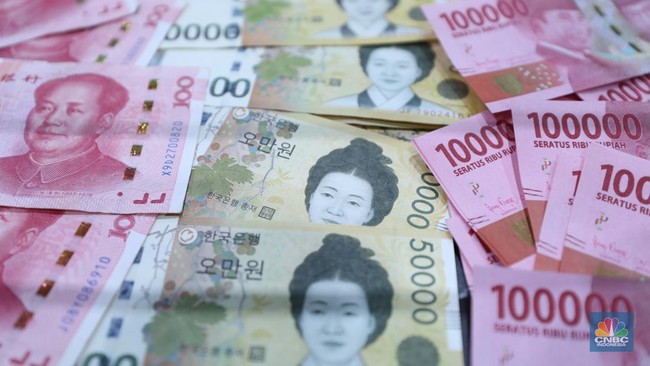
Most Asian currencies weakened against the US Dollar in Wednesday’s trading. The strengthening US Dollar is exerting pressure on other nations’ currencies, alongside intensifying conflict in the Middle East and growing expectations for interest rate hikes by the US Federal Reserve.
According to Refinitiv data, eight out of ten Asian currencies were observed to be weaker against the US Dollar, while one strengthened and another remained stagnant. The Philippine Peso faced the deepest pressure in Asia this morning, correcting 0.35% to PHP 62.622/US$.
The Indonesian Rupiah followed as the next deepest-weakening currency, declining 0.28% to Rp17,760/US.TheThaiBahtalsocorrected0.15, followed by the Malaysian Ringgit, which fell 0.14% to MYR 4.042/US$.
The Japanese Yen weakened by 0.09% to JPY 160.32/US, theSingaporeDollarfell0.05, the Chinese Yuan weakened 0.03% to CNY 6.7227/US, andtheTaiwanDollarcorrected0.02.
On the other hand, the South Korean Won was the only Asian currency to strengthen this morning, rising 0.19% to KRW 1,370.4/US, whiletheIndianRupeeremainedstagnantatINR94.95/US.
The decline in most Asian currencies occurred as the US Dollar regained strength. The US Dollar Index (DXY), which measures the greenback’s strength against six major world currencies, was observed at 99.788, a 0.11% increase, continuing a 0.25% rise from the previous trading session.
The strengthening of the US Dollar follows renewed tensions in the Middle East. The US launched airstrikes against Iran on Tuesday, which were subsequently met with retaliation from Iran. This escalation represents the most serious development in recent weeks.
These conditions have pushed global oil prices higher, triggering inflation concerns. Brent crude rose 0.92% to US$95.52 per barrel, while the benchmark West Texas Intermediate (WTI) rose 0.89% to US$91.02 per barrel.
“It is necessary to remain vigilant regarding the situation in the Middle East today,” said Kumiko Ishikawa, senior FX analyst at Sony Financial Group, as quoted by Reuters.
The US Dollar is receiving support from demand for safe-haven assets. Additionally, the rise in US government bond yields has further strengthened the greenback’s position. The 10-year US Treasury yield moved up to 4.8%. This rise in yields makes US Dollar-based assets more attractive, while simultaneously putting pressure on risky assets, including emerging market currencies.
The situation is further exacerbated by rising expectations for a Federal Reserve rate hike. Market participants now estimate the probability of a Fed rate hike in September at 67%, up from approximately 40% the previous week, according to CME FedWatch.
These rising expectations are still influenced by the speech by Fed Chair Kevin Warsh at Jackson Hole last week. Warsh signalled that the Fed could still raise interest rates if inflation does not decline more quickly towards the 2% target.
US economic data released last night was actually weaker than expected. Both the July JOLTS job openings and the August ISM manufacturing index were below market expectations. However, the impact of this weak economic data was offset by the re-escalation of tensions in the Middle East.
“Regarding US data, it should be noted that if the figures are weak, the impact can be balanced by increasing tensions in the Middle East,” said Ishikawa.
The market is now awaiting US employment data this Friday. The report is expected to show that the US economy added 56,000 jobs in August, based on the median estimate from economists compiled by Reuters.
Source: jawawa.id (https://jawawa.id/newsitem/middle-east-tensions-rise-asian-currencies-under-pressure-rupiah-weakens-1788321418)
Originally published by CNBC Indonesia (https://www.cnbcindonesia.com/research/20260902092511-128-764240/timur-tengah-panas-lagi-asia-kebakaran-rupiah-cs-ambruk), translated from Indonesian