
Middle East Conflict Paralyzes Strait of Hormuz, Alternative Routes Not Yet Ready
JAKARTA — The conflict between the United States (US) and Israel with Iran, which has intensified since the beginning of this year, is starting to have a significant impact on global energy trade flows.
One of the crucial points affected is the Strait of Hormuz, a narrow route that has long been the lifeline for world oil shipments.
Disruptions to shipping traffic in the Strait of Hormuz highlight the limitations of the Middle East region in finding alternative routes for exporting oil and gas.
The agency states that its impact exceeds two major previous events, namely the 1970s oil crisis and the disruption of Russian pipeline gas supplies after Moscow’s invasion of Ukraine.
“This is the largest recorded supply disruption, larger than the 1970s oil crisis and the simultaneous loss of Russian pipeline gas supplies,” the IEA wrote in its latest oil market report.
This situation is drawing global attention to available or still-planned alternative routes to avoid dependence on the Strait of Hormuz.
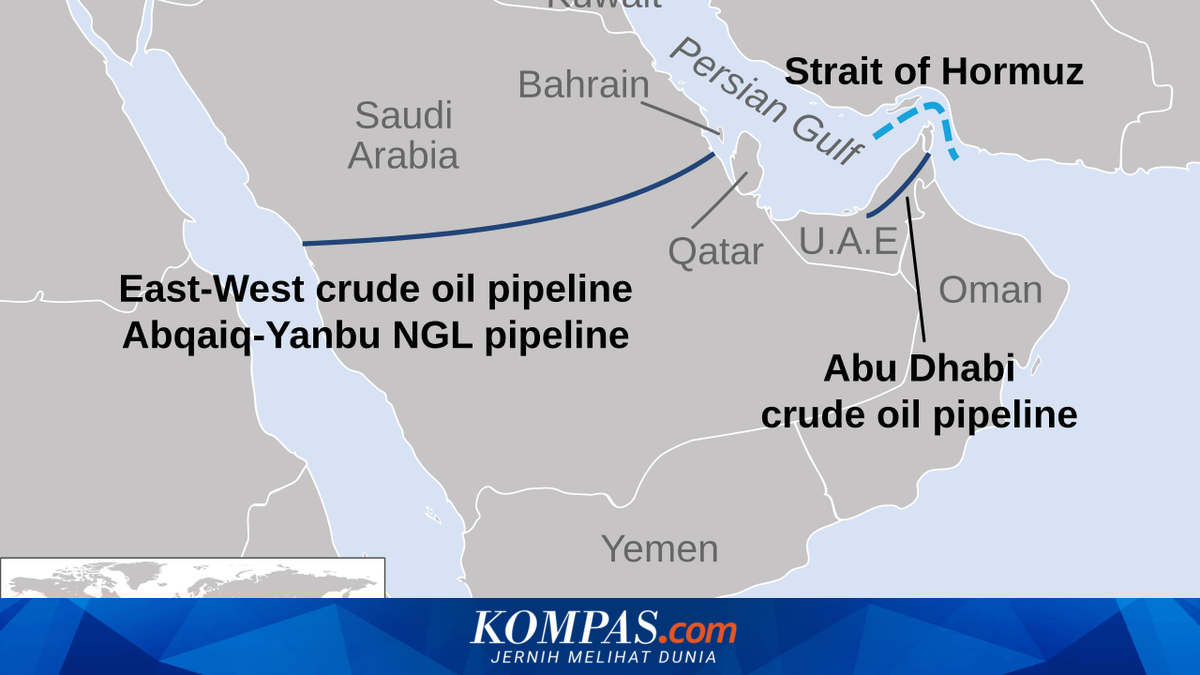
Quoted from Reuters on Wednesday (22/4/2026), one of the main routes is the East-West Pipeline in Saudi Arabia. This 1,200-kilometre pipeline can transport up to 7 million barrels per day (bpd) of crude oil to the port of Yanbu on the Red Sea.
However, its effective export capacity is estimated at only around 4.5 million bpd, depending on the availability of tanker ships and port facilities.
From Yanbu, oil shipments can be made to Europe via the Suez Canal or to Asia via the southern route passing through the Bab el-Mandeb Strait.
Another alternative is owned by the United Arab Emirates through the Habshan-Fujairah Pipeline or Abu Dhabi Crude Oil Pipeline (ADCOP).
This 360-kilometre pipeline connects the onshore Habshan oil fields to the port of Fujairah in the Gulf of Oman, which is outside the Strait of Hormuz.
Operated by ADNOC and operational since 2012, this pipeline has a capacity of around 1.5 to 1.8 million bpd. However, since the conflict with Iran heated up at the end of February 2026, oil loading activities in Fujairah have also been affected by drone attacks.