
Middle East Conflict Escalates, Asian Markets Plunge
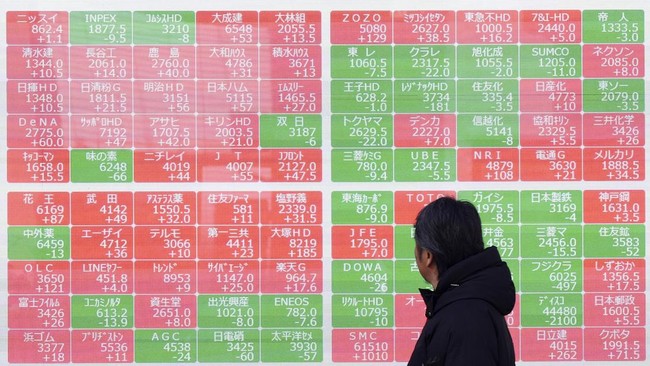
Asia-Pacific stock markets weakened during trading on Monday (18/5/2026) amid growing investor concerns regarding the escalation of geopolitical conflict in the Middle East.
According to CNBC, market sentiment deteriorated after US President Donald Trump warned Iran to ‘act quickly’, sparking fears of disruptions to the global oil supply. In a post on Truth Social on Sunday local time, Trump stated that ‘the clock is ticking’ for Iran and warned that ‘nothing will be left’ if immediate action is not taken. Trump also emphasised that ‘time is of the essence!’, though he did not specify the actions required from Tehran or the potential consequences.
The rise in geopolitical tension immediately drove a surge in global oil prices by more than 1%. Brent crude futures for July rose 1.34% to US$110.72 per barrel, while West Texas Intermediate (WTI) June contracts strengthened by 1.75% to US$107.26 per barrel.
The majority of Asian exchanges moved into the red. Australia’s S&P/ASX 200 fell 0.76%, while Japan’s Nikkei 2D5 weakened by 0.2%, though the Topix saw a slight increase of 0.1%. In South Korea, the Kospi and Kosdaq indices plummeted by more than 2%. Meanwhile, the yield on the 10-year Japanese government bond surged by more than 8 basis points to 2.785%, extending the global bond sell-off amid rising inflation concerns.
Hang Seng index futures in Hong Kong stood at 25,733, lower than the previous close of 25,962.73. Investors continue to monitor the high tensions between Washington and Tehran, despite a fragile ceasefire established in early April. The United States is reported to be continuing its blockade of Iranian ports, while Iran has kept the Strait of Hormuz closed since the conflict began, heightening market fears regarding the disruption of global energy distribution routes.
Conversely, US stock index futures tended to move sideways following last week’s strong rally. Market participants are now awaiting quarterly earnings reports from Nvidia and several major US retailers. Dow Jones Industrial Average futures fell 100 points or 0.2%, while S&P 500 and Nasdaq-100 futures remained flat. In Friday’s trading, Wall Street closed lower due to pressure on technology stocks and rising US bond yields. The S&P 500 index corrected 1.24% to 7,408.50, while the Nasdaq Composite dropped 1.54% to 26,225.14. The Dow Jones Industrial Average also weakened by 537.29 points or 1.07% to 49,526.17.
Profit-taking in technology stocks also weighed on the market following recent sharp rallies. Intel shares fell by more than 6%, while Advanced Micro Devices and Micron Technology dropped by 5.7% and 6.6%, respectively. Nvidia shares also corrected by 4.4%, while Cerebras Systems plummeted 10% after previously surging 68% on Thursday following its Nasdaq debut. This decline in tech stocks underscores investor concerns regarding high valuations in the AI sector amidst global uncertainty.