
Middle-Class Economy Under Pressure, 2026 Sacrificial Animal Buyers Predicted to Switch to Cheaper Livestock
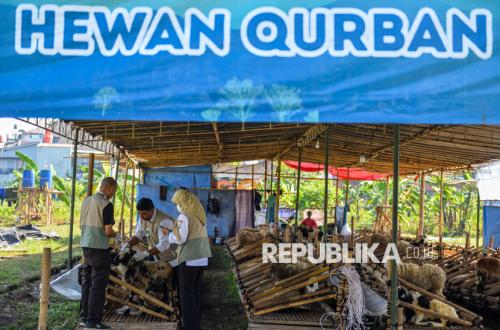
The Institute for Demographic and Affluence Studies (IDEAS) explains that the current economic situation, marked by rising food prices, living costs, and pressure on real household incomes, is making society more selective in allocating expenditures, including in choosing sacrificial animals. Although the sacrificial worship maintains strong social resilience, participation patterns are beginning to change in line with society’s economic capacity.
IDEAS researcher Tira Mutiara stated that the potential national sacrificial economy in 2026 is projected to reach Rp 26.89 trillion, with a total of around 1.90 million sacrificial households. From this number, the total sacrificial animals are estimated to reach 1.59 million heads, with a potential meat distribution of around 99,290 tonnes.
This estimate is calculated using an approach based on the number of Muslims with expenditure levels above five times the district/city poverty line as a proxy for the group of society with the economic capacity to perform the sacrifice. The calculation also considers preferences for animal types and sacrificial weights, ranging from whole cows of 750 kg, 500 kg, 250 kg, joint schemes of 1/7 cow, to goats and sheep in weight categories of 80 kg, 60 kg, 40 kg, and 20 kg.
“Meanwhile, the meat potential is calculated based on the effective carcass estimate, namely 57 per cent for cows and 41 per cent for goats/sheep, with the assumption that 75 per cent of the meat is ready for distribution to the community,” said Tira to Republika on Wednesday (13/5/2026).
She said that although the value is still large, the 2026 projection shows a weakening compared to 2025, which reached Rp 27.10 trillion. This decline is mainly caused by a reduction in the number of sacrificial households and a decrease in society’s preference for large-weight sacrificial animals.
Based on simulations of animal weights, almost all categories experienced a decline, particularly in whole cows and premium goats with high weights. Only the 40 kg and 20 kg goat/sheep categories showed an increase.
“This pattern indicates a change in society’s consumption behaviour in performing the sacrifice. Society is still striving to maintain the sacrificial worship but tends to choose animals with more affordable prices,” said Tira.