
Microsoft: Indonesia's Advanced AI Users Surpass Global Average
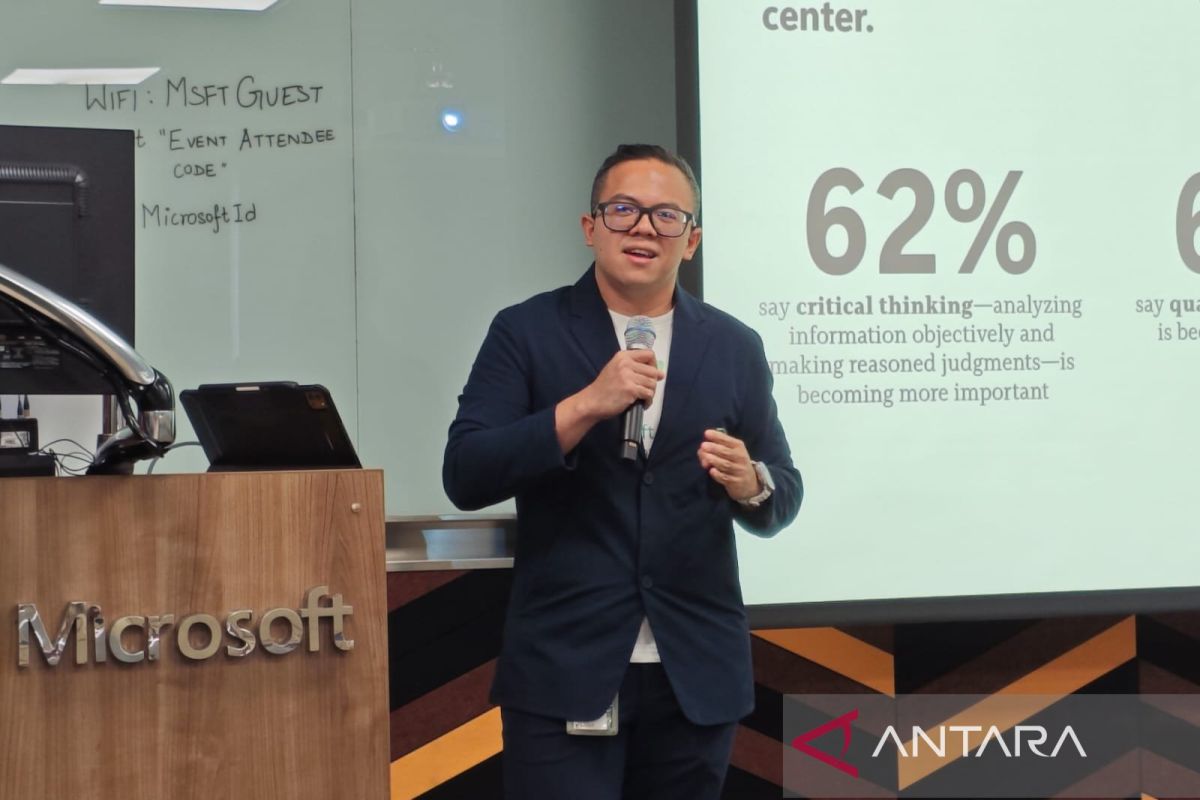
Jakarta (ANTARA) - Microsoft’s Work Trend Index (WTI) 2026 report reveals that 33 per cent of workers using artificial intelligence (AI) in Indonesia fall into the category of ‘frontier professionals’, or users who utilise AI in a more mature manner.
Senior Cloud and AI Platform GTM at Microsoft ASEAN Fiki Setiyono explained during a press conference in Jakarta on Tuesday that Indonesian AI workers not only use the technology to help complete complex tasks but also create new ways of working with AI support without fully surrendering the decision-making process to the technology.
‘Instead, they use their critical thinking abilities to get the best results from the AI agent’s capabilities, expanding their way of thinking and their thinking capacity,’ Fiki said.
Based on the research, 82 per cent of respondents in Indonesia claimed they were able to complete work that was previously considered difficult or even impossible. This figure is significantly higher than the global average of 58 per cent.
Furthermore, 74 per cent of respondents stated they habitually determine in advance which tasks will be handed over to AI before starting work. Meanwhile, 38 per cent of respondents said they still complete some work independently without AI assistance to keep their skills sharp, a percentage higher than the 28 per cent recorded among non-frontier users in Indonesia.
Microsoft also found that AI usage among frontier professionals is no longer limited to giving commands or prompts to chatbots. Fiki explained there are four main patterns in AI utilisation: delegation, collaboration, inquiry, and exploration.
In the delegation stage, users hand over part of the task execution to an AI agent. In collaboration, AI is used as a partner to assist in the analysis and decision-making process. AI is also utilised as a research tool to search for information through a question-and-answer process, as well as an exploration partner when facing increasingly complex problems.
Despite this, Fiki stressed that the main characteristic of frontier professionals is not just the ability to utilise these various AI functions, but also the willingness to remain responsible for the final results produced.
‘So frontier professionals, besides utilising AI with the available tools, still position themselves as responsible for the results and their impact,’ Fiki said.
Additionally, 60 per cent of respondents mentioned that the quality control process for AI-generated results is becoming increasingly crucial as the complexity of tasks delegated to AI agents grows. Other findings show that 93 per cent of AI users in Indonesia consider the results provided by AI only as a starting point, not a final decision.
‘AI users in Indonesia still place human judgement as the centre of their decisions on how they will use AI agents,’ Fiki said. He assessed that this approach is one of the key differentiators between merely adopting AI and achieving maturity in its utilisation. ‘One differentiator between AI adoption and maturity in using AI is a mindset that places human judgement as still playing an important, even critical, role.’