
Meutya Hafid Urges US Technology Investment, Focusing on AI and Indonesian Digital Talent
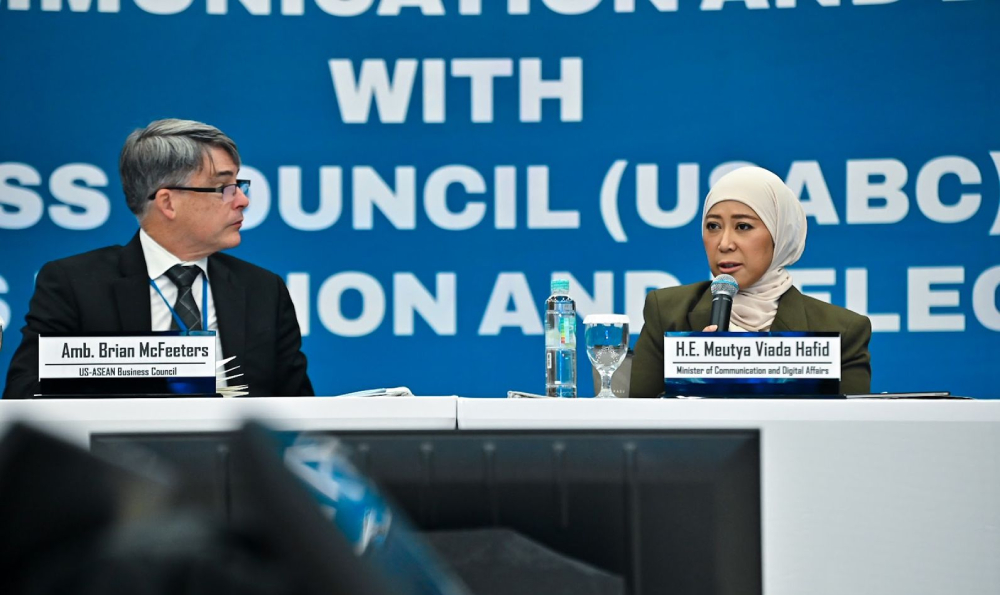
Communications and Digital Affairs Minister Meutya Hafid has urged US technology companies to expand their investment in Indonesia, focusing on job creation, workforce skills development and the use of technology to improve public services.
The government stressed that digital investment should do more than expand infrastructure and internet connectivity. Collaboration with global technology companies is also expected to transfer knowledge, strengthen national digital talent and widen access to innovation, including in rural communities.
Meutya delivered the message during a meeting with a US-ASEAN Business Council (USABC) delegation at the Ministry of Communication and Digital Affairs in Central Jakarta on Wednesday (28 October 2026).
“Digital development is not simply about connecting people to the internet. Connectivity must create opportunities for economic growth, improve the quality of human resources and public services. Without these benefits, the potential of digital infrastructure development cannot be fully realised,” Meutya said.
Indonesia needs investment that delivers direct benefits to the public, she said. Technology companies are therefore expected not only to develop their businesses, but also to help build human resource capacity and ensure the benefits of digital transformation are more evenly shared.
Meutya said Indonesia’s digital transformation was based on three principles: Connected, Growing and Protected. These principles underpin the government’s efforts to extend connectivity, raise productivity and ensure technology is used safely.
The government wants digital infrastructure development to go hand in hand with strengthening people’s ability to use technology. Digital investment is thus expected to support economic growth while improving the competitiveness of Indonesia’s workforce.
“Our relationship will grow stronger if we continue to pay attention to knowledge transfer and skills development in the various digital initiatives being undertaken in Indonesia,” Meutya said.
To achieve this, the ministry is encouraging US technology companies to expand digital talent development programmes, workforce training and the application of innovations that address public needs.
The government also hopes the collaboration will create new economic opportunities and widen access to technology across the country, including in areas that have yet to benefit fully from digital transformation.
The development of artificial intelligence (AI), alongside digital investment, was a key focus of the meeting.
Meutya said Indonesia was open to AI development and investment. However, its deployment must be accompanied by regulatory certainty, child protection and safeguards for personal data.
Indonesia’s large population offers opportunities for AI development, she said, but also makes governance arrangements that protect the public interest essential.
“Indonesia needs to continue developing AI and making use of the opportunities it offers. But with a population of around 280 million, we must also ensure that adequate rules and safeguards are in place so the technology can be used safely and responsibly,” Meutya said.
In drawing up digital policies, including a national AI roadmap, the ministry is committed to engaging industry and other stakeholders in dialogue.
Meutya said the government wanted to introduce transparent regulations that industry could understand. Clear rules were important to give companies guidance as they develop innovations, without compromising public safety and rights.
“We want to ensure that the regulations being prepared are understandable and predictable for stakeholders, rather than taking the industry by surprise. The drafting process must therefore be open to different perspectives, so innovation can develop while public protection remains a priority,” she said.
USABC chief executive Brian McFeeters said partnerships between government and the private sector were becoming increasingly important, particularly as digital technology and AI developed rapidly.
“Compared with other areas of concern for us, digital issues are an area that particularly needs government-private sector partnership. This partnership is extremely important because AI is advancing from week to week,” Brian said.
Brian also highlighted US companies’ contributions in Indonesia through investment, knowledge transfer, education, skills development and various corporate social responsibility programmes.
He said USABC had prepared a report documenting those contributions as part of efforts to strengthen economic ties and digital cooperation between Indonesia and the US.
The ministry views its partnership with USABC as an opportunity to broaden cooperation between the government and the technology industry. The collaboration is expected to go beyond investment and also support workforce development and the growth of the national digital ecosystem.
Through investment accompanied by knowledge transfer, skills development and responsible technology governance, the government aims to build a productive, inclusive, safe and trusted digital ecosystem in Indonesia.