
Meutya Hafid Says Social Assistance Data May Be 70% Inaccurate
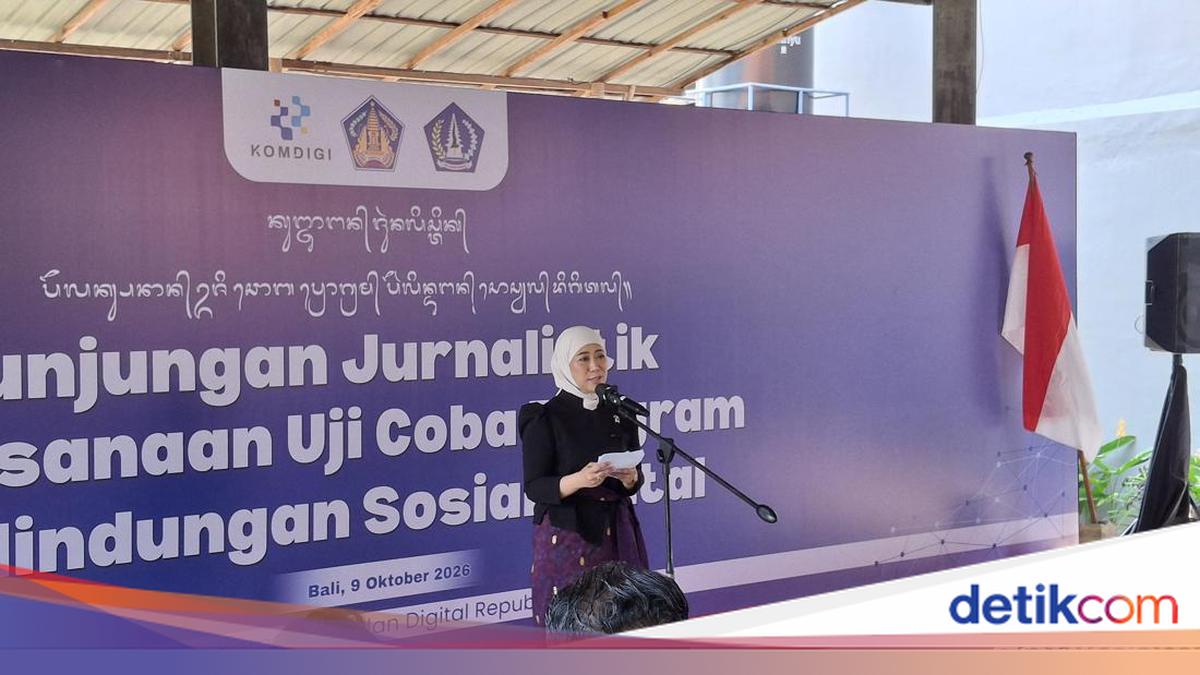
Communications and Digital Affairs Minister Meutya Hafid said data on social assistance recipients may be up to 70% inaccurate. As a result, improving the data is a priority in the digital transformation of social protection (Perlinsos).
The figure is based on preliminary findings by the Government Digital Transformation Acceleration Committee. Meutya said inaccurate data meant some people who were entitled to assistance had not received it, while people who were not eligible had received support.
“In the committee’s first findings, the preliminary data was said to be 70% inaccurate. That means many people who are entitled to assistance have not received it, while many recipients are actually not eligible. So that is where we are focusing first,” she said at a media visit to the pilot implementation of the Digital Social Protection Programme in Bali on Friday (9 October 2026).
She explained that digitising social assistance through Perlinsos is expected to improve data accuracy gradually, until there are no longer any errors in the distribution of aid. As an initial step, the government aims to bring the data inaccuracy rate down from 70% to 50%.
“In the end, we hope to reach 100% [accuracy]. But of course, we will do it gradually. With the data currently 70% wrong, our first target is 50%. Once we reach 50%, we will cleanse it again and aim to reduce the rate further. Ultimately, we hope there will be no incorrect data at all, meaning everyone who is entitled must receive assistance,” Meutya said.
According to Meutya, digitisation will allow the government to match data from various agencies to check whether applicants qualify for social assistance. The data includes information from the Ministry of Social Affairs, the Ministry of Agrarian Affairs and Spatial Planning/National Land Agency (ATR/BPN), state electricity company PLN, the National Police Traffic Corps (Korlantas), and the Social Security Agency (BPJS).
“Information on electricity use from PLN, data from ATR/BPN and the Ministry of Social Affairs, as well as data from Korlantas, BPJS and others, will all be cross-checked. That means an applicant cannot provide false or inaccurate information, because the system will detect it,” she said.
Meanwhile, Rahmat Danu Andika, coordinator of the Government Digital Transformation Acceleration Committee’s task force, said Bali is expected to complete verification of applicants’ data within the next three to four months.
“We hope that in the next three to four months, the province of Bali will have completed data verification for all applicants,” he said.
Nationally, the government aims to register around 48 million households by the end of 2026. This would represent about 50% of the population targeted for data collection.
The figure reflects the fact that not everyone needs social assistance. The government therefore aims for around 50–60% of the population to register, equivalent to approximately 48–50 million households.
“So the target is for 50–60% of the population to register, or around 48–50 million households by the end of the year,” he said.
Source: jawawa.id (https://jawawa.id/newsitem/meutya-hafid-says-social-assistance-data-may-be-70-inaccurate-1791561049)
Originally published by detikBali (https://www.detik.com/bali/berita/d-8700313/menkomdigi-meutya-hafid-sebut-data-bansos-diduga-70-tak-akurat), translated from Indonesian