
METI proposes special agency to oversee renewable energy project implementation
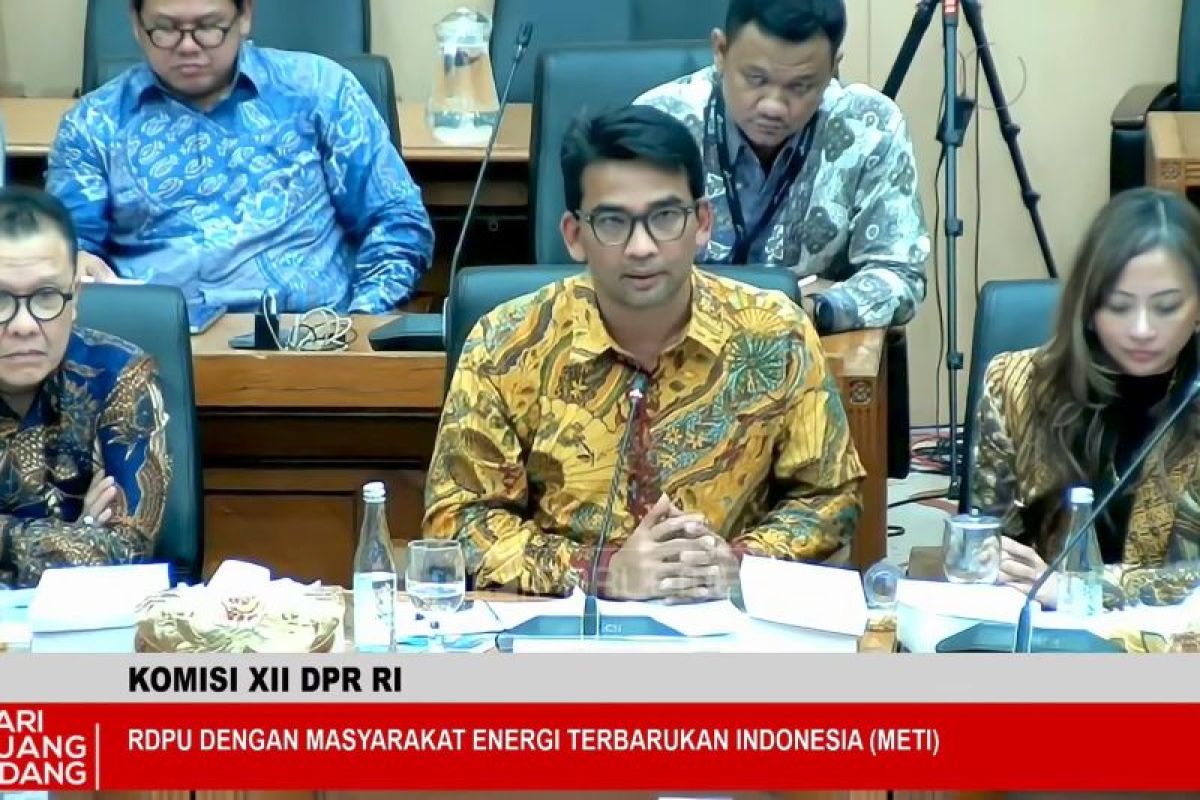
Jakarta (ANTARA) - The Indonesian Renewable Energy Community (METI) has proposed the formation of a special agency to oversee the realisation of new and renewable energy projects, from the planning stage through to operation.
METI General Chairman Norman Ginting stated that the proposed New and Renewable Energy Acceleration and Management Agency (BPP EBT) was presented as part of the discussions regarding the New and Renewable Energy Bill (RUU EBET) with Commission XII of the Indonesian House of Representatives (DPR RI) in Jakarta on Tuesday.
“We propose the need for a special agency to manage and pursue the targets of the BPP ETR,” said Norman during the meeting.
According to Norman, the development of renewable energy intersects with the authority of various ministries and institutions, including the energy, fiscal, forestry, and land provision sectors.
METI proposes that the BPP EBT serve as an implementing unit responsible for monitoring target achievements, controlling implementation, and assisting in resolving obstacles that arise in cross-sectoral renewable energy development.
This proposal for the agency’s formation is one of 22 key inputs from METI regarding the RUU EBET. In its presentation, METI noted that such a specialised institution is not yet regulated in the draft law currently under discussion.
Lucila Ismoyo Rukmi, Secretary General of the Indonesian Wind Energy Association (AEAI), also known as Maya, assessed that the existence of a single agency with accountability for final results is necessary to ensure renewable energy projects do not stall at the planning stage.
“Indonesia needs an accountable implementing agency capable of transforming these targets into bankable projects that are ready for operation,” said Maya.
She noted that renewable energy projects currently involve numerous agencies, including the Ministry of Energy and Mineral Resources (ESDM), PLN, ministries handling land, forestry, investment, and state-owned enterprises, as well as local governments and financing institutions.
According to her, the proposed agency could play a role in filtering project readiness before they enter the Electricity Supply Business Plan (RUPTL), coordinating the resolution of cross-agency obstacles, and overseeing projects until they are ready for execution.
The need for cross-institutional coordination is also evident from the scale of electricity projects that must be realised over the next decade. The PLN RUPTL 2025–2034 sets an additional generation capacity of 69.5 gigawatts (GW) up to 2034.
Of that total, 42.6 GW, or approximately 61 per cent, comes from new and renewable energy, while 10.3 GW consists of energy storage systems. The remaining 16.6 GW comes from fossil-based power plants.
The government also targets the construction of nearly 48,000 kilometres of transmission lines and substations with a capacity of approximately 108,000 megavolt amperes to support the development of the electricity system through 2034.
Meanwhile, as of April 2024, the national installed power generation capacity reached 108 GW. Of this amount, approximately 16.26 GW, or 15 per cent, is renewable energy, while the renewable energy mix in electricity production has reached 17.89 per cent.
Member of Commission XII of the DPR RI, Eddy Soeparno, assessed that the idea of forming a special agency could be considered, despite the complexity as some related functions are already performed by other institutions.
“(Regarding) that agency, I have no objection; the formation of such a body, in my view, is very necessary,” said Eddy.
However, he noted that strengthening existing institutional mechanisms could also be an option so that coordination functions do not necessarily require the creation of a new institution.
Eddy suggested that such functions could be carried out through a Coordinating Minister with a steering committee possessing the ability to coordinate relevant ministries and agencies.
“The institution or body capable of performing this integration does not need to be a new formation, but can be carried out by a body in the form of a Coordinating Minister. The Coordinating Minister would then form a Steering Committee to direct various initiatives and coordinate across ministries and agencies,” he said.
He added that this option should be considered because forming a new agency requires time and the restructuring of inter-agency functions.
The Deputy Chairman of Commission XII of the DPR RI, Dony Maryadi Oekon, who led the meeting, stated that METI’s input would be used as material in the ongoing discussions of the RUU EBET during this legislative session.
Commission XII previously stated that the RUU EBET remains a priority, with the hope that it can be finalised by 2026.
The bill is being prepared to strengthen legal certainty in the development of new and renewable energy as well as the national energy transition.