
Meta Faces Rp22,900 Trillion Lawsuit Over Child Addiction Claims
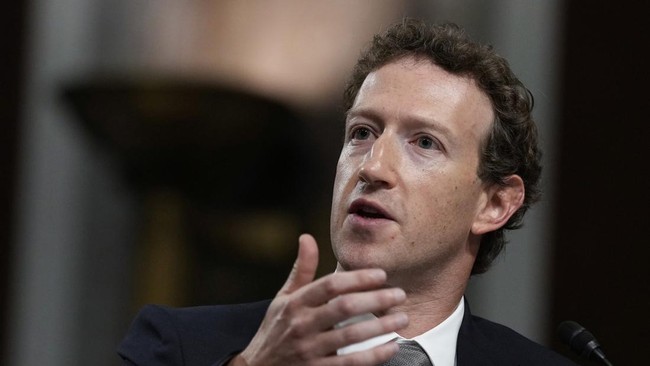
Social media giant Meta, the parent company of Facebook and Instagram, is facing one of the largest lawsuits in its history. Oral arguments began on 18 August 2026 at the federal court in Oakland, California, and several parties have described it as potentially becoming a ‘tobacco moment’ for Mark Zuckerberg’s company.
A total of 29 US states, led by California, Colorado, Kentucky, and New Jersey, are suing Meta over allegations that it deliberately designed platform features to make children addicted, misled the public about the dangers of its products, and violated children’s privacy.
California Attorney General Rob Bonta called the case a ‘tobacco moment’ for Meta, likening the alleged corporate deception to that which triggered massive payouts by tobacco companies in the 1990s, as well as opioid and pharmaceutical manufacturers more recently. Meanwhile, prosecutors from California also accused Meta of designing its platform so that children would keep coming back to use it.
On the other hand, Meta has consistently denied allegations that its products are harmful. The company’s legal team even called the analogy with the tobacco industry highly inappropriate. Meta argued that Facebook and Instagram actually benefit young people, and questioned why only it was being targeted, while usage of Google’s YouTube and ByteDance’s TikTok among teenagers is even higher than Instagram.
The amount of the claim in this case is staggering. Initially, the four plaintiff states estimated potential fines could reach US$1.4 trillion (around Rp22,900 trillion) if Meta loses, calculated based on the number of teenagers in their regions who use Instagram and Facebook for more than 30 minutes per day.
However, that figure was later reduced to around US$200 billion (around Rp3,270 trillion), which is roughly equivalent to Meta’s total revenue for 2025. If this figure is used as a benchmark for the other states that are also suing, the impact is said to be potentially devastating for the company.
Interestingly, the Oakland case differs from the Los Angeles hearing last March, where Meta and Google were ordered to pay compensation to a 20-year-old woman who was deemed to have been harmed by social media addiction. The Oakland case is described as the largest consumer protection lawsuit in US history, with the main focus on allegations that Meta misled the public rather than solely on addiction.
Vincent Joralemon, an observer from the Berkeley Centre for Law & Technology, assessed that the core question is whether Meta is proven to have deceived the public, which is similar to the tobacco and opioid cases. Therefore, whistle-blower testimony is expected to be more influential than psychological debates about addiction.
Despite the astronomical value of the lawsuit, Meta investors have not yet shown signs of major panic. According to Gil Luria, an analyst at D.A. Davidson, the burden of proof for fraud allegations is considered quite high. Litigation risk has indeed depressed Meta’s valuation, reflected in a lower price-to-earnings ratio compared to other tech giants.
However, investor concerns are more focused on the possibility of operational changes that could be forced if Meta loses, such as changes to the ‘infinite scroll’ feature that encourages users to keep scrolling – a feature that contributes significantly to the company’s advertising revenue.
Meta still has room to appeal, one option being to take shelter behind Section 230 of the Communications Act, which protects platforms from legal liability for third-party content. However, an attempt to halt the proceedings early on these grounds was rejected by the judge as premature.
History shows that major court rulings do not always have an impact as large as their headlines suggest. After the tobacco industry agreed to pay more than US$200 billion over 25 years in the 1998 settlement, the industry survived, partly by shifting sales to international markets.
Matthew Lawrence, a legal expert from Emory University, noted that such settlements have a disappointing track record in the United States, having been able to mitigate the harmful effects of industries that exploit addiction, but not yet succeeding in truly eliminating them.
Source: jawawa.id (https://jawawa.id/newsitem/meta-faces-rp22-900-trillion-lawsuit-over-child-addiction-claims-1787129501)
Originally published by CNBC Indonesia (https://www.cnbcindonesia.com/market/20260819141028-17-760629/induk-facebook-instagram-digugat-rp22900-triliun-ada-apa), translated from Indonesian