
MES Central Board Sworn In, Critical Moment for Sharia Economy Collaboration
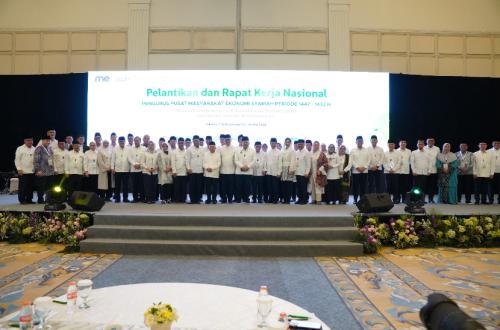
The Central Board of the Islamic Economic Society (MES) for the 1447-1452 Hijriyah period was officially inaugurated on Sunday, 24 May 2026. This milestone marks a crucial step in consolidating the organisation to strengthen Indonesia’s Sharia economic ecosystem.
The inauguration ceremony was led by MES Central Board Advisory Council Chairman Ma’ruf Amin. In his address, he expressed high optimism about the growth of the Sharia sector in Indonesia.
“Today, this very moment, I state that the future of Sharia economics is bright, not dark,” he asserted.
He noted that Sharia economics contributes approximately 30 to 40 percent to the national economy. Although Indonesia currently ranks third globally, he urged the formulation of strategies to secure the top position worldwide.
The former 13th Vice President of the Republic of Indonesia also reminded that Sharia economics must not solely pursue financial gain (istirbah). The system must prioritise public service and collective welfare (khidmah ijtimaiah).
“Sharia serves as a guidebook to ensure innovations proceed effectively, delivering justice and preventing harm to the people,” he added.
In alignment with this vision, MES Central Board Chairman Rosan Roeslani underscored the new board’s commitment to actionable implementation.
He stressed that board members represent the grassroots communities awaiting economic solutions.
“Thoughts, discussions, visions, and missions without implementation are mere illusions. Sharia economics must not be large in numbers but small in tangible impact,” Rosan said.
He affirmed that MES should not merely chase statistical rankings. The organisation must deliver concrete results, such as formulating schemes to reduce the saving period for umrah pilgrims in regional areas from 15 years to one or two.
As a foundational principle for future work, Rosan established a key guideline for all board members in decision-making.
“During every board meeting, I hope one thing is always prioritised and confirmed: whether the programme will genuinely benefit all Indonesian citizens,” he concluded.