
Mercu Buana University Develops Smart Rain Garden for Water Conservation
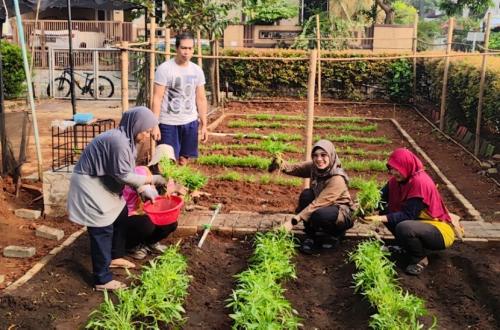
Universitas Mercu Buana (UMB) has developed a Smart Rain Garden as a rainwater harvesting system to support water conservation in urban areas. The technology is designed to reduce rainwater runoff while providing an irrigation source for urban agriculture.
The innovation is being applied through the Community Service Programme (PkM) Regional-Based Empowerment Scheme for 2026 in Pinang, Tangerang City. The programme involves collaboration between UMB, the Climate Village Programme (ProKlim) group, the Women Farmers Group (KWT), and the Tangerang City Environmental Agency.
UMB community service team leader Uly Amrina said that rainwater management in urban areas has so far been oriented towards disposal through drainage systems. In fact, she argued, rainwater can be utilised as a resource that supports water conservation and food security.
“Through the Smart Rain Garden, we want to change the way people view rainwater. Rainwater is no longer seen as a cause of flooding that must be disposed of immediately, but as a resource that can be stored, monitored, and reused to support water conservation and urban agriculture,” Uly said in a press release on Thursday (30 July 2026).
In its implementation, the Smart Rain Garden integrates a Ground Water Tank (GWT) as an underground rainwater storage system with a network of piping, pumps, water tanks, soil moisture sensors, water level sensors, and a digital monitoring system. The technology allows rainwater that would previously have become runoff to be reused as an irrigation source for farmland managed by the Women Farmers Group.
Beyond building infrastructure, the programme also emphasises capacity building within the community through outreach, training, and mentoring on system operation, facility maintenance, and water-efficient cultivation practices. A maintenance team has also been formed to ensure the operational sustainability of the Smart Rain Garden.
Uly said the programme’s success is measured not only by the technology built, but also by the community’s ability to manage and maintain the system independently.
“We hope this Smart Rain Garden model can serve as an example of good practice that can be replicated in various urban residential areas. Collaboration between universities, local government, and communities is the key to building cities that are more resilient to climate change,” she said.
The programme’s implementation team is led by Uly Amrina, with members Winda Widyanty, Sylvia Indriany, and Fajar Rahayu Ikhwannul Mariati. The four lecturers from the Faculty of Engineering and the Faculty of Economics and Business at Mercu Buana University integrate technical, environmental, management, and community empowerment approaches in developing the Smart Rain Garden system.
The programme has received support from the Tangerang City Environmental Agency, from the planning stage and site identification to technical assistance and field monitoring. It is also funded through the 2026 Regional-Based Empowerment Scheme of the Community Service Programme under the Directorate of Research and Community Service, Directorate General of Research and Development, Ministry of Higher Education, Science, and Technology.
UMB hopes the Smart Rain Garden can become a community-based water conservation model that can be replicated in various urban areas to strengthen environmental resilience while supporting the development of sustainable urban agriculture.