
Merauke Regency Promotes Development Based on Customary Territory Data
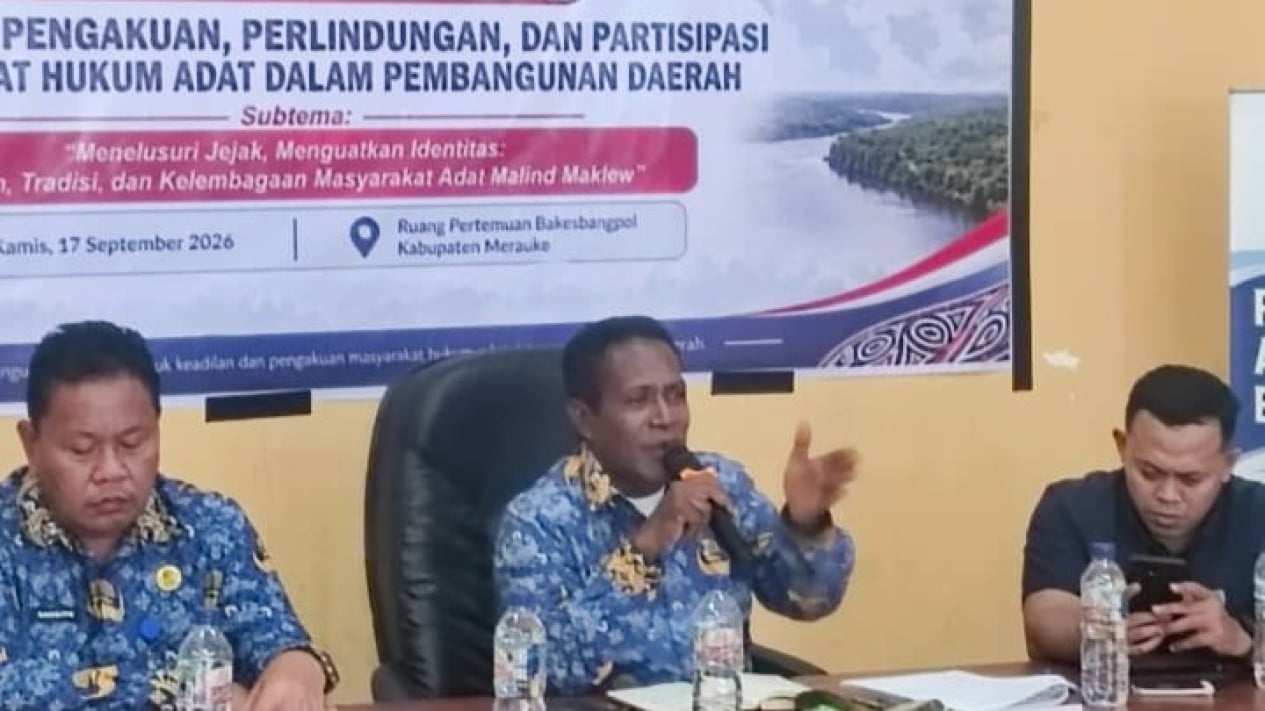
The Merauke Regency Government, South Papua, continues to encourage development at the village level to proceed in accordance with the social and cultural conditions of the local community.
One of the steps taken is the participatory mapping of customary territories involving various clans. This effort is intended to strengthen the government’s understanding of social structures and customary areas before various development programmes are implemented.
The Head of the Department of Community and Village Empowerment (DPMK) of Merauke Regency, Daud Holingger, stated that because every community has different characteristics, the government requires a comprehensive understanding when drafting policies.
“Every community possesses different social and cultural characteristics. Therefore, the government needs to understand social structures, customary leadership, and genealogical and clan relationships when formulating development policies,” said Daud, as reported on Thursday, 17 September 2026.
According to Daud, the existence of customary institutions does not act as an obstacle to development. On the contrary, customary structures can serve as a component that assists the government in understanding the needs of the community on the ground.
At the village level, the village head performs administrative government functions, whereas the customary chief holds social and cultural legitimacy within the community.
“The village head carries out government functions administratively, while the customary chief possesses social and cultural legitimacy arising from the traditional leadership structures of the community,” he added.
This condition is particularly important for programmes related to land. In several areas of Merauke, land ownership remains closely linked to clan lineages.
Daud assessed that understanding these conditions can assist the government in planning and executing development more appropriately according to the character of the local people.
“The recognition of customary law communities is not enough to be merely reflected in regulations and documents; it must also be realised through policies and development practices,” he said.
As part of these efforts, DPMK Merauke has conducted participatory mapping of customary territories in the Woyu Maklew area, involving various clans.
This mapping has resulted in the creation of customary territory maps. However, several outer boundaries of these territories still require further resolution.
Documentation regarding the history, territory, genealogy, and community life is also being collected to strengthen the government’s information base regarding customary law communities.