
Meranti Regent Attends Sago Business Forum 2026, Seeks Opportunities to Develop the Industry
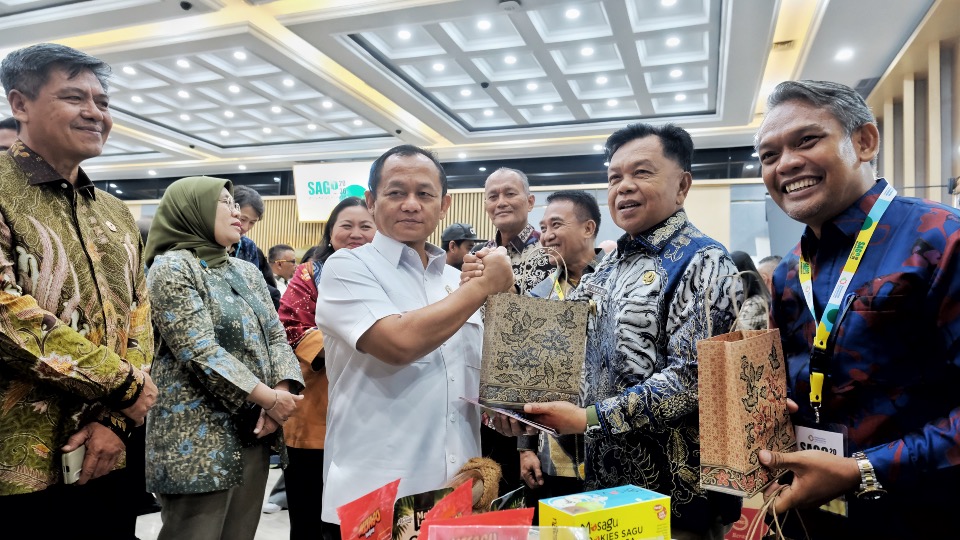
JAKARTA — Kepulauan Meranti Regent AKBP (Ret.) H. Asmar attended the Sago Business Forum 2026, organised by Indonesia’s Ministry of Industry. At the forum, he sought to open up greater opportunities for the development of the regional sago industry, particularly by expanding access to overseas markets. The event was held at the Garuda Building, Ministry of Industry, on Thursday (5 November 2026).
Those attending included Industry Minister Muhammad Sarmuji and officials; representatives of the Japanese Embassy in Indonesia, including Counsellor Keisuke Hosonuma; representatives of the Japan External Trade Organization (JETRO) and the Jakarta Japan Club (JJC); members of the Society of Sago Palm Studies and the Japanese Society for Tropical Agriculture; local governments; the Sago Industry Association; sago-processing businesses from Indonesia and Japan; universities; and research institutions.
Asmar was accompanied by Meranti Industry and Trade Agency head Marwan, secretary Mifta, Meranti Communications and Informatics Agency head Sukri, Public Relations and Protocol Division head Yusran, and Meranti Regional Development Planning Agency representative Robert.
Asmar said the forum offered Kepulauan Meranti Regency an important opportunity to receive guidance and build communication with the central government and businesses on developing the region’s sago potential.
He said Meranti had received support and recognition from the Ministry of Industry for its potential and sago products, encouraging the local government to continue developing the commodity, which is a regional strength.
“Thankfully, we received a great deal of encouragement and direct guidance from the Minister. He also had the opportunity to visit Meranti’s stand and praised what we have done to develop sago’s potential,” Asmar said.
Asmar added that he had spoken with several businesses from outside the regency to explore investment and marketing partnerships for Meranti sago. These included local businesses and Japanese representatives, as Japan is one of the largest consumers of Meranti’s sago production.
He hopes the partnerships will enable Kepulauan Meranti not only to supply raw materials but also to export sago directly to international markets.
“We have spoken with several businesses from outside Meranti. We hope Meranti sago can be exported directly overseas, while attracting investors to invest and partner with us in its development and marketing,” he said.
Asmar said that new investment and export opportunities could add value to sago, boost the local economy, create business opportunities and increase Kepulauan Meranti Regency’s locally generated revenue (PAD).
He said the local government was committed to continuing to develop sago so it could deliver broader economic benefits to the region and its people.
Industry Minister Muhammad Sarmuji said Kepulauan Meranti had significant sago potential and could become a regional force in supporting the development of Indonesia’s sago industry.
That potential is supported by the availability of raw materials and a tradition of sago processing that is well established and forms part of local life. This gives Kepulauan Meranti an opportunity to play a larger role in the processing and marketing stages of the sago industry chain.
Sarmuji stressed that the development and downstream processing of sago should be stepped up as part of Indonesia’s efforts to develop its leading commodities. Sago has economic potential and can also help strengthen national food security and sovereignty while improving industrial competitiveness.
He said Indonesia had substantial sago resources spread across several regions, including Maluku, Papua and parts of Sumatra, such as Kepulauan Meranti, Nias and Mentawai.
“Sago is one of Indonesia’s comparative advantages. Its potential is enormous, and we must develop it into a competitive advantage through industrial development, research, innovation and downstream processing,” he said.
Sarmuji said sago could be used in a wide range of ways, not only as an alternative food to replace rice, but also as an ingredient in higher-value products such as noodles, analogue rice, pasta, biscuits and other food products.
Sago could also be developed for non-food uses, including bio-packaging and bioethanol. Solid and liquid waste from processing could be used as animal feed or converted into alternative energy sources such as biogas.
By making full use of these resources, the sago industry could adopt circular-economy principles by turning raw materials and waste into products with economic value.
“If all this potential can be harnessed, sago will be more than a food commodity: it can also become a source of new industrial growth that creates added value for the community’s economy,” he said.
Sarmuji added that developing sago was important to strengthening Indonesia’s food sovereignty. The country’s food supply should not depend solely on rice, he said, given Indonesia’s rich diversity of local food resources.
Alongside the domestic market, the sago industry also has international opportunities, particularly in Japan, one of the destinations for Indonesian sago-starch exports.
According to figures presented at the forum, Indonesia’s share of Japan’s sago-starch market rose from 2 per cent in 2021 to 7 per cent in 2022, 8 per cent in 2023, 9 per cent in 2024 and 14 per cent in 2025.
The increase points to an opportunity for Indonesia to expand its export markets by increasing production capacity, strengthening processing industries, attracting investment and acquiring technology.
The Ministry of Industry is therefore encouraging partnerships between domestic industry players and international investors, particularly those from Japan, to develop Indonesia’s sago potential.
The Sago Business Forum is intended to foster collaboration in promoting the national sago-processing industry, exploring investment opportunities in sago-producing regions such as Kepulauan Meranti, developing technology and broadening market access.
“We invite Japanese industry players and investors to explore various opportunities to work with Indonesia’s sago industry. We want regions’ considerable potential to be developed into leading products that can compete in international markets,” Sarmuji said.
For Kepulauan Meranti, the central government’s push for downstream sago processing presents an opportunity to strengthen plantations and processing industries based on local commodities. The development is expected to increase sago’s added value, attract investment, create jobs and deliver broader economic benefits to the community.
Industry Ministry Director General of Agro Industry Putu Juli Ardika said the government was continuing to promote sago-processing industries through strategic measures to increase added value and product competitiveness and strengthen the national sago supply chain.
He said the forum provided a platform to strengthen business partnerships, expand market access and create opportunities for investment and strategic cooperation between Indonesia and Japan.
The forum was attended by around 130 participants: 60 representatives of Indonesian stakeholders and 70 participants from Japan. They included government representatives, associations, businesses, researchers and the media.
The event comprised three main sessions: an Industrial Forum to discuss sago’s potential and development policy; One-on-One Business Matching to connect Indonesian industry players with prospective Japanese business partners; and a Sagu Product Showcase to introduce processed products, regional potential, and sago research and innovation.
At the showcase, Kepulauan Meranti in Riau Province joined other sago-producing regions, including East Seram Regency, the Mentawai Islands and Lingga Regency.
Putu said he hoped participants would establish direct business contacts and form long-term partnerships, particularly in product development, trade, investment and technology transfer.
He said collaboration between Indonesia and other countries could strengthen the position of the national sago industry and open up wider opportunities to develop and market Indonesian sago products internationally.
Source: jawawa.id (https://jawawa.id/newsitem/meranti-regent-attends-sago-business-forum-2026-seeks-opportunities-to-develop-the-industry-1793861444)
Originally published by merantikab.go.id (https://merantikab.go.id/berita/bupati-asmar-hadiri-sagu-bisnis-forum-2026-buka-peluang-pengembangan-industri-sagu-daerah-sekaligus-perluas-pasar-ke-mancanegara), translated from Indonesian