
Men Not Inviting Women: Evidence That Males Have Preferred to Walk Alone Since Ancient Times
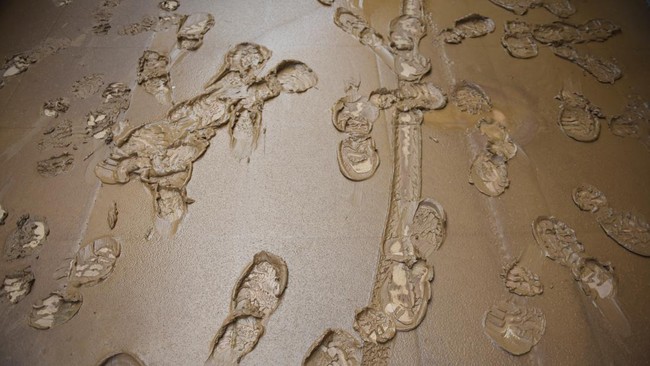
The habit of moving or travelling separately between males and females is apparently not only found in modern humans. Footprints dating back 1.4 million years discovered in Kenya provide early evidence that ancient human relatives already had travel patterns segregated by sex. A group of males moved together unaccompanied by females or children. The discovery, published in the journal Proceedings of the National Academy of Sciences on 27 July 2026, revealed 21 footprints preserved on the shore of an ancient lake in the North Turkana region of Kenya. Researchers estimate the tracks were made by eight individuals of the extinct human relative species Paranthropus boisei, walking in step at the same time. Based on the size and shape of the prints, the majority of the track-makers were adult males, and no footprints of females or children were found in the line. ‘The fact that eight Paranthropus boisei individuals, mostly adult males, appear to have moved together as a group, without females or children, hints at a more complex social structure in this species,’ said Neil Roach, a researcher from Harvard University who co-authored the study. Roach added that although males competed for mates, they still tolerated each other and gathered for safety in the dangerous environment of that era. This pattern aligns with findings of other ancient footprints at the Engare Sero site in Tanzania, which are around 5,700 to 19,100 years old. There, a group walking together was instead dominated by adult females. Fourteen women were accompanied by only two adult males and one adolescent male, who were thought to be hunting or gathering food. Researcher Kevin Hatala from Chatham University explained that footprints provide a valuable record of behaviour because they capture a real moment in a short time frame, unlike skeletal remains which represent spans of thousands of years. ‘Footprints give us a direct picture of how they moved, where they were going, and who was travelling together,’ Hatala said. From these two findings, it appears that a division of roles and travel patterns has been rooted since prehistoric times. Groups of males sometimes moved alone or with other males, while females more often travelled with groups of fellow females or nuclear families. The researchers plan further excavations to see whether this pattern applies generally to various species of ancient human relatives, or only to specific groups. Nonetheless, the current evidence increasingly strengthens the suspicion that the habit of ‘walking alone’ or grouping based on sex has existed for millions of years.