
Megawati's Full Letter: PDIP's Position as a Balancing Force, Not Opposition
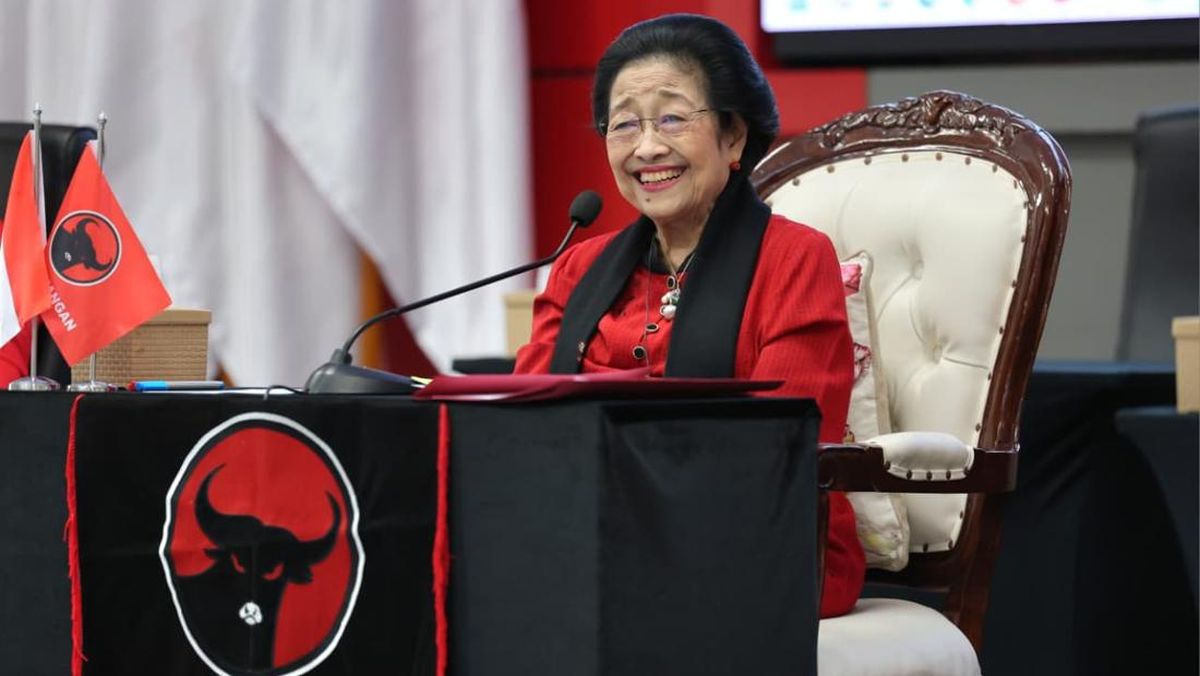
PDI Perjuangan Chairwoman Megawati Soekarnoputri has published an internal letter explaining the party’s position as a balancing force to the Merah Putih Cabinet coalition under President Prabowo Subianto’s administration. In the letter, dated 1 July, Megawati stressed that PDIP’s stance is that of a balancing force, not an opposition.
According to Megawati, this position has clear historical roots and a foundation within the presidential system adopted by Indonesia. She cited the ideas of Giovanni Sartori in his book ‘Parties and Party Systems: A Framework for Analysis’ (1976), noting that Sartori introduced the concept of responsible opposition. This concept posits that the opposition should not merely reject and criticise but must also bear a sense of responsibility for the continuity of the governmental system.
In the letter, Megawati wrote that during the opening of the VI PDI Perjuangan Congress in Badung Regency, Bali, in August 2025, she asserted that the Indonesian presidential system does not recognise the terms opposition and coalition as constitutional categories. She stated that Indonesian democracy is not a democracy of power blocs but one based on popular sovereignty and constitutional supremacy. She cautioned that democracy must not move towards a concentration of power that weakens oversight and correction mechanisms, adding that a healthy democracy requires a balance of power and the moral courage to deliver criticism and corrections for the safety of the nation.
Megawati further explained that the 1945 Constitution does not recognise the legal status of an ‘opposition party’. Article 4, paragraph (1) of the Constitution stipulates that the President holds governmental power according to the Constitution. The President is directly elected by the people, and the continuity of the government is not determined by majority support in the House of Representatives (DPR). The President cannot be removed except through the impeachment mechanism regulated by the Constitution. She contrasted this with a parliamentary system, where the government is formed by a majority party or coalition in parliament and must continuously maintain parliamentary confidence.
She also referred to Article 20A, paragraph (1) of the Constitution, which mandates that all DPR members, regardless of their political party origin, bear the functions of legislation, budgeting, and oversight of the government’s operations. Therefore, she argued, the oversight function is not an exclusive right of any so-called opposition but a constitutional mandate inherent to all representative institutions.
Megawati traced this understanding back to her political history, recalling that on 3 November 1996, during the political dynamics of the New Order era, she rejected being labelled an ‘opposition leader’. She stated that her struggle was not to build opposition politics as known in parliamentary systems but to fight for the upholding of democracy, constitutional supremacy, popular sovereignty, and citizens’ political rights. She reiterated that Indonesian politics does not recognise a permanent division between the government and the opposition.
To support her argument, Megawati referenced political scientist Robert Dahl’s work, ‘Polyarchy: Participation and Opposition’ (1971), which argues that the essence of democracy lies not in the formal institutionalisation of opposition but in the functioning of mechanisms for contesting power. She also cited Dahl’s ‘Political Oppositions in Western Democracies’ (1966), which demonstrates that mature democracies do not necessarily produce antagonistic oppositions that reject the entire government agenda.