
Megawati Weeps Watching Documentary on Indigenous Rights, Highlights Forest and Palm Oil Destruction
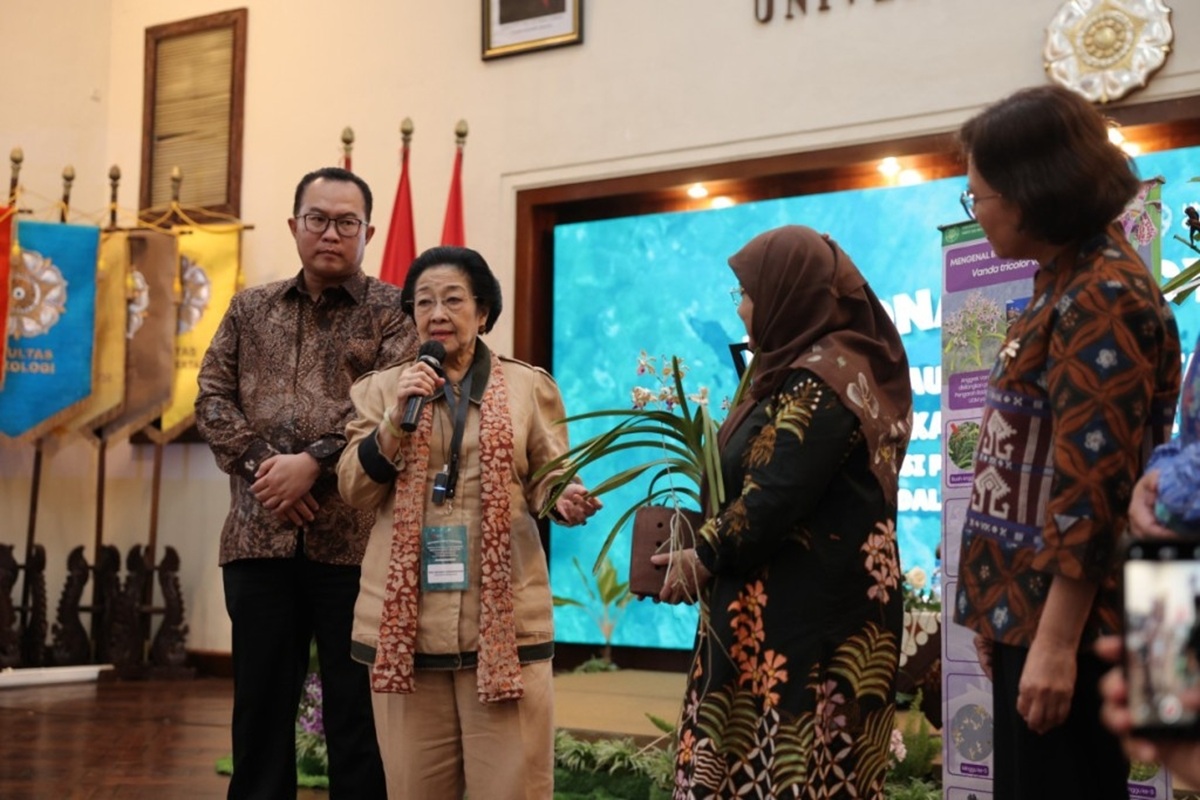
Indonesia’s fifth president and chair of the Advisory Council of the National Research and Innovation Agency (BRIN), Prof. Dr. (HC) Megawati Soekarnoputri, disclosed that she wept whilst watching the documentary “Pesta Babi” (Pig Party), a 1.5-hour film directed by Dandhy Dwi Laksono and Cypri Jehan Paju Dale.
“I cried yesterday when I watched Pesta Babi. It is true. How much forest has been converted to palm plantations—for what purpose? There is customary tradition there, customary law, territorial law. They ask to be respected; is that wrong?” Megawati stated at the National Policy Dialogue forum titled “Maritime Sovereignty Based on Marine Biological Wealth: Orchestrating Knowledge, Innovation, and Geopolitics in Indonesia’s Blue Economy” at UGM Senate Hall on Friday, 22 May.
Megawati highlighted various environmental concerns and national development directions that she viewed as increasingly divergent from the spirit of national sovereignty. She criticised the extractive approach to natural resource management, which she deemed had driven environmental degradation, agricultural land conversion, and neglect of indigenous peoples’ rights.
According to her, it is essential to respect customary law and the rights of local communities in managing natural resources.
Megawati emphasised the importance of all national elements strengthening confidence in their own strength and being capable of standing independently in managing national natural resources. She stated that Indonesia must not depend on other nations in managing natural wealth or determining the direction of national development.
“A great nation is one that believes in its own national strength; the sea must become the path to Indonesia’s civilisational progress once again,” Megawati said.
Amid intensifying global geopolitical competition and the struggle for marine resources, Indonesia was deemed to need reaffirm its identity as a maritime nation. Strengthening research, innovation, and the management of marine biological wealth became key to reinforcing national sovereignty whilst promoting sustainable blue economy development.
Indonesia’s strategic position between the Indian and Pacific Oceans was viewed as presenting both significant opportunities and challenges in safeguarding sovereignty and independent utilisation of marine resources.
She assessed that Indonesia had not yet fully harnessed the potential of the sea as a foundation for national development. Yet Indonesia, according to her, possessed abundant marine biological wealth and a strategic position in the Indian and Pacific Ocean regions.
“Indonesia is not merely a terrestrial nation. We are a maritime people with a strategic position in the Indian and Pacific Ocean regions,” Megawati stated.
She recalled that the concept of “Tanah Air” (homeland) should form the basis of Indonesia’s perspective in viewing the sea as a unifier of territory and a source of civilisation.
She also referenced the geopolitical vision of Indonesia’s first president, Soekarno, who positioned Indonesia as a world maritime power.
She stressed the importance of Pancasila as the foundation for national development. According to her, strengthening research, innovation, and maritime sovereignty must remain grounded in national identity and the spirit of self-reliance inherited from the nation’s founders.
“Do not forget your own national history. Pancasila is a universal value respected by the international community,” she stated.
Strengthening the maritime sector, according to her, required not merely resource exploitation but must be supported by mastery of knowledge, technology, and national research. Therefore, Megawati requested that BRIN and universities integrate research with industrial needs and public policy so that research results could provide tangible benefits to society.
She also reminded the importance of protecting Intellectual Property Rights (IPR) over Indonesia’s biological wealth to prevent it from being claimed by other nations. “Please promote awareness about patents, because once patented, it becomes international law,” she urged.
Megawati further emphasised that universities need to possess strategic focus in knowledge development. She cited UGM as a centre for developing Pancasila and democracy, Bogor Agricultural Institute as a centre for food sovereignty, the University of Indonesia in medicine and financial systems, and Bandung Institute of Technology in industrial and military technology.
“I envisage a city of intellect. UGM, for instance, for Pancasila and democracy, IPB for food sovereignty, UI for medicine and financial systems, ITB for industrial and military technology,” she said.
In the context of national development, Megawati also touched upon the importance of having a clear and sustainable long-term direction. She deemed that Indonesia should possess a clearly defined national course so that development does not change with every shift in national leadership. According to her, the concept of planned universal development needed to be revived to maintain continuity of the nation’s development vision.
“If the president changes, do not let the development direction change entirely. We must have a pattern of long-term development for the nation’s future,” Megawati concluded.
The documentary “Pesta Babi,” created by WatchDoc and directed by Dandhy Dwi Laksono and Cypri Dale, has drawn public attention after several screening events were dispersed in various regions. The documentary addresses the plight of South Papuan indigenous communities affected by large-scale industrial and agricultural projects, whilst sparking public debate.