
Megawati stresses importance of upholding historical justice
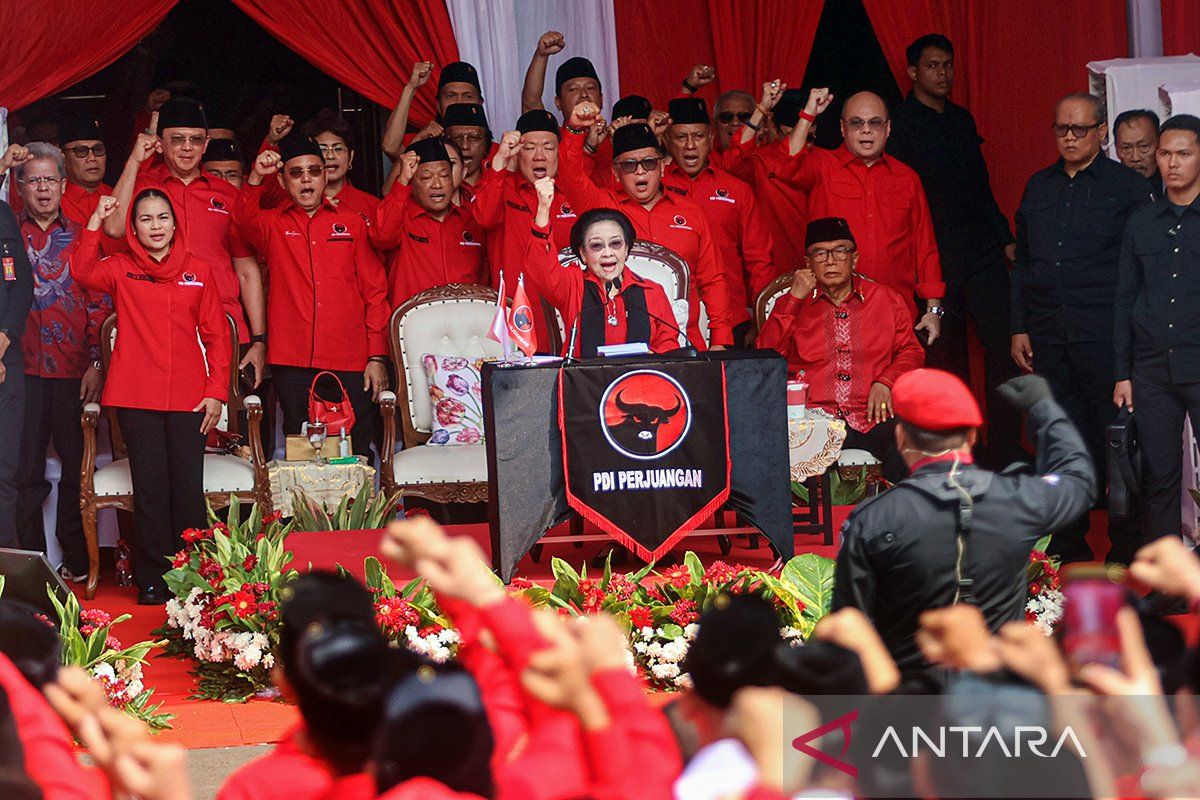
Indonesia’s 5th President and Chairperson of the PDI-P Central Leadership Board, Megawati Soekarnoputri, has stressed the importance of upholding historical justice for the nation, saying it must not stop at the political decision to revoke MPRS Decree (TAP MPRS) No. 33 of 1967.
Megawati called on all elements of the nation to have the courage to look at history honestly, including acknowledging the political suffering endured by the Proclaimer of Indonesian Independence, Soekarno (Bung Karno), during the New Order era.
“Although MPRS Decree No. 33 of 1967 concerning the revocation of state governmental authority from President Soekarno has been revoked, for me the question of history does not end with the revocation of a decree. What is more important is the conscience of history,” Megawati said in Jakarta on Monday.
Megawati made the remarks while serving as Ceremony Inspector at the raising of the Red and White Flag to commemorate the 81st Anniversary of Indonesian Independence at the At-Taufiq Mosque field, PDI-P Party School, Lenteng Agung, South Jakarta, on Monday.
Megawati reminded that a nation that does not dare to confront its own history will be vulnerable to being tossed about by external interests and will become a diminished nation.
In her speech, Megawati laid out the dark record of Bung Karno’s political journey, during which he spent a total of around 18 years in isolation from power, prison, and exile.
The breakdown includes 12 years in prison and exile during the Dutch colonial period, two years of exile during the physical revolution, and four years under house arrest without any judicial process during the New Order era.
“Just imagine, Bung Karno was the proclaimer, then suddenly during the New Order era, during Mr Harto’s time, because Mr Harto wanted to become president, Bung Karno was subjected to a form of detention. I myself do not know what it was called. He was initially placed at Bogor Palace, then at Batu Tulis, then at Wisma Yaso. Without any judicial process,” she said.
Nevertheless, Megawati highlighted the contrast between domestic treatment and international respect, noting that Bung Karno’s name and statues have been honoured in various countries.
“Next month I have been asked to go to Uzbekistan to inaugurate a statue of Bung Karno there. Why do we here instead disparage him?” Megawati said.
Megawati stressed that her account was not intended to stir up hatred or reopen old wounds, but rather as a form of moral accountability and historical education for the younger generation.
“I speak not only because I am Bung Karno’s child. I speak as a citizen of the nation, I speak as an Indonesian citizen. Why? Because Bung Karno does not belong only to his family; Bung Karno is part of the history of the Indonesian nation and the world,” Megawati said.
Reviewing her family’s 57-year struggle until TAP MPRS No. 33 of 1967 was finally revoked, Megawati conveyed a moral message about steadfastness in upholding the truth.
“That event taught me one thing: that truth may be delayed, but truth will never lose its way, and truth will surely prevail!” she asserted.
Megawati also urged the next generation not to inherit hatred, but also not to allow historical dishonesty to continue.
According to Megawati, the fundamental values of Bung Karno’s struggle, including the teachings of Trisakti, Pancasila, and the mastery of science and technology for national sovereignty, must continue to be kept alive to ensure Indonesia remains eternal.