
Media Indonesia Journalist Wins 2026 BPJS Kesehatan Journalism Competition
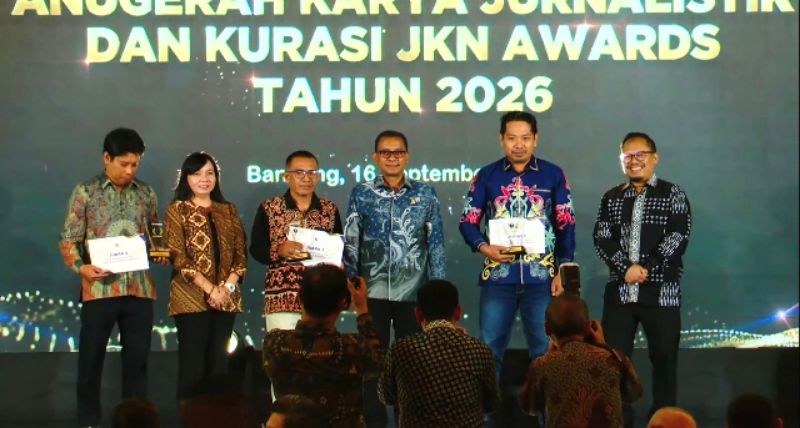
Palce Amalo, a journalist from Media Indonesia, has won first place in the print media category of the 2026 BPJS Kesehatan Journalism Competition. The award was presented during the 2026 JKN Journalism and Curation Awards in Bandung on Wednesday night.
Palce earned the accolade with a journalistic piece titled ‘Crossing the Sea Towards Referral Hospitals’. This work led Media Indonesia to victory in the print category, while Muhammad Rizki from Kaltim Post took second place and Heru Prayitno from Radar Sampit secured third.
The 2026 BPJS Kesehatan Journalism Competition featured 236 entries from journalists across Indonesia. The works were evaluated by a jury panel comprising journalism professionals, including the Chairperson of the Indonesian Editors’ Forum, senior journalists, and editors-in-chief of national mass media.
To ensure objective judging, the names of journalists and their respective media outlets were anonymised during the evaluation process.
The President Director of BPJS Kesehatan, Prihati Pujowaskito, stated that the award serves as appreciation for the contribution of journalists in providing public education regarding the National Health Insurance (JKN) Programme.
“Mass media is a vital component that connects BPJS Kesehatan, the government, the public, and other stakeholders. The media helps create spaces for improvements in the implementation of the JKN Programme moving forward; we are open to constructive criticism and input,” said Pujo.
He expressed his appreciation to all journalists who have helped disseminate information regarding the benefits of JKN, BPJS Kesehatan innovations, and the importance of multi-stakeholder involvement in maintaining the programme’s sustainability. He also urged journalists to continue voicing accurate information to maintain public trust.
Representing the Governor of West Java, the Head of the West Java Provincial Health Office, R Vini Adiani Dewi, noted that mass media plays a crucial role in helping the public understand their rights and obligations as JKN participants, while also driving healthcare service improvements through constructive criticism.
“Compared to 12 years ago, healthcare services are now much better. Information regarding the vast benefits of the JKN Programme needs to be continuously voiced by the media. Thank you for bridging policy information with community needs and impacting the improvement of healthcare quality,” she said.