
Medan Mas Mangroves: Protecting the Coast, Growing the Economy
Preserving nature as the foundation of the village economy also means ensuring that marine resources remain sustainable.
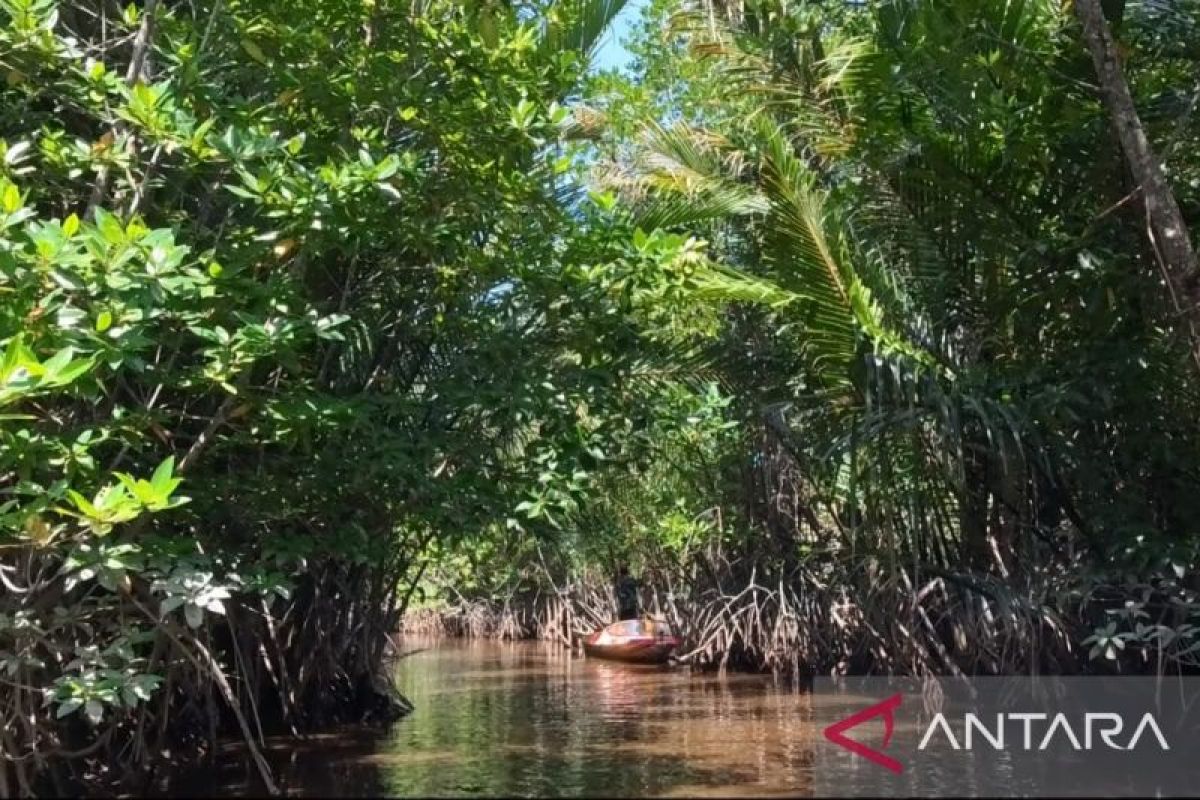
Pontianak (ANTARA) - A boat moves slowly, cutting through the calm river flow. To the left and right, mangrove roots grip the muddy banks, some protruding above the water’s surface, forming a natural bulwark that has for years been part of life for the coastal community of Medan Mas Village, Batu Ampar Subdistrict, Kubu Raya Regency, West Kalimantan.
Behind the dense mangrove vegetation, the community is gradually finding new ways of viewing the nature around them. The mangrove forest is no longer seen merely as an area growing between land and sea, but also as a living space holding economic potential if managed wisely.
That awareness is what the Medan Mas Village Tourism Awareness Group (Pokdarwis) is now trying to build through the development of mangrove conservation-based ecotourism. The effort is part of the community’s endeavour to protect the coastal ecosystem while opening up new economic opportunities for residents.
Medan Mas Village received an award in the 2024 Indonesian Tourism Village Awards at regency level as the third-best tourism village. The recognition has become a spark of enthusiasm for the community to continue developing the village’s potential, making natural conservation an important part of the tourism journey.
Afif, chairman of the Medan Mas Village Pokdarwis, said the development of ecotourism is not merely about attracting tourists. More than that, ecotourism is expected to be a means of inviting the community to understand that nature can provide economic benefits without being excessively exploited.
For coastal communities, this idea is no simple matter. Some residents previously faced challenges in understanding the importance of protecting mangrove areas and coastal resources. Therefore, education and mentoring have become an important part of building a change in the community’s mindset.
“Through mentoring and learning, we continue to invite the community to see how to utilise and manage natural resources for economic growth without neglecting conservation,” said Afif.
He said ecotourism in Medan Mas Village is expected to become a meeting space between the community, nature, and knowledge. Tourists do not only come to enjoy the scenery, but can also get to know coastal community life and understand the importance of mangroves for environmental sustainability.
Community involvement is key to this effort. Residents are encouraged to help protect the mangrove area and surrounding environment, whilst also benefiting from the developing tourism activities. In this way, environmental conservation and economic improvement are expected to go hand in hand.
“Our hope is that this ecotourism can potentially increase community income whilst introducing Medan Mas Village to the world,” said Afif.
However, protecting the coast is not only about mangroves. In the waters that serve as the community’s living space, other problems are still being faced. The use of marine resources in environmentally unfriendly ways is a challenge that must be overcome together.
Abu Hanifan, chairman of the Medan Mas Community Supervision Group (Pokmaswas), said his side continues to encourage residents to abandon fishing practices that could damage the ecosystem. Education for fishermen is carried out in stages so that the use of marine resources can proceed sustainably.
“Slowly, we want environmentally harmful fishing gear to be eliminated, especially the use of poisons, whose impact on the environment is quite severe,” said Abu.
For Abu, protecting the coastal ecosystem is work that cannot be done alone. The mangroves growing along the land’s edge, the waters where fishermen seek their livelihoods, and community activities in the village are all part of a single interconnected ecosystem.
Therefore, support from various parties, including non-governmental organisations that have been mentoring the community, is considered to play an important role. The knowledge and experience shared become provisions for residents to understand how to protect nature whilst utilising it more responsibly.
Even so, coastal area surveillance efforts still face limitations. Facilities and infrastructure are among the constraints experienced by the Pokmaswas, especially when having to monitor a wide area of waters. Bad weather conditions make surveillance activities even more difficult due to the limited number of vessels available.
Abu hopes that support from the government and various parties can be strengthened, particularly in providing facilities to support community-based surveillance. With such support, the community will be better able to protect the marine resources and coastal areas that have long been the mainstay of their livelihoods.
In Medan Mas, mangrove conservation ultimately does not stand alone. It is linked to efforts to build the economy, protect the sea, strengthen the community’s role, and introduce the village to the world. From the mangrove roots that hold back abrasion to the fishing boats moving out in search of a living, everything becomes part of the story of how coastal communities strive to survive and grow together with nature.
The award as the third-best tourism village in Kubu Raya is an achievement. However, for the people of Medan Mas, the real challenge lies in ensuring that tourism potential does not sacrifice the nature that is the source of their livelihood.
For when the mangroves keep growing, the sea remains protected, and the community gains economic benefits sustainably, then ecotourism is not merely about presenting a destination. It becomes an effort to ensure that nature and humanity can continue to live side by side, today and for generations to come.
Economic empowerment
Behind the sturdy mangrove roots along the coast of Medan Mas Village, various aquatic ecosystem potentials are hidden, offering economic opportunities for the community. Besides mangrove crabs, prawns, clams, snails and other fishery potentials, they continue to provide sources of livelihood for local residents.
However, waste has become one of the challenges that must be solved by the surrounding community. Stemming from that problem, a group of residents organised in a waste management group in the village is trying to conserve the mangrove area by transforming something long considered useless into goods of economic value.
The group, formed in 2021 by Blue Forest, was born out of concern over the waste problem facing the community in the mangrove area.
“At first it was because of the amount of waste in our village. Then we thought about how this waste could be managed and processed into something of value,” said Desi, one of the group’s managers, when met in Medan Mas Village.
Group members then go from house to house to collect waste that has been sorted. Liquid soap packaging, oil containers, and various types of plastic that can still be used are collected to be processed into craft products.
From residents’ hands, the waste is transformed into bags, tissue holders, fans, baskets and shopping containers. Rubbish that previously could have ended up polluting the environment is slowly given a second life through the community’s creativity and skills.
The group provides collection bins so that used packaging is not immediately discarded. For the community, this simple step becomes part of efforts to build new habits in dealing with waste.
Support from various parties has strengthened the movement. The Blue Forests Foundation, for example, provided machinery to support waste processing activities. However, the use of such equipment still faces obstacles due to residents’ limited technical knowledge.
Meanwhile, the spirit of building an economy from local potential is also evident in the growth of community micro, small and medium enterprises (MSMEs). One of these is an amplang crackers business started by Ayu in 2013 from a home-scale operation.
Initially, amplang production was limited and not widely known. Marketing only circulated around the village. However, the courage to take the product beyond Medan Mas and expand the market as far as Pontianak gradually changed the course of the business.
“I used to only make a small amount and not everything sold. After I started daring to take products elsewhere, thank God, there was an improvement and demand kept increasing,” said Ayu.
Meetings and mentoring with various parties then opened up new opportunities. Her production capacity increased, from around 700 kilogrammes previously to roughly one tonne.
Ayu’s business journey shows that the coastal community’s economy does not have to depend on a single source of livelihood. Local potential can be developed into value-added products, whilst tourism activities can become a space to introduce these products to a wider public.
However, protecting nature as the foundation of the village economy also means ensuring that marine resources remain sustainable.
Source: jawawa.id (https://jawawa.id/newsitem/medan-mas-mangroves-protecting-the-coast-growing-the-economy-1785146175)
Originally published by Antara (Indonesian) (https://www.antaranews.com/berita/5667717/mangrove-medan-mas-menjaga-pesisir-menumbuhkan-ekonomi), translated from Indonesian