
Medan Immigration Deports Eight Chinese Nationals for Visa Misuse
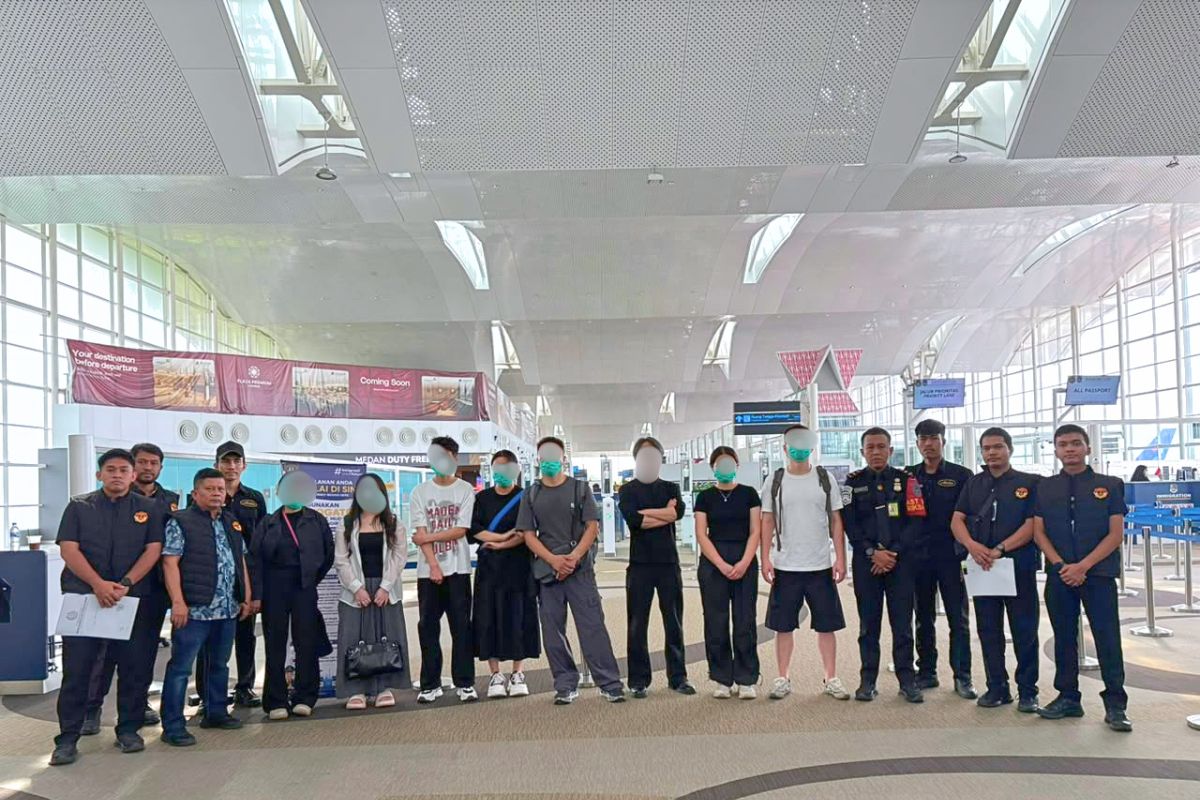
The Class I Special TPI Medan Immigration Office in North Sumatra has deported eight Chinese nationals for misusing their stay permits by working at a hotel.
Every foreign national in Indonesian territory is obliged to comply with immigration regulations, including using visas and stay permits in accordance with the purpose of their arrival, said Uray Avian, Head of the Class I Special TPI Medan Immigration Office, on Thursday. Uray stated that the eight Chinese citizens were working as photographers, editors, and make-up artists at an event in a Medan hotel.
The eight foreign nationals were deported via Kualanamu International Airport on Tuesday (9/6) bound for Kuala Lumpur, Malaysia. He explained that the uncovering of the case began with an immigration supervision operation conducted by Medan Immigration on 31 May 2026. The supervision was carried out on an activity that brought in a number of foreign workers to support an event in the creative industry sector.
While conducting checks at the location, officers found eight Chinese nationals directly involved in organising the event. From the results of the examination, the foreign nationals performed various technical roles: CW, GH, and YP as make-up artists; LK and YX as editors; and YX, YZ, and XJ as photographers at the event. They were found to be using C18 index visit visas, B1 index visit visas, and D2 index limited stay permits.
Medan Immigration stated that based on the preliminary examination, the foreign nationals are suspected of violating Article 122 letter a of Law Number 6 of 2011 on Immigration concerning the misuse of stay permits, and were subjected to Immigration Administrative Actions in the form of deportation and entry prohibition based on Article 75 paragraph (1) in conjunction with Article 75 paragraph (2) letter a and letter f of Law Number 6 of 2011 on Immigration. Uray said the supervision carried out by Immigration is a commitment to maintaining order, legal certainty, and state sovereignty through the application of the selective policy principle.