
Measure, Then Reduce: Crafting a National Standard for Landfill Methane Measurement
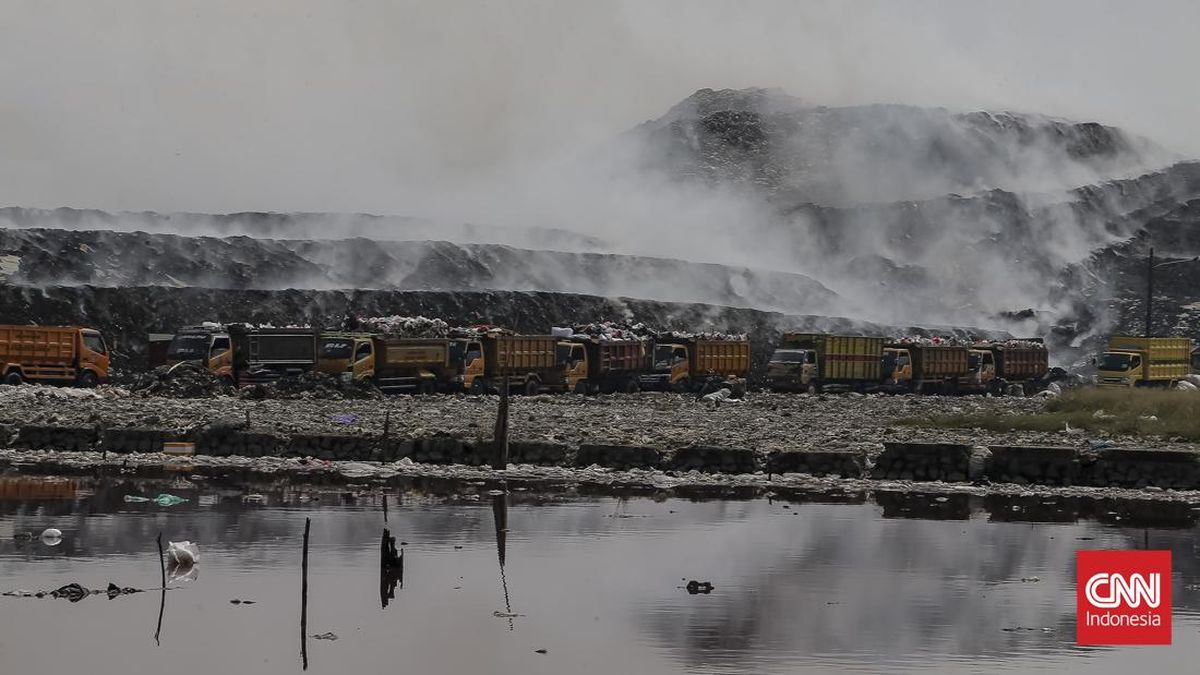
The past decade has shown that the dry season is always the most vulnerable period for waste management in Indonesia. The fire at the Jatiwaringin landfill in Tangerang Regency on 30 June was the latest reminder. The blaze consumed around 15 hectares of waste piles and took almost two weeks to extinguish.
Behind the flames lies an overlooked risk: methane gas, which continuously forms from the decomposition of organic waste within landfill piles, can increase the risk of fire when it accumulates under certain conditions.
Methane is invisible to the eye, but its impact is real. Besides being highly flammable when it accumulates at certain concentrations, the gas is one of the main drivers of global warming, with a warming potential roughly 84 times greater than carbon dioxide over a 20-year period.
As long as organic waste continues to pile up and decompose without oxygen in landfills, methane will keep being produced, making waste not merely a cleanliness issue but also a threat to climate and safety.
The Jatiwaringin fire is not an isolated case. Throughout 2023, the National Disaster Management Agency (BNPB) recorded at least 30 landfill fires across various regions with similar patterns. This risk will keep recurring as long as the character of the waste entering landfill sites remains unchanged.
A survey conducted under the SMART Waste study (Strengthening Methane Action through Reliable Tracking in Waste Sector) Indonesia, carried out by a team of scientists from ITB together with WRI Indonesia in 2025 across five landfill sites, showed that 52.02 per cent of the waste piles at the surveyed locations were still organic waste, with a further 12.83 per cent consisting of paper. Both types of waste produce methane when decomposing in low-oxygen conditions, making them a continuous source of emissions as well as increasing fire potential.
Amid this threat, Indonesia is in fact at an important moment for change. After declaring a waste emergency, the government has accelerated waste-to-energy projects, expanded waste processing facilities, and made waste management a national agenda.
The Jakarta Provincial Government has begun mandating waste sorting at source, including at the household level. Public awareness is also showing a positive trend.
A perception survey by WRI Indonesia together with CNN Indonesia Academy in February showed that the majority of the public is willing to participate in reducing methane from waste. As many as 85.4 per cent of respondents said they were willing, compared with 14.6 per cent who were not.
This momentum must not stop at building new facilities alone. Compared with the energy or agricultural sectors, reducing methane emissions from waste is often described as low-hanging fruit because the management technology is already available and the benefits can be felt immediately, from cleaner air to reduced landfill fire risk, along with a tangible contribution to slowing climate change.
What is needed now is not simply more waste processing projects, but ensuring that waste management genuinely prevents methane formation at the source while also capturing and utilising the methane still being generated in landfills.
However, there is one fundamental problem that is rarely discussed: we do not truly know how large methane emissions from Indonesian landfills are.
The ability to measure emissions accurately is a prerequisite before we can claim that emissions have fallen in line with government targets. Without trustworthy figures, it is difficult to know whether the various waste management investments currently being pushed by the government are genuinely reducing emissions or merely appearing to fall on paper.
The core problem is that Indonesia does not yet have a monitoring, reporting and verification (MRV) system for methane at the landfill level that is applied uniformly and comparably across locations. MRV is not merely an administrative document sent from the regions to the centre once a year. MRV determines how emissions are calculated, how regions report their data, whether figures from one landfill can be compared with another, and most importantly, whether reported emission reductions are actually happening on the ground.
Emissions inventories currently still rely heavily on activity data and modelling parameters of uneven quality. Direct measurements to map concentrations, identify hotspots and validate emission estimates also remain limited.
As a result, national methane emission figures are uncertain, making it difficult to use them as a basis for evaluating policy effectiveness. On the other hand, investors wishing to finance methane reduction projects struggle to assess the real impact of their investments. Meanwhile, the government itself finds it difficult to show concrete evidence of achieving its Nationally Determined Contribution (NDC) targets in international forums.
Therefore, what Indonesia needs is not only more methane reduction projects, but also a measurement system that serves as a national reference.
It is against this backdrop that the SMART Waste initiative was conceived by WRI Indonesia. The initiative seeks to strengthen the data foundation by mapping methane concentrations using drones, conducting flux chamber testing in the laboratory, collecting primary data, and characterising waste at five landfill sites. The five locations were selected to reflect the variation in typologies and management conditions of Indonesian landfills, from small cities to metropolitan areas. Of course, data from these five landfills alone is not enough to solve the national methane and waste problem.
There are at least two fundamental needs that must be met simultaneously.
First, the need for resources in the field. Many landfills in Indonesia, particularly outside the large cities, lack monitoring equipment, trained personnel and routine budgets to measure methane emissions accurately. Standardised measurement will mean little if these regions are not given the capacity to implement it. Investment in training landfill officers, affordable monitoring equipment and a simple digital reporting system is a prerequisite, not an afterthought.
Second, the need for a national regulatory umbrella. Without regulations requiring uniform measurement, reporting and verification methods, each region will continue doing things its own way. A regulatory umbrella is what will ensure that data from landfills in Merauke to Aceh can be compared and combined into a complete national picture. This standard protocol can then become a mandatory reference for regional governments managing local landfill sites.
That is why, although the pilot covers emission measurement at only five landfill locations, the SMART Waste initiative is expected to offer an approach that regional governments across Indonesia can replicate in standardising how they measure, record and report methane emissions from their landfills.
Indonesia submitted its Second NDC to the Secretariat of the UN Framework Convention on Climate Change (UNFCCC) in October 2025, setting out pathways and emission targets for the period up to 2035. Achieving them requires robust baseline data, estimation methods and verification systems. Without proper MRV, it will be difficult to confirm whether these emission targets are genuinely met. The absence of such a system will also hinder access to carbon finance and climate investment, as well as weaken Indonesia’s position in international climate transparency forums.
The political capital to resolve the waste problem is already in place, with President Prabowo Subianto himself announcing the government’s guaranteed support for national waste management projects through Presidential Regulation Number 109 of 2025 (Perpres 109/2025) on Urban Waste Management through Environmentally Friendly Technology-Based Waste Processing into Renewable Energy.
Public support has also taken shape, with increasingly solid public participation. On the measurement technology side, various options are already available. What we still lack is simply a trustworthy measurement system, supported by adequate resources in the field and a clear regulatory umbrella at the national level.
In climate policy, the basic principle is simple: we cannot manage what we do not measure. Before claiming success in reducing methane emissions, Indonesia needs to ensure that emissions from landfill sites are estimated using consistent methodology, supported by quality data, verified through field measurement at priority locations, and reported transparently.
For only with trustworthy figures will climate targets have meaning, policies be evaluable, and every investment genuinely deliver real change.
Source: jawawa.id (https://jawawa.id/newsitem/measure-then-reduce-crafting-a-national-standard-for-landfill-methane-measurement-1785811942)
Originally published by CNN Indonesia (https://www.cnnindonesia.com/nasional/20260803194631-21-1388173/ukur-lalu-kurangi-menyusun-standar-nasional-pengukuran-metana-tpa), translated from Indonesian