
Meagre aid, hunger returns to haunt Gaza
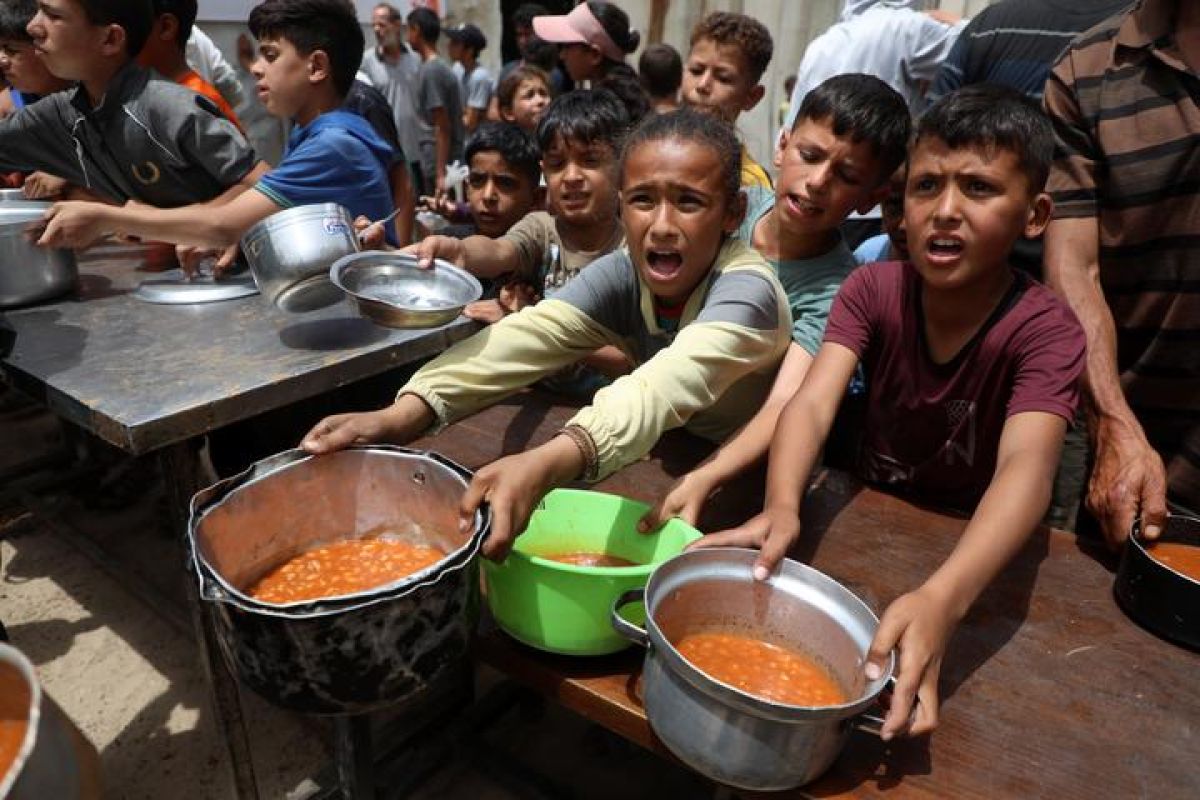
Gaza (ANTARA) — Khairi Harara waited for hours under the scorching sun before eventually reaching the front of the queue. The 75-year-old relied on a wooden staff, and as he left he carried a small pot of lentil soup which, he says, should be enough to feed nine people for a day. “I don’t know who this food ration will be given to,” he said. “The quantity is very small.” Harara, who fled from the Shati refugee camp to the west of Gaza City, said many people queuing behind him never made it to the front. “If you arrive late, you go home with nothing.” The communal kitchen where he collects his meals is affiliated with World Central Kitchen (WCK), one of the largest humanitarian non-governmental organisations still operating in Gaza. However, the organisation has been forced to reduce services. On 14 May, WCK announced it would cut meals to the level distributed before the truce due to mounting financial pressures. Since the Israel-Hamas conflict erupted in 2023, World Central Kitchen has spent more than half a billion dollars (1 USD = Rp17,685) on food aid in Gaza and at its peak distributed around one million hot meals per day. The organisation, which relies mainly on private donations, has urged governments and international partners to provide more stable funding. The cuts have had wide-ranging effects on a population already hovering at the edge of survival. The United Nations Office for the Coordination of Humanitarian Affairs (UNOCHA) this month warned that funding shortfalls have reduced the daily number of meals provided by communal kitchens from around 1.8 million portions in February to around 1 million currently. As a result, one in five families now only eat once a day, with some adults choosing not to eat so that their children can eat. In Maghazi, central Gaza, Samah Hamad (37) said that she and her two children are now entirely dependent on a food distribution point near their home. Her husband was killed in the conflict. “The communal kitchen provides one meal a day, and sometimes that is not even enough for one child,” she said, holding the plastic container she had just received. According to Hamad, the meals provided are almost always the same — pulses and lentils. “When there is rice and meat, it feels like a rare moment for the children.” The fall in food aid reflects broader restrictions on aid flows into Gaza. Ismail Thawabta, head of the Hamas-run government media office, said that since the truce came into effect last October, around 48,600 trucks have entered Gaza out of a total of 131,400 trucks expected to arrive. In the first weeks of May alone, he said, only about a quarter of the hoped-for shipments succeeded in entering. Thawabta described the restrictions as a deliberate policy using food as a tool of political pressure, violating international humanitarian law. He also said that restrictions on several food items, including meat and frozen goods, coupled with disruptions to electricity and fuel supplies needed for cold storage, have worsened malnutrition and pushed prices higher.